A Perfect Example of a “Trump Lie”

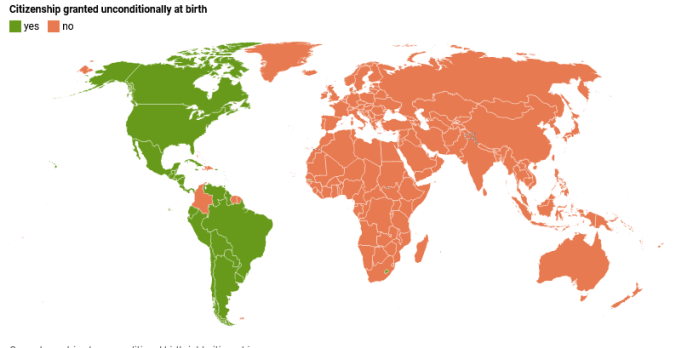
On both MSNBC and CNN today, a big deal was made over the fact that President Trump said that “no other country” confers automatic citizenship on those born within its borders. They were both sneering so hard that I bet they needed a lip massage afterwards, “Of course, 33 nations have birthright citizenship,” said one, with the other making a similar statement.

No question about it, they are right and Trump was wrong. What he meant, however, was “No nations anywhere but the Americas have birthright citizenship, and we are the only major power in the world that does.” Or, “Almost no nations that know what the fuck they are doing have birthright citizenship.” Presidents shouldn’t be that careless, but Trump is, he refuses to change, he’s not going to, and nobody should pretend that they are shocked when he does.

Here’s the list, as represented in the chart above: Antigua and Barbuda, Argentina, Barbados, Belize, Bolivia, Brazil, Canada, Chile, Costa Rica, Cuba, Dominica, Ecuador, El Salvador, Gambia, Grenada, Guatemala, Guyana, Honduras, Jamaica, Lesotho, Mexico, Nicaragua, Panama, Paraguay, Peru, Saint Kitts and Nevis, Saint Lucia, Saint Vincent and the Grenadines, Trinidad and Tobago, Tuvalu, United States, Uruguay, and Venezuela.
Continue reading

A Supreme Court Section 3 Ruling Preview?

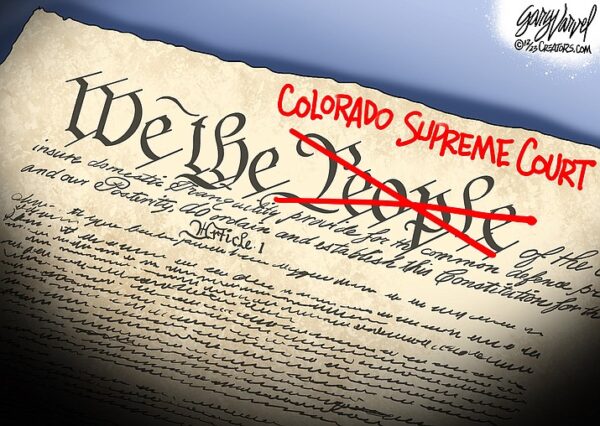
Over at the Volokh Conspiracy on Reason’s website, where constitutional law experts hang out and opine and then mostly inarticulate readers pile on, Steve Cabrizzi has pretty much slam-dunked the position that the 14th Amendment’s prohibition against those who supported the Confederacy in the Civil War holding office in the re-united United States of America can’t be used against Donald Trump. Unlike the convoluted and boot-strapping decision of the Colorado Supreme Court and the transparently partisan decision by Maine’s Secretary of State (both part of the now eight year-old effort by Democrats to use extra-legal means to destroy an adversary they fear and loathe), Bacrizzi’s brief is clear and straightforward.

First he explains the technical reasons why “Donald Trump is obviously not disqualified from seeking re-election under Section 3 of the 14th Amendment,” writing in part,

The words “President or Vice President” were deliberately edited out of the final version of Section 3 of the Fourteenth Amendment. This, together with the disqualification of presidential electors and vice-presidential elector who have engaged in “insurrection or rebellion” makes it clear that the Framers’ of Section 3 did not intend for it to apply to presidents or vice presidents who engaged in insurrection. This impression is augmented by the fact that Section 3 methodically applies in order from the highest office to the lowest office. Section 3 first disqualifies insurrectionist Senators and then Representatives. It then disqualifies all appointed civil or military officers; it then disqualifies insurrectionists from serving as a member of any State legislature, and it finally disqualifies in insurrectionists from serving as State executive or judicial officers. This careful hierarchy suggests that the phrase “or hold any office, civil or military, under the United States” does not apply to the President or Vice President, but applies only to appointed federal officers…

This fact is further confirmed by the Appointments Clause of Article II, Section 2, which says [The President shall nominate, by and with the advice and consent of the Senate shall appoint Ambassadors, other public Ministers and Consuls, Judges of the Supreme Court, and all other Officers of the United States.”  The President does not appoint himself so obviously he is not an Officer of the United States under the Appointments Clause. Moreover, the Commission clause of Article II, Section 3 says that “[T he President] shall” i.e. must, “Commission all the Officers of the United States.”  No President has EVER commissioned himself or his Vice President either before or after the adoption of the Fourteenth Amendment.  The President is obviously not an Officer of the United States for the purposes of the Commission clause.

Continue reading

Observations On The NeverTrump Section 3 Big Lie Push

Maine joined Colorado in barring from its GOP primary ballot yesterday, as Maine Secretary of State Shenna Bellows (D) decided that she “had no choice.” She had no choice because she is a rapid partisan Leftist who, like many Democratic operatives in various positions of power within the legal establishment, she is determined that President Biden be rescued from his election peril by any means necessary. Trump’s actions before and during the January 6, 2021, riot in the U.S. Capitol do not justify charging him with inciting a riot, much less an “insurrection” that would trigger Section 3 of the 14th Amendment. Maine’s completely partisan and anti-democratic move is sure to be appealed along with Colorado Supreme Court’s finding last week that Trump could not appear on the ballot in that state under the 14th Amendment provision designed to keep members of the Confederacy that prevents insurrectionists from holding office. The U.S. Supreme Court will review the case, one hopes quickly, and had better resolve the issue of whether Trump can run again or if the nation will be thrown into Constitutional chaos by allowing some states to block him.

Continue reading

Comment of the Day: “The Ethicists, Backing Judge Walker and Gay Marriage, At An Unacceptable Price”

The motion to vacate Judge Walker’s ruling on Proposition 8 has been filed, you can read it here. Since the original post, I have detected some cracks in the formerly near-united front of legal ethicists and journalists deriding Walker’s critics. Some of them are finally, grudgingly, admitting that the Judge might not have handled his potential conflict so well after all, and that the motion is not a frivolous, anti-gay outrage as they originally labelled it.  The most rickety of the rationalizations put forth on Walker’s behalf, advanced by some his most respected defenders, is that he had no obligation to reveal his own sexual orientation by disclosing his domestic arrangement because of its intimate and private nature. Yet the judge voluntarily disclosed it after his decision was in the books, raising a rebuttable presumption that his original silence was to avoid suggestions of conflict, not out of a desire for privacy.

First time commenter Jada adds her Comment of the Day to the discussion: Continue reading

The Ethicists, Backing Judge Walker and Gay Marriage, At An Unacceptable Price

"Oh, all right...as long as we like the decision."

Thanks to the Judge Walker controversy, now have proof that the best legal ethicists in the nation are human. I suppose that’s something.

My colleagues in the legal ethics field are arguing—decreeing, really— that Judge Vaughn Walker’s decade-long same-sex relationship didn’t need to be disclosed before he ruled against Proposition 8 (California’s voter-approved gay marriage ban) because, they say, it created no reasonable doubts about his impartiality. Coincidentally, they also really, really like his decision. But then, so do I. Continue reading

Judge Walker Was Wrong

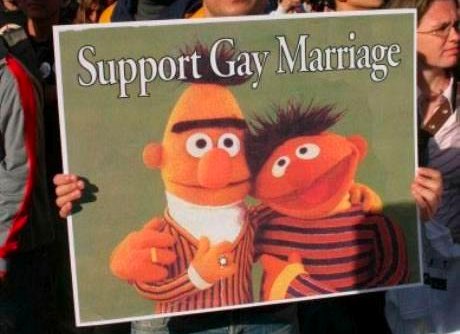
Now that we know about Bert, should Judge Ernie have recused himself?

Judge Vaughn Walker, the Federal District judge who a year ago ruled California’s Proposition 8, which banned same-sex marriages, unconstitutional, was wrong. No, not about the law, which is pretty clearly unconstitutional: his opinion was fair and well-reasoned, and is likely to be upheld on appeal. Walker was ethically wrong in his handling of the delicate issue of his own sexuality, which had raised a controversy about his objectivity and ability to be impartial.

Two weeks ago, following his retirement from the bench, Walker publicly disclosed for the first time that he has been in a same-sex relationship for the past ten years. This changes the analysis regarding the propriety of his ruling on Perry v. Schwarzenegger. Walker had long been rumored to be gay; supposedly “everybody” knew he was gay. My position, as well as that of many others considering the arguments of anti-gay marriage opponents that he should recuse himself, was that sexual orientation could not and should not create a presumption of bias, any more than gender, age, race or marital status. Continue reading

Ethics Quote of the Month: Judge Vaughn Walker

His opinion declaring the voter-approved ban on same-sex marriages in California unconstitutional is here.

The opinion really begins on page 110. Opponents of the opinion are calling it “judicial activism,” “overturning the will of the people,” and “ruling by fiat.” Don’t buy it. The judge logically, fairly and appropriately explains why withholding the basic right of marriage from same-sex couples is a violation of essential values and American principles of ethics and law. Forget about the pundits and the spin: read what Judge Walker wrote.