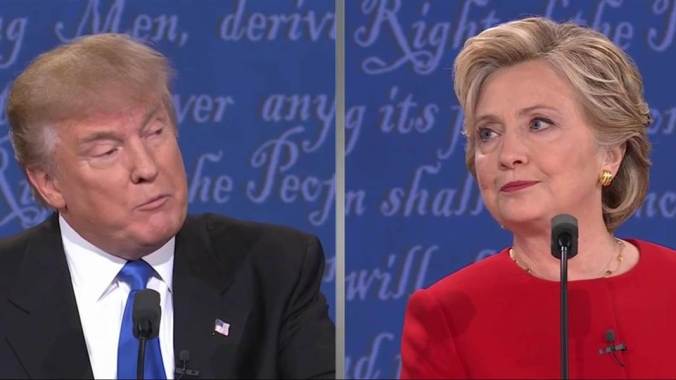
It was as predictable as it was tragic: on Drudge shortly after the debate, his debate poll showed that over 90% of Matt’s readers—almost as high a percentage as that of black Americans who believe Barack Obama has been a great President—believed that Donald Trump won. At CNN, the percentages weren’t as lopsided, but still reversed: about 70% believed Hillary won. Confirmation bias rules supreme in such settings, and bias makes us stupid. Fortunately, as my analysis of these two awful candidates should have proven by now, I have no biases in this race. I would like to see both candidates lose,and badly. Indeed, as both are the political equivalents of virulent cancers on the culture and potentially the office they seek, I would like to learn that both have mysteriously vanished without a trace, like Judge Crater, Ambrose Bierce, Rick Moranis, or Gilbert O’Sullivan
Observations on last night’s debate:
1. The conservative websites are whining about Lester Holt serving as the “third debater” last night. In a word, baloney. Holt did all right, not great, in an impossible role, primarily by letting the combatants talk; in fact, a heavier moderator hand would have been preferable. The birther question to Trump and the “Presidential look” questions were undoubtedly moderator shots at Trump, but shots like that are opportunities too. Trump didn’t handle either well. Character is the issue with Trump, not policy, and those were character questions that he should have been prepared for. Maybe he was; maybe those pathetic answers were Trumps’ idea of good ones. Yes, Holt pressed Trump on the ultimately irrelevant issue of whether he was or was not in favor of the Iraq invasion and when, but that was also an appropriate approach for a moderator, and it gave Trump a chance to clarify his position, if one can ever use “clarify” and “Trump” in the same sentence.
As an aside, I wonder if “Sean Hannity can back me up” is the lamest defense ever uttered in a Presidential debate. It may be.
2. Trump was Trump, that’s all, and perhaps a slightly less offensive and more substantive version than usual. Hillary was smug, with a frozen smile and an expression that said, “Boy, is this guy an idiot!” all debate long. That’s a big mistake, for virtually nobody likes smug. Trump’s expression toward Hillary was usually one of a wary and respectful foe. He was listening, she was sneering. Her repeated call for “fact-checking” was weak, and appeared to be appeals for assistance. Continue reading
 Ethics Alarms