Unthical Quote of the Week: Bill Cosby Attorney Martin Singer

lying-lawyers“The new, never-before-heard claims from women who have come forward in the past two weeks with unsubstantiated, fantastical stories about things they say occurred 30, 40 or even 50 years ago have escalated past the point of absurdity.These brand new claims about alleged decades-old events are becoming increasingly ridiculous, and it is completely illogical that so many people would have said nothing, done nothing and made no reports to law enforcement or asserted civil claims if they thought they had been assaulted over a span of so many years.  Lawsuits are filed against people in the public eye every day. There has never been a shortage of lawyers willing to represent people with claims against rich, powerful men, so it makes no sense that not one of these new women who just came forward for the first time now ever asserted a legal claim back at the time they alleged they had been sexually assaulted. This situation is an unprecedented example of the media’s breakneck rush to run stories without any corroboration or adherence to traditional journalistic standards. Over and over again, we have refuted these new unsubstantiated stories with documentary evidence, only to have a new uncorroborated story crop up out of the woodwork. When will it end?

—-Martin Singer, one of comedian Bill Cosby’s lawyers, trying to quell the public relations storm that threatens to blow the 77-year-old icon’s career and reputation apart.

Wow.

I advise lawyers not to make sweeping, emphatic statements like this, for several reasons. First, it comes very close to violating the ethical prohibition against dishonesty, misrepresentation, fraud and deceit. If the lawyer wants to say such words on behalf of his client, that’s one thing, and legitimate representation, though I would prefer to see such statements come from a publicist. For Singer to say something like this on his own behalf, however, harms all of his other clients by scarring his credibility. I don’t believe him, and when it becomes indisputable that Cosby is guilty and that his lawyers had to know, no one will be able to believe him again. Lawyers are supposed to tell the truth, and to represent even the most despicable clients without behaving unethically themselves, within the standards of the profession. That can be difficult, as in this instance. That is why lawyers get the big bucks, however. They should be able to walk that tightrope.

Singer falls right off: Continue reading

A Shocking Legal Ethics Violation In Utah

So...would you like to revise your testimony about the harmless electric shock, Professor?

“So…would you like to revise your testimony about the ‘harmless electric shock,’ Professor?”

(The title is an uncreative and obvious pun, but on the other hand, how often do I have a chance to make it?)

I always advise lawyers that whenever they have a sudden inspiration that involves a trial tactic that they have never heard of anyone else trying, they need to stop and examine whether there are ethical issues involved. Here is a good example of why that’s a good idea.

Electricity expert Athanasios Meliopoulos, while testifying to dispute the claim of Utah dairy farmers who had sued a power company alleging that current from its plant harmed cattle grazing nearby,  said under oath that 1.5 volts could not be detected by a human being.

Don Howarth, an experienced Los Angeles litigator who represented the farmers, decided to undermine the expert’s testimony on cross-examination by giving Meliopoulos  a joke shop pen that was rigged to deliver an electric shock. Howarth told the witness that the retractable pen contained a 1.5-volt AAA battery and challenged him to click it and “tell the jury whether you feel it or not.” What he did not tell the witness, or the jury, or the judge, was that in addition to the AAA battery, the pen also contained a transformer that boosted the battery voltage to up to 750 volts, enough to deliver “a harmless powerful shock,” according to the pen’s packaging.

Meliopoulos, a Georgia Tech professor, pushed the ball-point pen’s button  and was indeed shocked enough to cause  his body to jerk and force him to drop the pen.

How unethical is this? The judge, in fining the lawyer $3000 and issuing other sanctions, listed the breaches: Continue reading

Legal Ethics Quiz: The Bean Bag Tossing Defense Lawyer

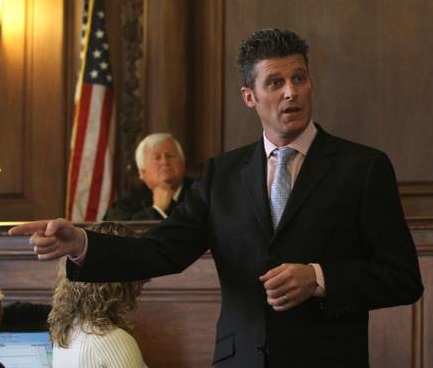
" I swear, you can do this in court. I saw it on "Ally McBeal"...

” I swear, you can do this in court. I saw it on “Ally McBeal”…

Holy crap! Here is a courtroom stunt you don’t see everyday…or ever.

The dramatic bribery trial of Rhode Island defense lawyer Donna Uhlmann and co-defendant Jamaal Dublin took a hard left turn into “Boston Legal” territory and beyond with the, well, creative closing argument of Dublin’s lawyer, Christopher T. Millea. It was so creative, he was nearly held in contempt of court.

“You see, all of this has to do with the throwing of feces,” said Millea, cleverly reminding the jury of the bizarre conduct of a key state witness who once threw his own excrement at a prison guard.  “The state wants to throw as much against the wall to see what sticks, just like Michael Drepaul throwing his feces …”

With that introduction, Millea took two bean bags out of a box he had placed in front of the jury, and threw them at the courtroom door. Then he retrieved the turd stand-ins and placed them in another box near the door, and placed that box next to the one in front of the jury, which, it was later discovered, read “Reasonable doubt,” though only the jury could see the words. The first box was labelled, “State’s case.” Continue reading

“Jack Reacher” Ethics, Or Why It’s No Fun Going To Movies With Me

Jack ReacherI thought the Tom Cruise action film “Jack Reacher” would be a good way to escape from an aggravating day at the ethics grindstone, but no. It was rapidly apparent that this would be one of these movies with a sociopathic vigilante hero—Reacher (Cruise) is kind of a cross between Steven Segal and Billy Jack, summarily executing bad guys and completely uninterested in nuances like trials. The character, from the pen of British writer Jim Grant, is supposed to be 6’5″ tall and weigh about 250, so having the diminutive Cruise play him is a bit like having Danny DeVito play Fezzik in “The Princess Bride.”

The main annoyance was the typical persistent misrepresentation of legal ethics, especially the attorney-client privilege. Reacher is dark, free-lance, drifting Mr. Fix-it, and he is engaged by lawyer Helen Rodin as an investigator to prove her client, an ex-military sniper who is being prosecuted by her father, the DA, for apparently gunning down five random innocent victims in a shooting spree, is something more than a mad dog killer. In their initial conversation about the case, Cruise asks if what he is telling her is privileged. She assures him that it is, but the sequence is misleading, for Reacher and for the audience. Continue reading

Why Is A Lying Journalist Not Fit To Practice Law, When A Lying Presidential Candidate Is?

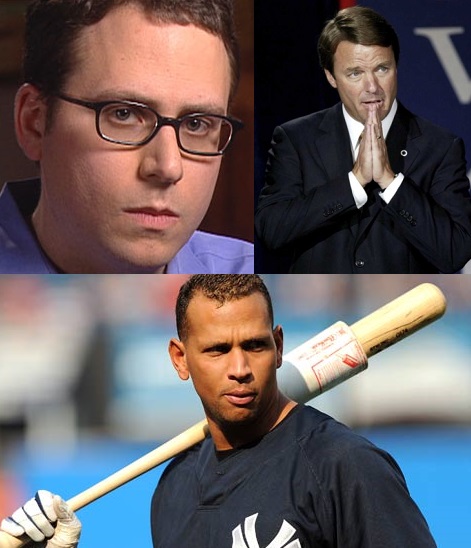
Question: Which two men are fit to practice law? (It's a trick question...)

Question: Which two men are fit to practice law? (It’s a trick question…)

The Wall Street Journal Law Blog muses on an issue that has troubled me for a long time: the fact that the legal profession allows people to keep practicing law whose conduct would have kept them out of the profession had it occurred before they were lawyers.

The reason for the current examination is the apparent inconsistency of disgraced New Republic journalist Stephen Glass continuing to fight and uphill battle (and, I think, doomed) to be admitted to the California bar, while lying scum-of-the-earth John Edwards still has his law license and is opening up a new practice in North Carolina. I wrote about Glass here, and Edwards here.

In the Journal piece, estimable legal ethicist Stephen Gillers opines that the different standards applied to Glass and Edwards are paradoxical,  with the law grads entering the profession being held to more stringent ethical standards  than a veteran attorneys. “If anything, you might say it should be the opposite,” he says.

Especially if the veteran lawyer is a high-profile, national figure who makes every other lawyer want to crawl under a rock… Continue reading

Professional Discipline For Unethical Law School Deans?

Why not?

What the North Carolina Bar considers a trustworthy lawyer...

What the North Carolina Bar considers a trustworthy lawyer…

Law professor Ben Trachtenberg has caused a stir by suggesting in a law review article for the University of Missouri Law School Journal  that law school administrators responsible for intentional and egregious misrepresentations in advertising for their schools have violated the professional ethics codes and could, and should, face discipline, such as disbarment.

I don’t want to cause Nando a fatal cognitive dissonance attack, really I don’t, but I agree with the professor wholeheartedly. I have long believed that the Model Rules prohibition of dishonesty in Rule 8.4 should be applied to lawyer conduct not related to the practice of law more frequently and stringently than it is. Lawyers, for their own protection, are fond of the fictional Clinton myth that one can be an upright and trustworthy lawyer while displaying deceitful and dishonest conduct in their “personal lives,” as if lawyers are ethically schizophrenic. The proof: John Edwards still has his license.

The law school deans that Trachtenberg targets, however, don’t get the benefit of this pass. They are lawyers who were dishonest in their professional duties that, while not requiring a law license, have a clear impact on the legal profession.  Trachtenberg writes,

“In light of the common application of Rule 8.4(c) to lawyers who engage in dishonesty unconnected with the practice of law, there is little doubt that dishonest law school marketing conducted by members of the bar justifies professional discipline. Paul Pless lied repeatedly, over a period of years, about the quality of incoming students at the University of Illinois College of Law, deceiving the ABA and U.S. News, along with prospective students and others who relied on statistics they compiled.191 Mark Sargent conspired with colleagues to engage in similar conduct at Villanova.192 Can anyone dispute that these men engaged in “conduct involving dishonesty, fraud, deceit or misrepresentation”? Surely serial dishonesty—committed with the purpose of gaming the rankings used by prospective students deciding whether and where to spend tens (if not hundreds) of thousands of dollars—is at least as serious a violation as falsifying a resume and transcript.”

Sure it is. As with Edwards, however, the profession is unlikely to be willing to expand the range of activities by lawyers outside of actual practice that will trigger discipline. Continue reading

Bizarro World Legal Ethics Update….

This just in:

You know that aneurysm-inducing defense in the case of the Republican consultant who created a robocall designed to trick black Democrats into not voting on election day?

It worked. Continue reading

Criminal Defense Ethics: The Aneurysm-Inducing Argument

Darrow would understand.

Apoplectic stand-up comic Louis Black has a classic routine in which he describes how a snippet of a conversation he over-heard at an IHOP nearly killed him. The statement, “If it hadn’t been for that horse, I never would have spent that year in college,” made no sense to him at all and kept going around and around in his brain, threatening to cause a fatal aneurysm.

I know exactly how he feels.

A week ago, I read a news account of the election fraud trial of one Julius Henson, a former campaign consultant to ex-Maryland Governor Robert Ehrlich. This was the second trial arising out Ehrlich’s dirty and unsuccessful campaign in 2010 to win re-election over Democrat Martin O’Malley. In the first one, Ehrlich’s campaign manager, Peter Schurick, was convicted of election fraud for approving an election day robocall that went out to African-Americans in Maryland who were registered Democrats, suggesting that they “relax” and stay home, because O’Malley had already won. In the article, it said that Henson’s attorney had offered the defense that the call, which was created by Henson with his wife’s voice on the recording, was not designed to suppress the black vote for O’Malley. It was, argued Edward Smith, intended to prompt them to go to the polls and vote for Erhlich through the use of “reverse psychology.”

WHAT??? Continue reading

The Legal Profession’s Muddled Standard For “Fitness To Practice”

OK, he has a temper, but hire him as your lawyer, and you can trust him with your life!

I confess: my profession’s standard for discipline bewilders me, and leads me to believe that nobody really knows what kind of conduct by a lawyer should dictate that he or she should be kicked out of the profession. I was reminded of this when I read a report about a former associate at a large New York law firm whose license was suspended for three years because he physically abused his girlfriend. A hearing panel had recommended a 60 day suspension, but the Appeals Court decided on three years.

Here is the basic rule regarding misconduct by lawyers, from the ABA’s Model Rules:

Maintaining The Integrity Of The Profession

Rule 8.4  Misconduct

It is professional misconduct for a lawyer to:

(a) violate or attempt to violate the Rules of Professional Conduct, knowingly assist or induce another to do so, or do so through the acts of another;

(b) commit a criminal act that reflects adversely on the lawyer’s honesty, trustworthiness or fitness as a lawyer in other respects;

(c) engage in conduct involving dishonesty, fraud, deceit or misrepresentation;

(d) engage in conduct that is prejudicial to the administration of justice;

(e) state or imply an ability to influence improperly a government agency or official or to achieve results by means that violate the Rules of Professional Conduct or other law; or

(f) knowingly assist a judge or judicial officer in conduct that is a violation of applicable rules of judicial conduct or other law.

Tell me: which provision did the brutal lawyer violate? Continue reading

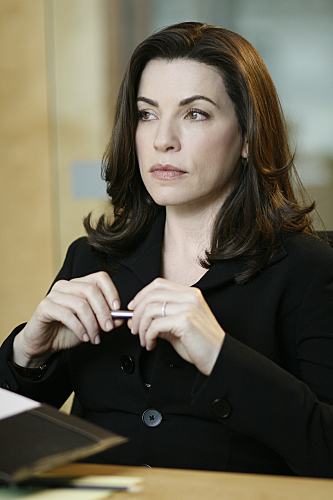
I’m Worried About “The Good Wife”

Shape up, Alicia.

CBS’s “The Good Wife” seems to be getting more cavalier with its ethics breaches, a disappointing trend. Showing the ethical fudging that undoubtedly goes on behind the scenes at major law firms (on occasion) is appropriate; treating major violations with a shrug is not. I know it is tempting for the show to assume it has the intelligent legal TV show championship sewed up, since “the Defenders” is a joke and “Harry’s Law” is a disgrace, but it’s standards have been high, and it is dispiriting to see them flag with such missteps such as…

  • Prosecutorial misconduct casually brushed off as nothing. When Alicia asks why a videotape  is so much clearer than the one the prosecutor’s office turned over as evidence, she is told that what she received before was a copy of a copy of a copy–“just to mess with you.” Continue reading