Ironically, If Trump Had Been Assassinated He Would No Longer Be A “Convicted Felon.”

The memo has gone out to alert Democrats that part of the plan to vilify and delegitimize the candidacy of Donald Trump is to constantly refer to him as a “34 times convicted felon,” or just “convicted felon” for short. The former is a deceitful description, though I’d guess 99% of those using it have no idea what Trump was charged with in the infamous “hush money” trial. In an egregious example of over-charging, Alvin Bragg’s lackeys turned a single misdemeanor into 34 felony counts, a slimy prosecutorial tactic but unfortunately a common one. But even “convicted felon” is misleading. A conviction in New York (and just about everywhere else) isn’t final until appeals have been exhausted and the defendant is sentenced. Neither has taken place yet in Trump’s case, and since the trial was as much of a partisan contrived travesty of justice as the charges, the smart money is on all those convictions being reversed.

Meanwhile, New York still operates under the common law doctrine of abatement ab intio, which holds that if a convicted individual dies before his or her appeals have been exhausted, the convictions no longer stand. That means, then, that if the aspiring assassin who shot the former President in the ear had killed Trump, he would have also rendered him innocent of those “34 charges.”

Trump would have been vindicated! Dead, but vindicated..
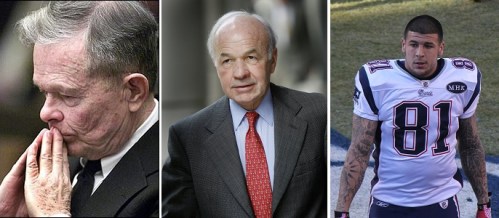
Aaron Hernandez And The Weird Legal Doctrine Of Abatement Ab Initio

The predator priest, the corrupt CEO, and the murderous Patriot, all innocent because they’re dead….

Massachusetts judge Judge E. Susan Garsh ruled that the state’s law required her to vacate the 2015 murder conviction of former New England Patriots star Aaron Hernandez. Because Hernandez’s appeal was pending when he committed suicide in his cell, she said,  the common law doctrine known as abatement ab initio applied: a defendant’s death before an appeal erases his conviction. Prosecutors argued that Hernandez’s purpose in hanging himself on April 19 was to to void his conviction, but Judge Garsh responded that she was bound to follow state law anyway, especially since Hernandez’s motives were unknown. She had presided at the trial in which a jury found Hernandez  guilty beyond a reasonable doubt of the murder of semi-professional football player Odin Lloyd.

The fact that some legal and ethical puzzles have proven unsolvable despite troubling lawyers, judges, legislators and scholars for decades (and sometimes centuries) is one of the best proofs I know for The Ethics Incompleteness Principle, which holds that no rule or principle makes sense in all circumstances, and that human beings are incapable of articulating perfect laws and rules that will work as intended in every case. Abatement ab initio is a classic example.

Abatement is the dismissal or discontinuance of a legal proceeding “for a reason unrelated to the merits of the claim.” It is available in both a civil and  criminal context. Traditionally, the death of a criminal defendant following conviction  but before an appeal can be made mandates abatement. The effect of  the doctrine is to discontinue all proceedings  and to dismiss the appeal as moot, overturn the conviction, and dismiss the indictment. The deceased defendant reverts back to his status before being charged. In the eyes of the law, he is innocent…again. Continue reading