How Amy Bouzaglo Makes Us Better People

Run away! But pay attention!

Run away! But pay attention!

I’m not going to take back every negative thing I’ve ever said about reality shows, but there is no getting around it: now and then an episode of one of them is a better training film for good ethics than  “Leave It To Beaver,” “Star Trek, The Next Generation,” and “Father Knows Best” combined.

A case in point was a recent episode of “Kitchen Nightmares,” a Fox reality show that sends chef and restaurateur Gordan Ramsay to turn around failing eateries, usually by his browbeating them into basic management competence and the use of fresh ingredients. This time, however, Ramsay was pitted against the proprietors of Amy’s Baking Company Bakery Boutique & Bistro in Scottsdale Arizona, specifically the eponymous Amy Bouzaglo, a textbook narcissist who dominates her much older husband and partner, abuses employees, and treats all criticism and constructive suggestions as a personal attack. Continue reading

Now THIS Is Sexual Harassment!

Meet your new boss...

Meet your new boss…

In Chicago, “A Cook County highway boss asked a woman who worked for him ‘to come into his office every day at around 4 o’clock while he watched porn and masturbated,’ the woman claims in court.”

There’s really no ethics controversy in stories like this, other than the same three questions I have after all of them:

1. How can someone be in a position of authority in the 21st Century and not know this kind of conduct toward an employee is not only horribly wrong, but illegal?

2. Why would any woman put up with this for so long…16 months, according to the complaint? Shouldn’t the first episode be the last one? Would you say to such a creature, “Now, that’s enough. I don’t want you calling me into your office to watch you masturbate ever again. Okay?”

3. What the hell is  the matter with men, anyway? Continue reading

Ethics Dunce: Ryan Thompson

You may have heard about this guy: he took his girlfriend up in his private plane, and pretended that the plane was about to crash as part of his set-up to propose to her. As he supposedly tried to get the plane under control to save their lives, Thompson told Carlie Kennedy to read from an emergency protocol explaining how to pull the plane out of a dive. “I genuinely did believe that we were going to die,” Kennedy told ABC News. “I felt like our lives depended on me making it through that checklist.” Then, as she read through the list, it slowly dawned that it was actually an marriage  proposal leading up to the final bullet point: “Will you marry me?” She turned to the smiling pilot, who was holding a ring. She said yes.

And then they crashed.

No, not really. And I suppose this sadistic narcissist has found a perfect mate, a naive victim who will doubtless enjoy all the hell he puts her through for his own amusement. It was a pretty good test, when you think about it. What better way to let your intended know exactly what she’s getting into, and to find out whether she’ll tolerate despicable treatment and outrageous conduct with a smile and a kiss?

Good luck, Carlie, and I mean that sincerely. Your husband to be is an Ethics Dunce, an especially cruel one, and you’re an idiot.

You’ll need all the luck you can get.

And You Think YOU Have An Abusive Boss!

Count your blessings, Homer? Your boss isn’t so bad after all!

We must place the word “alleged” in front of all of this, for it is just a law suit at this point, but if the outrageous conduct described in the complaint made by Albert Sultan against his former boss, Manhattan real estate broker Jack Terzi, is even close to true, Terzi may be the Tin Standard against which all other abusive employers should be judged.

Sultan says in his 15-page lawsuit that he was hired by Terzi in 2009, shortly after Terzi started his real estate business. After three years of Terzi’s reign of terror, Sultan says, he became “emotionally distraught,  humiliated and embarrassed” by “systematic and continuous unlawful harassment” at the hands of his tyrannical and abusive boss, who, among other things…

  • Made him perform personal tasks not in his job description, such as parking Terzi’s car and bringing him coffee.
  • Required him to work a 60-hour week, including 26 Sundays annually, with no sick days or vacation.
  • Cheated him out of six months salary and commissions worth $129,320.

Wait! I haven’t gotten to the juicy stuff yet! Continue reading

A Cautionary Ethics Tale From Texas

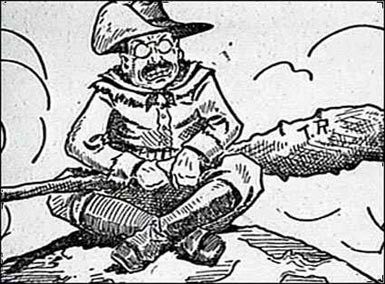
A Good Samaritan Teddy could relate to

In Texas, a 62-year-old man pulled over on the highway to help a couple whose truck had run out of gas. While he was assisting, the Good Samaritan apparently objected to the demeaning way the 31-year-old husband was addressing his wife, and said so. The husband then attacked the older man…who drew his concealed gun and shot him in the shoulder.

<sigh> Continue reading

How the Lack of Ethics Cripples Democracy, Reason #1: Ethical Leadership Is Neither Encouraged Nor Rewarded


How many elected leaders will be responsible when it means risking THIS?

Washington Post Metro columnist Robert McCartney relates the cautionary tale  of Fairfax (Va.) School Board member Liz Bradsher.  The school board, like others across the nation, was required to make some tough choices with its resources scarce and stretched to the breaking point.  The costs of renovating a high-achieving elementary school in the Fairfax County countryside  didn’t pass an objective, cost-benefit analysis, so the board voted to close it. Bradsher, whose district includes Clifton, the neighborhood served by the school, was expected to vigorously oppose the move.  But after studying the costs and enrollment forecasts, she reluctantly concluded that it made more sense to shutter the facility so the county could spend scarce renovation dollars where they would benefit more children.

She did what was best for the Fairfax community as a whole, which, as an elected official, is her duty. But rather than appreciating the courage it took to agree to close a beloved institution in her district for the greater good, she is being attacked. Anonymous postings on a popular local website have spread false rumors that she has a drinking problem and that her marriage is on the rocks. She is receiving threatening letters, and obscene e-mails.   Continue reading

Comment of the Day: “The Hazing Abuse of Michael Warren”

Reminding us that one or even several incidents can’t give us the full whole measure of an organization, Hartwick College alum Fred Stoss recalls an act of courage and principle by the fraternity that hazed Michael Warren. Let Fred tell the story:

“I cannot defend the actions of what happened to Mr. Warren. I am a member of Alpha Delta Omega Fraternity, having pledged in 1969 and served as its President from 1971 to 1972. During this time our fraternity was a rather diverse community of whites, blacks, browns, Protestants (Hartwick was then a Lutheran College), Catholics, and Jewish. There is, however, a piece of ADO history (taken from the ADO FaceBook site) that deserves mention: Continue reading

Comment of the Day: “The Hazing Abuse of Michael Warren”

Frequent commenter and anti-child abuse advocate Steven Mark Pilling catalogues the defenses and rationalizations offered here by collegiate commenters who thought my post was overly hard on pro-hazing Hartwick College. The references to “Hounddog” relate to a thankfully buried film shot five years years back that required a 12-year-old Dakota Fanning to be the victim in a graphic rape scene with an adult actor. Steven, along with Paul Petersen and others, successfully exposed the film’s skirting of laws and exploitation of Fanning. You can read my ethics commentary on that horrible story here and here.

“Jack: In reading those collegian posts and your responses, I almost had a feeling of deja vu. Isn’t it amazing how all the excuses and means of “defending the indefensible”- no matter what the specific issue- have points of commonality that immediately grab at you? When I was involved in the “Hounddog” issue, I ran into them all. I see many of them here… Continue reading

The Hazing Abuse of Michael Warren

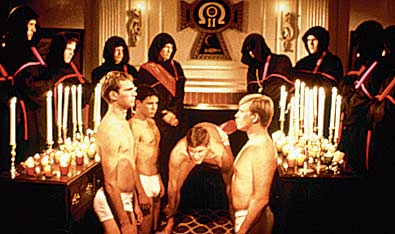
Michael Warren should have consulted Kevin Bacon...

A fraternity hazing story—yes, amazing as it seems, there are still hazings—raises the persistent ethical issue of whether a victim is responsible for his own mistreatment if he consents to it. Even if he shares responsibility, however, his consent does nothing to reduce the ethical failings of the abusers, or those of the irresponsible authorities who presided over a sick campus culture.

Michael Warren is an African American who was the only black pledge of the Alpha Delta Omega fraternity at Hartwick College (in Oneonta, New York). His potential “brothers” locked him in a bathroom with other pledges for hours, where they were subjected to ear-splitting music and strobe lights; he was forced, he says, to dress like a pimp, a humiliating bit of racial stereotyping; and, shades of the evil Omega Theta Phi fraternity in “Animal House,” was paddled so hard that he needed medical treatment (“Thank you, sir, may I have another?”). Warren complained, and found himself a pariah on campus, making him so uncomfortable that he gave up his scholarship to transfer to Hofstra. Now he is suing Hartwick, and his lawyer is arguing that his mistreatment by the fraternity “may have ruined his life.” Continue reading

The “Baby Emma” Saga Revisited: The Core Issue

Didnt King Solomon have a case like this once?

When the mother of the child an unmarried father co-created with her decides that she doesn’t want to/ can’t raise the child and doesn’t trust the father to raise her, is it ethical to put said child up for adoption without notifying or consulting the father?

That is the ethical issue the “Baby Emma” incident, first discussed here in an earlier post, ultimately raises. It is a question that I did not discuss in that post, focusing instead on the father’s conduct and his current plight, as self-described on his “Baby Emma” website. I made three ethical assessments, each of which are self-evident:

1. The whole situation would have probably not occurred if John Wyatt and Baby Emma’s mother had been married before conceiving a child.

2. Both of them were irresponsible to plan on having a child together without formalizing a mutual commitment to form a family and raise the child together…that apparently archaic institution known as “marriage.”

3. The mother betrayed John’s trust, deceived him, and treated him unfairly.

I also suggested that, absent a marriage, it is fair and reasonable that the mother of a newborn be able to put the child up for adoption if she deems that course better for the child than being raised by the child’s father. I did not say that was the law, or even that I would vigorously oppose a law that directed otherwise, as Virginia’s law does. I only stated that my own belief is that incentives for irresponsible parenthood are unwise. I have been asked why I focused on the issue I did, rather than the other ethical issues raised by the controversy. It was because the issue was brought to me with the presumption that John Wyatt, the father, was a blameless and unequivocal victim in the matter. My ethics alarms sounded: he has significant ethical accountability for the mess, and I explained why.

As to the answer to question above, I can only say this: it depends. The conduct of Baby Emma’s mother is mysterious and extreme. Did she panic? Did she have a mental break? Why would a lifetime friend and partner of a man conceive a child, pretend to plan to raise her with him, and then secretly negotiate to have the baby adopted and taken out of state?

I see many scenarios that could be behind her decision, which fall into three distinct categories: ethical, unethical, and too close to call: Continue reading