Wait…WHAT? Where Does A Law School Get Off Ordering Students Not To Talk About George Clooney’s Wife?

Of course, Columbia could order Amal from not dressing like this, but that would be outrageous.

Of course, Columbia could order Amal from not dressing like this, but that would be outrageous.

Every day, I am more amazed that I got through my formal education without being suspended, expelled or arrested.

From the New York Times:

At 10:30 a.m. on Monday, Amal Clooney walked into Classroom 103 in William and June Warren Hall at Columbia Law School. The human rights lawyer and wife of the actor George Clooney …was by herself, far from the tangle of paparazzi who gather outside the Carlyle hotel, where the couple are staying while Mr. Clooney is in town making “Money Monster,” a film directed by Jodie Foster and co-starring Julia Roberts. Ms. Clooney, 37, greeted a man preparing slides for the class in human rights for which she is a guest lecturer this spring. As she spoke, passers-by peeked at her through the sliver of glass in the door. If anyone had thoughts to share about Ms. Clooney, they weren’t talking.

“We are under strict orders not to discuss her or anything about her class,” said a student who declined to give her name. A representative from the law school politely asked a reporter to leave.

What? WHAT? Columbia University can’t “order” students not to talk about a professor! How did they get the idea that they could, or that it was appropriate to try? Of course, Columbia of late has shown less than a sterling respect for the values of academic freedom and the Bill of Rights. Still, this is pure abuse of power.

WHAT? What kind of jello-spined, ignorant, submissive worm are they admitting to Columbia who would accept such outrageous “strict orders”? [ Well, we do have some strong indications…] I couldn’t care less about Ms. Clooney, but if my law school said that to me, I’d hold a press conference.

WHAT? Why  does this woman, who voluntarily thrust herself into the limelight, warrant special privileges that justify restricting a law school’s students right to talk about anything they want to?

University classes have been taught for more than a century by men and women with far more impressive accomplishments and greater fame than Amal Clooney. Shouldn’t Columbia be combating celebrity culture rather than catering to it?

Any students who meekly accept such restrictions on their speech and autonomy are too craven to be trusted to practice law, and no institution that would demand such restrictions should be trusted to teach them.

________________________

Pointer: Above the Law

Facts: New York Times

Harvard’s Black Mass: An Ethics Problem With No Answer


Impossible.

Impossible.

P versus NPthe Hodge conjecturethe Riemann hypothesisthe Yang–Mills existence and mass gap The Navier–Stokes existence and smoothness. The Birch and Swinnerton-Dyer conjecture. These are some of the unsolved problems of mathematics, but they are child’s play compared to the unsolvable ethics dilemma concocted at Harvard College.

Is Harvard right to allow students to hold a historic recreation of a Black Mass? Is Harvard wrong? Is it unethical for the students to engage in the project? Is it gratuitously insulting to religion, particularly Catholicism? Does it even matter if it is?

To bring you up to date:

The Harvard Extension Cultural Studies Club is planning to recreate a “satanic black mass” on campus next week, enacted by Satanic Temple, a New York-based, Satanist group that engages in outrageous displays to draw attention to First Amendment rights. “Our purpose is not to denigrate any religion or faith, which would be repugnant to our educational purposes, but instead to learn and experience the history of different cultural practices,” the HECSC said in a statement.

The statement lays the foundation for a hung jury in seeking an ethics verdict. Since the Black Mass was originally devised to denigrate the holy mass, saying that recreating the mass isn’t intended to denigrate religion is the kind of thing Captain Kirk used to say to evil, logic-bound computers to make smoke come out of their hard drives. “It-is-true-but- it’s-not-true-but-nothing-can-be-true-and-not-true–KABOOM! Continue reading

Fundraising Ethics Controversy in Michigan! Naming Buildings After Big University Donors: Ethical or Not?

Enron-Field

I worked in the development (capital fundraising) office of Georgetown University for many years, and am well aware of the sausage-making that goes into attracting big donations. Thus the controversy that recently erupted in Michigan is of interest both for its ethical content and the way it dances around inconvenient truths.

With the college student’s wonderful knack for avoiding the obvious, the student newspaper of Grand Valley (Michigan) State University declared ethics war on what it called “billboards”: buildings and lecture halls named after corporate and individual donors. With naivete and boundless ignorance of the world of philanthropy and non-profit fundraising, the editorial declared (among other things)…

  • “What’s next? Will we turn Lake Huron 133 into the “Amway Lecture Hall?” Will the backs of our chairs have plaques dedicated to the lower-level donors?” COMMENT: For enough money, of course the university would rename the hall. Why should it care what a lecture hall is called, if it can avoid having to raise tuition? As for the backs of seats: did the editors do any research at all? Opera companies, theaters, museaums and other non-profit entities do exactly this. So what?

Continue reading

Being Fair To College Student Ideological Idiocy

Luckily for him, the bank president who wrote this foolishness in 1969 didn't sign his name to it...

Luckily for him, the bank president who wrote this foolishness in 1969 didn’t sign his name to it…Ah, my old college days!

My attention has been drawn recently to two essays by college students, both presumably sent to me on the theory (or hope) that reading them would kill me. The first, published in the Drexel Triangle (the student paper), argues that stage directors should be prevented from casting actors who look the way the playwright envisioned them. The second, published in the Harvard Crimson, makes an even more disturbing assertion: its author asserts that Harvard should stop guaranteeing professors and students the right to advocate controversial views or pursue research that challenges liberal views and assumptions.

I don’t want to devote the bulk of this post to rebutting these two essays, which are, I think self-rebutting. In the theatrical essay, student actress Alyssa Stover argues that a stage director shouldn’t have the right to decide that, say, casting an Asian dwarf as black boxer Jack Johnson in “The Great White Hope” would lead to a less effective production (that is my example, not hers—she objects to a director of “Cabaret” refusing to cast African-Americans as a matter of historical accuracy):

“These arguments are fundamentally flawed. What the audience wants is almost impossible to measure because the “audience” is composed of anyone who can get a ticket. A director or producer’s right to deny someone a role due to their appearance is debatable because this is a judgment based on one person’s preferences and may not actually create something that is stage worthy. The current status quo allows people to be barred from the stage due to physical “flaws,” as determined by the direction. These judgments are not harmless, and when the issue of race is involved, the problem only gets bigger.” Continue reading

Are Universities Ethically Obligated To Tolerate Professors Who Embarrass Them By Saying Idiotic And Offensive Things?

Apparently the answer to the above is “Yes.”

"Duh!"

“Duh!”

If the university is a state school, then for it to fire a professor who makes ridiculous, foolish or hateful statements that make people wonder why they should ever entrust the minds of their tender charges into an institution that would knowingly hire cretins and jackasses to pollute student RNA, then this is probably a First Amendment violation, since it amounts to the government punishing speech and chilling free expression. If, on the other hand, the university involved is not a state school, then to send a professor packing because he or she has rammed his or her foot down his or her throat up to the knee is a violation of the crucial principle of academic freedom, which is, in brief, that to encourage the free discussion of ideas on a college campus, education being the purpose of the institution, literally no idea, point of view or position should be blocked or chilled by substantive negative action.

Three cases of recent vintage illustrate the university’s plight: Continue reading

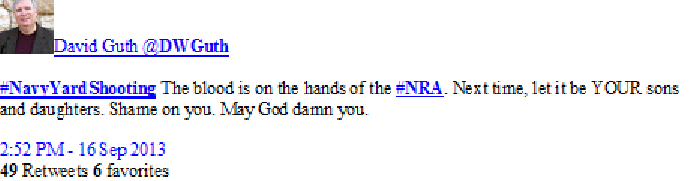
Unethical Tweet Of The Week: Prof. David Guth

Guth Tweet

With this brain-jarring twitter offal from University of Kansas journalism professor David Guth—and if you marvel at the abysmal quality of today’s journalists, there’s a big clue right there—Ethics Alarms launches a new category, the Unethical Tweet of the Week. Clearly, Twitter has a magic ability to make even reasonable public figures and professionals engage in irresponsible, hateful and idiotic discourse, though I seriously doubt that this particular tweet’s author needed much of a shove.

What’s the matter with the tweet? Well, how long have you got? Let’s see: Continue reading

Ethics Dunce + Incompetent Elected Official = Censorship In North Carolina

Thank-you. I see no reason to believe that your funding is in any jeopardy, by the way."

Thank-you. I see no reason to believe that your funding is in any jeopardy, by the way.”

Central Carolina Community College pulled the plug on a public affairs  talk show airing on its radio station after a legislative assistant for State Rep. Mike Stone complained about an online post by one of the show’s hosts, criticizing the  Sanford, N.C. Republican.  Susan Phillips, Stone’s legislative assistant, wrote the school’s president, T.E. “Bud” Marchant, with pointed questions about the program’s affiliation with the school, funding sources, and budget.  Central Carolina Community College is one 58 community colleges in North Carolina that depend on the  legislature for funding, and Stone’s message was received loud and clear. Marchant shut down the show, known as “The Rant,” two days later. He also denied that Stone’s interference had anything to do with it.

Sure.

There shouldn’t be any question over what happened here. An elected official in a supposedly democratic nation decided to abuse his position and power as well as violate his oath of office  by using veiled threats and intimidation to stifle Constitutionally protected criticism of his job performance, and a craven educator caved to his pressure, violating his duty of respecting academic freedom and standing against efforts by the state to stifle free speech and political dissent. Marchant, if he had even a rudimentary backbone, would have told Stone’s minion to back off and reported this clumsy attempt at extortion to the area’s news media. Stone, if he had any integrity or respect for the founding principles of the United States, would have taken “The Rant’s” host’s criticism like an adult and a believer in free speech, and responded with a defense or a rebuttal, not by leaning on the radio station’s management. As for Marchant’s incredible claim that Stone’s complaints and the show’s demise were unrelated, even if that were true, his creating the appearance of censoring campus speech in response to government disapproval would be nearly as offensive as censorship itself, because it would still have the effect of chilling First Amendment rights.

I’m certain, considering what appears to be the generally low quality of state legislators across the country (which figures, given the abysmal quality of national legislators), that this kind of thing occurs far more frequently than we know. Let’s see if Stone’s bedrock, conservative supporters are sufficiently offended by his efforts to use government power to muzzle adverse opinion, and send him on a new career path. My guess? This incident won’t make any difference to his election chances at all, if voters like Stone’s politics and believe the radio host is a nettlesome lefty. We are constantly told how much of the country is willing to dispense with the Second Amendment, as if that proves that amendment is archaic. Sincere public support for the First Amendment is similarly shaky.

All right, let us agree that both legislator and college president are unqualified for their positions by virtue of their abandonment of their ethical obligations in their respective roles—Stone’s duty to respect free speech and observe proper limits on government power, Marchant’s duty to protect academic freedom and oppose government efforts to stifle free expression. That still doesn’t justify the elitist coverage of this story by Jonathan Turley, whose blog post first alerted me to it. For some reason, the noted civil rights expert and law professor believes that it is Stone’s wan academic credentials and humble work experience that explain his bullying tactics. Why else would Turley feel it is germane to note that Stone lists his education as ‘“Attended, Accounting, Central Carolina Business” and lists his experience as “Business Owner, O’’Connell’s Grocery Store”’ ? Why is any of that relevant? The law school professor is evidently a bigot, and believes that one’s ethical instincts and character are directly proportional to one’s degrees and work experience.

Rep. Stone is a citizen of the United States, and like every citizen, should be presumed to know about the Four Freedoms whether he graduated from Harvard or the School of Hard Knocks. There are plenty of well-credentialed bullies, fools and ignoramuses in elected office. It is sufficient to judge Stone by what he did; Turley’s implied ridicule of his educational and work background is a cheap shot, and reflects badly on the commentator, not his target.

_____________________________

Pointer: Res Ipsa Loquitur

Facts: NC Policy Watch

Graphic: Pozniak

Ethics Dunce: Columbia University

A Columbia professor charged with teaching his students the bewildering topic of quantum physics chose to employ performance art to send the message that conventional assumptions would be an impediment to their learning. Using projections, music, and himself as a performer (he stripped to his boxers and ate a banana before curling into a fetal position), Professor Emlyn Hughes got his students’ attention and tried an innovative approach to teaching. Now the university says it is “reviewing” his methods, with a spokesman saying that “Universities should have a climate of academic freedom though classes should stick to the subject matter.”

Translation: “Columbia gives lip service to ‘academic freedom,’ but it is perfectly happy to do what it can to discourage creative and controversial teaching experiments by publicly announcing an investigation whenever that likes of Gawker starts making fun of us, and the university certainly is hyper-sensitive to breaches of political correctness, since Professor Hughes employed gratuitous violence in his performance by having Ninjas impale stuffed animals.” Continue reading

Unethical Quote of the Week: “Chronicle of Higher Education” Editor Liz McMillen

A Note to Readers: When we published Naomi Schaefer Riley’s blog posting on Brainstorm last week (“The Most Persuasive Case for Eliminating Black Studies? Just Read the Dissertations”), several thousand of you spoke out in outrage and disappointment that The Chronicle had published an article that did not conform to the journalistic standards and civil tone that you expect from us. We’ve heard you, and we have taken to heart what you said. We now agree that Ms. Riley’s blog posting did not meet The Chronicle’s basic editorial standards for reporting and fairness in opinion articles. As a result, we have asked Ms. Riley to leave the Brainstorm blog. Since Brainstorm was created five years ago, we have sought out bloggers representing a range of intellectual and political views, and we have allowed them broad freedom in topics and approach.  As part of that freedom, Brainstorm writers were able to post independently; Ms. Riley’s post was not reviewed until after it was posted. I realize we have made mistakes. We will thoroughly review our editorial practices on Brainstorm and other blogs and strengthen our guidelines for bloggers. In addition, my Editor’s Note last week inviting you to debate the posting also seemed to elevate it to the level of informed opinion, which it was not. I also realize that, as the controversy unfolded last week, our response on Twitter did not accurately convey The Chronicle’s message. I sincerely apologize for the distress these incidents have caused our readers and appreciate that so many of you have made your sentiments known to us. One theme many of you have sounded is that you felt betrayed by what we published; that you welcome healthy informed debate, but that in this case, we did not live up to the expectations of the community of readers we serve.
You told us we can do better, and we agree.”

Liz McMillen, editor of the highly respected Chronicle of Higher Education, tossing away the integrity of her publication in a complete and cowardly capitulation to political correctness and enforced academic dogma, while trashing the principle of academic freedom and the free exchange of ideas which her publication is supposed to champion.

The big ‘C’ stands for “chicken.” Or maybe “choke.”

Riley, the fired blogger, is a well-established iconoclast and critic of liberal arts institutions, which is undoubtedly why she was recruited as a blogger in the first place.  Her post was a reaction to an earlier Chronicle article about rising scholars in “black studies,” and she took to the the blog to point out that the summaries of their scholarly topics in that article’s sidebar showed what was wrong with the field, at least as it was currently taught.  She concluded, Continue reading

Comment of the Day: “Ethics Quote of the Week: Yu Jie”

Michael, fortunately, focuses attention back on the actual meaning of the quote from the Chinese dissident, Yu Jie, that I had posted as an Ethics Quote of the Week. I then confused the issue by expanding my commentary to the dangers (or, as commenter properly corrected me, theoretical dangers) of  U.S. indebtedness to China. My error, and I am grateful to Michael both for returning to the issue and his thoughtful comments.

Here is his Comment of the Day on the post, Ethics Quote of the Week: Yu Jie:

“…No matter how craven our federal government has been, why are the Universities allowing themselves to be censored by the Chinese? There are two reasons: Continue reading