From a Cornucopia of Disturbing Ethics News, Which Story Shall We Start the Week With Today? How About This One…

Accountability!

Guess what company was just awarded a $2.56 billion contract from the U.S. Air Force? Why, Boeing, of course! The fact that the aircraft company’s corruption and incompetence have been almost continuously in the news for years now, that it finally dismissed its lying CEO recently and that the company currently has NASA astronauts trapped in outer space appears to trouble the United States government not one bit. (Here is the first Boeing story posted about here on Ethics Alarms in 2024.)

The contract is for the production of two rapid prototype E-7A Wedgetail AEW&C (Airborne Early Warning & Control) aircrafts, similar to the one pictured above. I’m sure it will reassure you to learn that the Wedgetail is based on Boeing’s 737 design that has been working out so well lately.

Continue reading

Good To Know: Major League Baseball Demands More Accountability Than The U.S. Government.

The Chicago White Sox announced this morning that manager Pedro Grifol has been fired. “As we all recognize, our team’s performance this season has been disappointing on many levels,” general manager Chris Getz said in a statement within this morning’s press release. “Despite the on-field struggles and lack of success, we appreciate the effort and professionalism Pedro and the staff brought to the ballpark every day. These two seasons have been very challenging. Unfortunately, the results were not there, and a change is necessary as we look to our future and the development of a new energy around the team.”

Ya think? Under Grifol, the White Sox just finished tying the all-time American League record for consecutive losses at 21. He leaves with the third worst winning percentage of any manager in Major League history who has managed more than a single season. But believe it or not, his two and a two thirds-season tenure at the helm of the ChiSox was even worse than those stats indicate.

Last season, Keynan Middleton publicly criticized the White Sox’ clubhouse culture after he was traded to the Yankees. The pitcher said that there were “no rules” and “no consequences;” he said he knew of instances of “rookies sleeping in the bullpen during games” and players skipping team meetings and fielding drills. Veteran pitcher Lance Lynn was asked if Middleton’s comments were just the complaints of a disgruntled ex-, and he said that Middleton was “not wrong.” This year there were reports that the White Sox had a “fractured” clubhouse that wasn’t helped any when Grifol told his players that they would be remembered as the worst team in MLB history if they didn’t shape up. One player told a local sportswriter, “It’s been really tough in there. Pedro is a really good guy, just not the man for the job.”

So he was fired. That’s what’s supposed to happen to the leader of an organization that falls flat on its metaphorical face with terrible consequences. Was the White Sox losing all those games—nobody expected the team, which is a re-building mode, to be good this season, just not so spectacularly bad—as spectacular an organizational failure as, just to pick a random example out of the air, the Secret Service? Nobody has been fired for its astounding incompetence in Butler, Pa., although many culprits have been identified. Nobody has been fired from a leadership position during the entire Biden Administration, although the culture of incompetence is throbbingly obvious. (I guess Joe himself comes the closest to having been fired.)

In an essay on substack, conservative law professor and blogger Glenn Reynold sees the culture rotting from the head down:

Continue reading

Before Offering Second Thoughts J.D. Vance’s “Childless Cat Ladies” Controversy, These Relevant Horror Stories:

I was literally in the middle of a preparing a post about the cultural sickness J.D. Vance was allegedly trying (and failing miserably) to focus public attention on when he mocked “childless cat ladies” dictating U.S. policies when these two awful stories came across my screen.

In the first, I learned that Parker Scholtes, 2, was found dead in her parents’ Honda SUV parked outside their home in the Tucson suburb of Marana. Her father, an irresponsible man-child named Christopher Scholtes, had left the baby “to nap,” that is, to broil, for more than three hours on July 9. He said he left her in the car with the air conditioner on (like a good dad, or his warped idea of one), but got involved playing PlayStation video games and didn’t check on her until three hours had gone by. He confessed to police that he knew the car’s engine would automatically shut off after 30 minutes, but just got, you know, carried away and lost track of time. You know how it flies by when you’re having fun.

Continue reading

The Other Shoe Drops: Why Can’t Leaders Accept Responsibility Until They Are Forced To?

Gee, waddya know? The incompetent head of the Secret Service finally resigned.

Less than a week ago, Ethics Alarms expressed disgust and amazement that Secret Service head Kimberly Cheatle hadn’t resigned from her job (She’s “historic,” see, so that’s why President Biden wouldn’t fire her.) “This is basic management ethics,” I wrote then. “When the organization leader fails that badly—and it is hard to imagine a worse failure—the leader takes full responsibility and leaves, because the organization cannot retain public trust as long as that leader is in place. There is no other honorable or ethical course.”

Yet she defiantly said that she would not resign, despite also saying that she accepted “full responsibility.” She had spent all of the time since the Secret Service’s incompetence nearly got Donald Trump killed making absurd excuses, trying to blame local police, and lying outright. Yesterday, Cheatle further soiled what remained of her dignity and reputation, evading questions and infuriating members of Congress trying to get to the bottom of what happened in Pennsylvania. Almost as one, the House members told her she needed to quit. If Cheatle has done anything laudable, it is bringing together the parties in a bi-partisan expression of outrage at a single target.

Continue reading

The Guinness Book of Records Is a Catalyst For Self-Destructive Conduct, Not That There’s Anything Wrong With That…

I guess it’s that time on a sweltering Friday afternoon that I am not quite up to finishing any of the more substantive posts on the runway, and only feel like tackling the stupid stuff. (These are the posts long-time critic/commenter Neil Dorr prefers. This one’s for you, Neil!)

Tara Berry just set the Guinness Book of Records record for “‘most tattoos of the same musician on the body.” She has 18. ( The former record-holder has 15 portraits of Eminem tattooed on her body.) A big Madonna fan from the beginning of The Material Girls’ pop-culture ascent in 1983 ,Tara only started her Madonna tattoo collection in 2016 when she was looking for fans who had Madonna’s image tattooed on their bodies to feature in a video. I guess she’s suggestive (or <cough> or something): she had an overwhelming urge to get her own Madonna tattoo. Once she started, she couldn’t stop.

Well, bless her heart. It’s her skin and her body: this is one example of “choice” that doesn’t hurt anybody except the chooser. Hey, if she wants to go for 20, or 50, I won’t criticize.

I do hear a bit of a ping one of my smaller ethics alarms about the Guinness Book of Records. Why does it even have a record in this category? I’ve touched on the issue in the past: the GBOR seeds the needs of narcissists and sad, insecure people searching for some level of fame or notoriety with records that can only be set or sought with some danger to the aspiring record-setter. There were “the Biking Vogels,” the various children endangered by their parents to have them be the “youngest” to achieve some pointless and dangerous goal, and my personal favorite, Sheyla Hershey, who ended up with size M breasts to set the Guinness record for “largest breast implants.” I concluded that 2010 post by stating that it was unethical for Guinness to publish “records” that can only be achieved by risking long-term harm.

And yet…blaming Guinness for Tara Barry mutilating her body is like blaming hip-hop records and violent TV shows or movies for people doing in reality what is only sung about or shown on a screen. It was her choice, albeit a crazy one. Tara is supposedly an “artist,” so maybe being festooned with pictures of a washed-up and aging pop-star won’t harm her at all, as long as she doesn’t seek employment at a school or a bank. Or with me.

As I said, that ethics alarm isn’t pinging very loudly. The GBOR doesn’t make anyone do anything. But the alarm has been pinging, however faintly, for 13 years.

In Memory of Grace: “The Amazing Mouthwash Deception: Helping Alcoholics Relapse For Profit”

When I last re-posted this early Ethics Alarms entry from 2010, I called it, “Since Ethics Alarms Appears To Be The Only Source Trying To Publicize This Problem, Here, For The Third Time.” Not much has changed since then, except that my wife is dead. Listerine played a major role in killing her: Grace’s last major relapse—she battled alcoholism her entire adult life—occurred right before the pandemic when she impulsively drank down an entire jumbo bottle of the vile stuff and shortly thereafter took a nearly fatal fall off a curb outside our home. She never fully recovered from the effects of that fall, though other, less catastrophic relapses involving the mouthwash occurred at regular intervals.

As I explained in an earlier introduction, the original post “raised an important and shamefully under-reported topic, one that despite my exhortations then has yet to be adequately examined in the media.” In 2016, when I googled various combinations of “mouthwash,” “Listerine,”‘alcoholism,” and “alcoholic,” the first result was still my post. [UPDATE: The Ethics Alarms post is now about 100 deep, behind such links as “Should I switch to alcohol-free mouthwash?” Note that since 2016, Google’s algorithm buries EA in its searches because it is insufficiently in tune with the Axis.]

“Most people who are not afflicted with the disease of alcoholism have no idea that mouthwash is a popular stand-in for liquor, or that is used to deceive family members who think an addict is no longer using or intoxicated,” I wrote in the 2016 intro. First I was prompted to re-post the essay after I had been shocked to hear a physician friend who treated alcoholics plead complete ignorance of the links between mouthwash and alcoholism. The last time, it was the surprising reaction of my own physician, who is usually up-to-date on all medical research, and had treated alcoholism sufferers at the VA. He had never heard anything about the problem.

I’m re-posting this time because of Grace. The quote from my 2016 intro is still valid:

“Despite my frustration that what I regard as a true exposé that should have sparked an equivalent article in a more widely read forum has remained relatively unknown, I am encouraged by the effect it has had. Most Ethics Alarms posts have their greatest traffic around the time they are posted, but since 2010, the page views of this article have increased steadily…More importantly, it has drawn comments like this one:

‘Am looking after my twin sister who is a chronic alcoholic. She has been three days sober and then she just walked in and I couldn’t work out what the hell happened. She was in a stupor , but there was no alcohol and I am dispensing the Valium for detox period and she smelt like mint!! Found three bottles of it !!! This is my last big push to help her and she pleaded innocent and no idea it had alcohol in it! Hasn’t had a shower for two days but keeps her mouth fresh and sweet !! Thanks for the information. Much appreciated XXX’

“Most of all, I am revolted that what I increasingly have come to believe is an intentional, profit-motivated deception by manufacturers continues, despite their knowledge that their product is killing alcoholics and destroying families. I know proof would be difficult, but there have been successful class action lawsuits with millions in punitive damage settlements for less despicable conduct. Somewhere, there must be an employee or executive who acknowledges that the makers of mouthwash with alcohol know their product is being swallowed rather than swished, and are happy to profit from it….People are killing themselves right under our noses, and we are being thrown of by the minty smell of their breath.”

Here again is “The Amazing Mouthwash Deception: Helping Alcoholics Relapse For Profit.” Maybe this time it will help someone to avoid Grace’s pain and her ultimate fate.

I’m so, so sorry, my darling, that I couldn’t give you the peace you needed to fight this curse.

*** Continue reading

Thinking About “The Box”

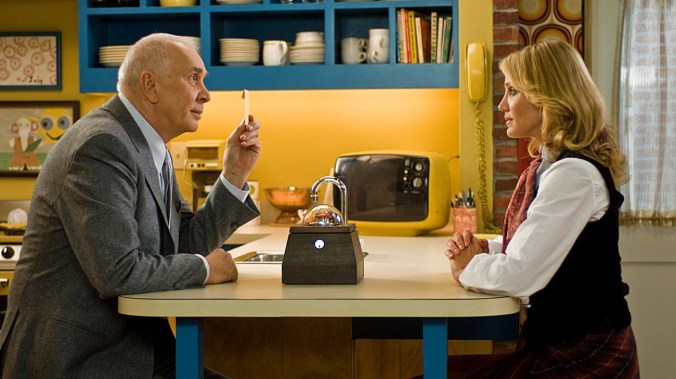
I recently re-watched “The Box,” which my wife and I had first seen more than a decade ago. It is a horror movie based on the 1970 short story “Button, Button” by Richard Matheson, one of the writers of the original “Twilight Zone,” and Matheson’s conceit, a mash-up of science fiction and ethics as his work often was, had been turned into an episode of one of the reboots of Rod Serling’s creation.

If I recall, I didn’t make it to the end of the film the first time, because the set-up was so annoying. A strange, disfigured man shows up at a couple’s door with a strange box in his hands. It consists of a red button under a locked glass dome that must be opened with a key. The man explains to the stunned wife (her husband is at work, getting bad news about his job) that they have been chosen to be the recipients of a gift. All they have to do is push the red button, and the man will return to hand over a brief case filled with a million dollars, which will be tax free. However, when the button is pushed, someone, somewhere in the world, will die. He assures the wife that they won’t know the doomed individual. They have only 24 hours to consider the offer, at the conclusion of which the man will return and take the box away to offer to someone else.

It is, obviously, an ethics hypothetical that has been posed in many different ways through the years. What bothered me originally, and worries me now, is that anyone I would care to have in my community would ever push the button. (As you can guess, one of the couple does—“Why not? It’s just a box…” and a chain reaction is launched that causes havoc.)

Continue reading

A Relatively Minor Incident That Explains Why Nobody Can Trust Anybody in Politics, and Shouldn’t.

A robo call supposedly featuring President Biden urging New Hampshire Democrats not to vote in the state’s presidential primary was immediately used by the news media to accuse Republicans of suppressing votes, because, you know, that’s what they do. The media reported that two Texas companies were the source of the calls: Life Corporation and Lingo Telecom, and that the Federal Communications Commission (FCC) had issued cease-and-desist letters to both companies. Texas companies—well, we all know what THAT means.

Surprise! The deep-fake recording was not the work of those racist Republicans, but of a Democratic consultant who worked for Democrat Dean Phillips’s quixotic Presidential campaign. Phillips has the ethical mission of giving his party’s voters the opportunity to show that they would prefer not to have a rapidly declining dementia sufferer carry the Democratic banner in November.

Paul Carpenter, a New Orleans magician—that’s him doing street magic above— came forward to admit that he was hired to use artificial intelligence to impersonate President Joe Biden for the robocalls. Carpenter explained that he was hired in January by veteran Democratic consultant Steve Kramer, who has been advising Phillips. “I created the audio used in the robocall. I did not distribute it,” Carpenter said. “I was in a situation where someone offered me some money to do something, and I did it. There was no malicious intent. I didn’t know how it was going to be distributed.” He says he was paid $150.

Continue reading

“It Wasn’t Our Fault! That Bad Robot Did It!”

Hey, Canada Air! Can you say, “accountability?” How about “responsibility”? Sure you can.

Jake Moffat needed to fly from Vancouver to Toronto to deal with the death of his grandmother. Before he bought the tickets for his flights, he checked to se whether Air Canada had a bereavement policy, and the company’s website AI assistant told him he was in luck (after telling him it was sorry for his loss, of course.) Those little mechanical devils are so lifelike!

The virtual employee explained that if he purchased a regular priced ticket, he would have up to 90 days to claim the bereavement discount. Its exact words were:”If you need to travel immediately or have already traveled and would like to submit your ticket for a reduced bereavement rate, kindly do so within 90 days of the date your ticket was issued by completing our Ticket Refund Application form.” So Moffatt booked a one-way ticket to Toronto to attend the funeral, and after the family’s activities a full-price passage back to Vancouver. Somewhere along the line he also spoke to a human being who is an Air Canada representative—at least she claimed to be a human being— confirmed that Air Canada had a bereavement discount. He felt secure, between the facts he had obtained from the helpful bot and the non-bot, that he would eventually pay only $380 for the round trip after he got the substantial refund on the $1600 non-bereavement tickets he had purchased.

After Granny was safely sent to her reward, Jake submitted documentation for the refund. Surprise! Air Canada doesn’t have a reimbursement policy for bereavement flights. You either buy the discounted tickets to begin with, or you pay the regular fare. The chatbot invented the discount policy, just like these things make up court cases. A small claims adjudicator in British Columbia then enters the story, because the annoyed and grieving traveler sought the promised discount from the airline.

Continue reading

From Texas, A “Better Late Than Never” Horror Story

The Texas Monthly story is titled, “The Juror Who Found Herself Guilty.” Its tone is celebratory: a juror who made an unethical decision (though the writer attempts to mitigate it in many ways throughout his article) courageously decided to undo the wrong, and succeeded. Far from being impressed with the alleged ethics hero, Estella Ybarra, I found the story infuriating, and its conclusion that Ybarra should be admired untenable.

The story is in the familiar, long-form format familiar to readers of the New Yorker, Esquire, Vanity Fair and The Atlantic. We are given more details about the lives of all the participants in a drama than we need as well as thick context about every facet of the tale. It can be summarized easily, however, and relatively quickly.

In 1990, when Ybarra was 48 years old, she served on a jury charged with determining the guilt of a Mexican-American man accused of rape. She was the hold-out juror, Henry Fonda in “Twelve Angry Men”; everyone else was certain Carlos Jaile (above) had raped an eight-year-old girl. Ybarra was not: she felt the evidence was thin. There was no physical evidence, the defendant had an alibi, and the main proof of his guilt offered was a child’s eyewitness identification after the fact. But, we are told, Estella was still learning English despite being born in the U.S. (Whose fault is that?) and didn’t understand the justice system very well. (Or that?). As a result, she allowed herself to be bullied into voting ‘guilty’ by the men on the jury, even though she was not at all convinced Carols Jaile was.

She went home after Jaile was convicted and sentenced to life in prison, and wept, we are told. This is supposed to make her seem sympathetic. Later, Estella received a certificate in the mail stating that by serving as a juror and “accepting this difficult and vital responsibility of citizenship in a fair and conscientious manner, you have aided in perpetuating the right of trial by jury, that palladium of civil liberty and the only safe guarantee for the life, liberty and property of the citizen.” Ybarra threw the document into a drawer. She told the writer, Michael Hall, that she thought to herself, “We sent an innocent man away for the rest of his life.”

Continue reading