The Great Texas Warrant Roundup

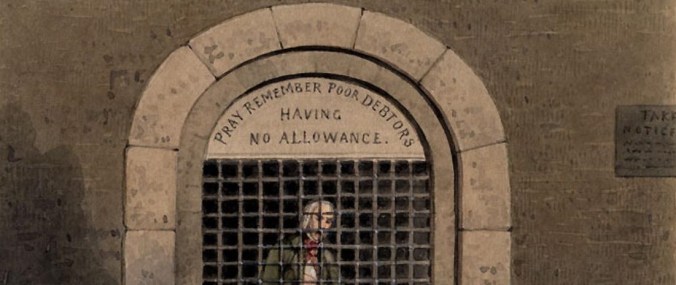
debtors prisons

If the news media did their job, somebody would have asked Ted Cruz about this by now.Something like, “Senator, what is your position on the growing use of debtors prisons in your state and other states around the U.S.?”

On March 5th, Texas commenced what is known as the Great Texas Warrant Roundup, an annual statewide collaboration of courts and law enforcement agencies to squeeze payment of overdue fines and fees from Texans. The Texans targeted are overwhelmingly poor citizens who have outstanding warrants for unpaid traffic tickets, many of which were dubious, the product of aggressive policing to meet budget quotas. The carrot is an amnesty period that precedes the “roundup;” the stick is the threat of arrest and jail for those who can’t pay.

In Texas, a ticket for failing to signal a lane change—a favorite way to start the process of bleeding vulnerable citizens to cover city and county budget shortfalls— will cost about $66. That’s just the beginning, though.  Texas adds $103 in court costs, a public defender fee,  a fee to put you on a payment plan if you can’t pay,  and the always versatile “administrative fee.” Writes the ACLU: “For people who are too poor to pay their tickets, that $66 fine can grow to over $500.”

Once the victim can’t pay the collective fines,Texas will suspend renewal of the driver’s license, adding the License Renewal Suspension Fee, another $30.  Now it’s illegal to drive to the work, and without work, it will be impossible to support a family and pay bills. Faced with that dilemma, many citizens drive anyway, and get eventually get pulled over, leading to more tickets, fines, fees…and more debt. Continue reading

More Photography Ethics: A Federal Court Rules That There Is No Right To Photograph Police

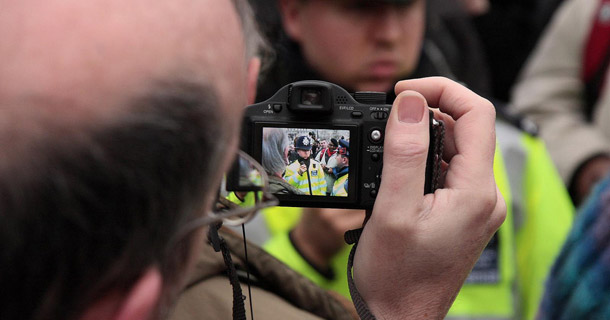
photographing_police

U.S. District Judge Mark Kearney has ruled that citizens don’t have a First Amendment right to take cellphone videos and photos of police unless they are challenging or criticizing the police conduct.

This opinion makes no sense, and is dead wrong.

Richard Fields, a Temple University student, took a cellphone photo of about 20 police officers standing outside a house party because, he testified, he thought it would be an interesting picture. Amanda Geraci, who says she is “a trained legal observer,” whatever that is, tried to video an arrest during a an anti-fracking  protest.

Fields had his cellphone seized and was cuffed, as an officer searched his cellphone before returning it and cited him for obstructing the highway and public passages while taking the photo.  Geraci said an officer physically restrained her to prevent her from recording the arrest. The two both sued for alleged First and Fourth Amendment violations, and their cases were consolidated before the court, as the same Constitutional issues were involved.

Judge Kearney argued that Fields and Geraci would have to show their behavior was “expressive conduct” to support a First Amendment claim. Neither plaintiff met that burden, because neither told the police why they wanted to capture the images, Kearney wrote. “The conduct must be direct and expressive; we cannot be left guessing as to the ‘expression’ intended by the conduct.”

“Applying this standard, we conclude Fields and Geraci cannot meet the burden of demonstrating their taking, or attempting to take, pictures with no further comments or conduct is ‘sufficiently imbued with elements of communication’ to be deemed expressive conduct. Neither Fields nor Geraci direct us to facts showing at the time they took or wanted to take pictures, they asserted anything to anyone. There is also no evidence any of the officers understood them as communicating any idea or message.”

What astounding nonsense! Would Kearney argue that an oil painting was similarly ambiguous as “expressive” without the painter saying, “I am painting the picture so that I have a painting that I can show others”? Continue reading

A Merry Christmas For The Washington Redskins, “The Slants,” And The First Amendment

Yes, The Slants were apparently, disparaging. themselves.

Yes, The Slants were apparently disparaging. themselves.

The political-correctness obsessed Democratic component of our government has decided that forcing Dan Snyder to change the name of his football team due to its alleged offensiveness to people who don’t care about football is a legitimate government function, or so they would have us believe. Actually, they believe it is a legitimate political function to lick the moccasins of progressive activist groups who thrive on opportunities to tell others what they can safely say.

After Senate Democrats signed an unethical  missive threatening the Washington Redskins if the team wasn’t renamed something that an enterprising race-baiter wouldn’t find offensive—not as easy as it may seem— the Patent and Trademark Office canceled the registration of “Redskins” using the excuse that Federal trademark law excludes the registration of “scandalous, immoral, or disparaging marks” as well as trademarks that a “substantial composite of the referenced group” perceives as disparaging to a religion, nation, ethnic group, or  belief system. [ You can read my opinion on this ruling here. I’d quote from it, but it’s Christmas Eve.]

The ruling was upheld in the Fourth Circuit, despite the fact that it seem to be fairly blatant viewpoint-based restriction of speech, or in other words, unconstitutional. To his credit, Snyder is not allowing the Democrats to bully him or illegally try to control his speech either, and has the resources to fight. The betting is that the Supreme Court will tell the Trademark Office to stop playing politics.

The Patent and Trademark Office also barred the registration of “The Slants,” the trademarked name of Simon Tam’s Asian-American band. Now the U.S. Court of Appeals for the Federal Circuit just held, in the case of In re Tam, by a 9-to-3 vote, that this exclusion of “disparaging” trademarks, and, by extension, the Redskins ban as well, violates the First Amendment.  This means that the Redskins case is likely to go to the Supreme Court if the government doesn’t agree to let people trademark whatever the want to, regardless of who or what it might “disparage.” Continue reading

Unethical Quote Of The Month: Co-chair of the Colorado Springs American Civil Liberties Union Loring Wirbel

“The thing is, we have to really reach out to those who might consider voting for Trump and say, ‘This is Goebbels. This is the final solution. If you are voting for him I will have to shoot you before election day.’ They’re not going to listen to reason, so when justice is gone, there’s always force, as Laurie would say.”

Loring Wirbel, Co-Chair of the Colorado Springs American Civil Liberties Union, in a Facebook post.

As the post was circulated and criticism of Wirbel grew, he told the local paper that he was just joshin’.

Well, yes, I’d assume he wasn’t really going to start shooting Trump supporters. On the other hand, the ACLU is supposed to stand for freedom of expression, and an organization executive appearing to advocate violence to stifle unpopular political views is more than a little irresponsible. So is casually joking about shooting people in Colorado Springs.

What? Too soon?

“It was intended totally as a joke,” Wirbel said. “They are taking that stuff out of context. It’s smear politics.” No, actually it’s called “embarrassing your organization and calling its credibility into question.” He resigned today.

Good.

One does have to wonder, however, how thick the progressive bias and hatred for conservatives is in the ACLU’s culture, how it affects the organization’s judgment, and whether an organization led by people like Wirbel is really the best guardian of the First Amendment.

UPDATE: More on Wirbel, including some mind-blowing quotes, and the ACLU’s statement, here.

If Anyone Starts Paying Attention To What Bernie Sanders Is Saying, He’s In Trouble

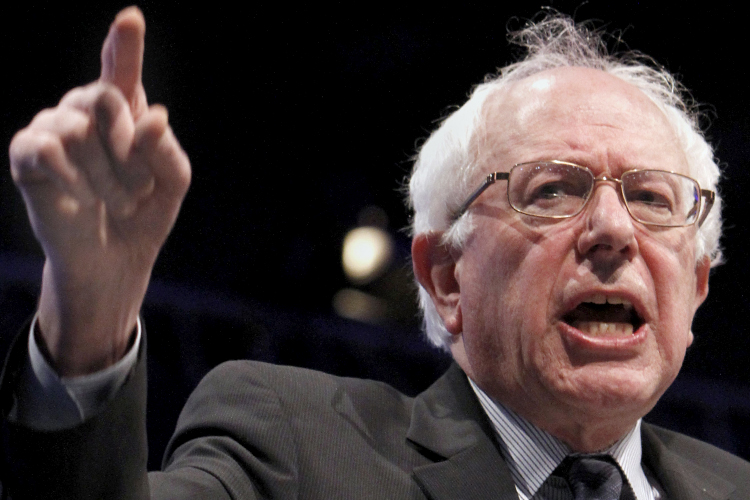
U.S. Sen. Bernie Sanders, I-VT, gestures as he speaks at the Californi Democrats State Convention in Sacramento, Calif., Saturday, April 30, 2011. Sanders called on Democrats to work together to stop what he calls the GOP's attack on the middle class.(AP Photo/Rich Pedroncelli)

So far, Bernie Sanders’ major function in the Democratic presidential nomination race is as a gauge of how badly Hillary Clinton is doing. The same function could be served by a wooden spoon or an Elmo doll, but Bernie will do: as Hillary’s machinations and lies about them sloooowly convince even Democrats that she should not be allowed near any office that includes a button labeled “Power,” he rises in the polls. So far, this had not required anyone actually thinking about Sanders himself, but the contents of a recent speech to a throng in Portland, Oregon should be cause for alarm. Sanders managed to announce his willingness to rig the Separation of Powers and eliminate judicial independence as well as his contempt for judicial ethics and his ignorance of how the Supreme Court works, all at once. All of this indicates that Sanders really isn’t qualified to be a U.S. Senator, much less President.

In his speech, to the sounds of cheers, Bernie shouted, “My nominees to the U.S. Supreme Court will in fact, have a litmus test and that test will be that they will have to tell the American people that their first order of business on the Supreme Court will be to overturn Citizens United.” Those cheers are interesting. My guess would be that not a single member of the audience, and quite possibly not even Bernie himself, has read the decision. Most people who turn red in the face and twitch when one mentions Citizens United do so because they think that it stands for the proposition that “corporations are people.”

It actually stands for the rather reasonable principle that the First Amendment protects the rights of people who band together for common purposes, and who wish to use such organizations to express their opinions regarding elections. The decision forbade the government from restricting independent political expenditures by a nonprofit corporation, and by extension to for-profit corporations, labor unions and other associations. Among other things, the law that was struck down in the case allowed the Federal Government to ban books and films based on content. Continue reading

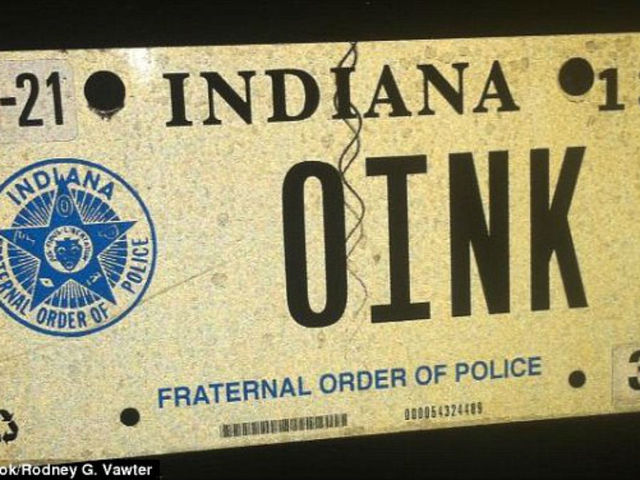
Law vs. Ethics: A Snatched Bar Mitzvah Gift, A Leaky AG, An Embarrassing Scoreboard, and”OINK”

Oink

I try to keep my legal ethics seminars up-to-the-minute, so while preparing for yesterday’s session with the Appellate Section of the Indiana Bar, I came across a bunch of entertaining stories in which the ethics were a lot clearer than the law, or vice-versa. All of them could and perhaps should sustain separate posts; indeed, I could probably devote the blog entirely to such cases.

Here are my four favorites from the past week’s legal news, involving a mother-son lawsuit, a brazenly unethical attorney general, a college scoreboard named after a crook, and police officer’s sense of humor: Continue reading

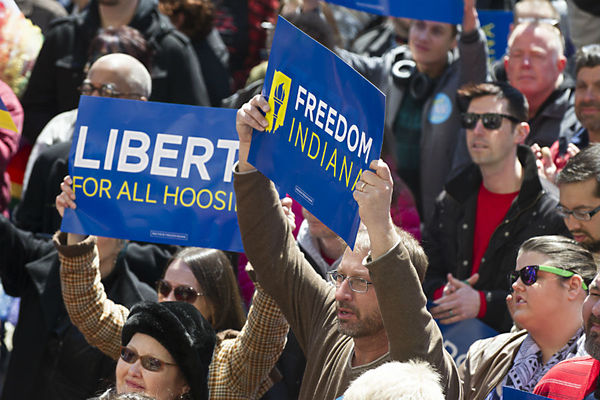
Jerks, Liars, Hypocrites, Fools and Hoosiers: 10 Ethics Observations On Indiana’s Religious Freedom Restoration Act Controversy

Indiana5

1. The law was passed to make discrimination against gays, trans individuals and especially same-sex couples seeking marriage if not easier, to at least seem easier. Anyone claiming otherwise is lying, or being intentionally obtuse. Would Indiana be passing this law without the Hobby Lobby decision or the various court rulings requiring photographers, bakers, and other businesses to provide the same products and services to gay couples that they do to heterosexuals? Yes, you say? Tell me another.

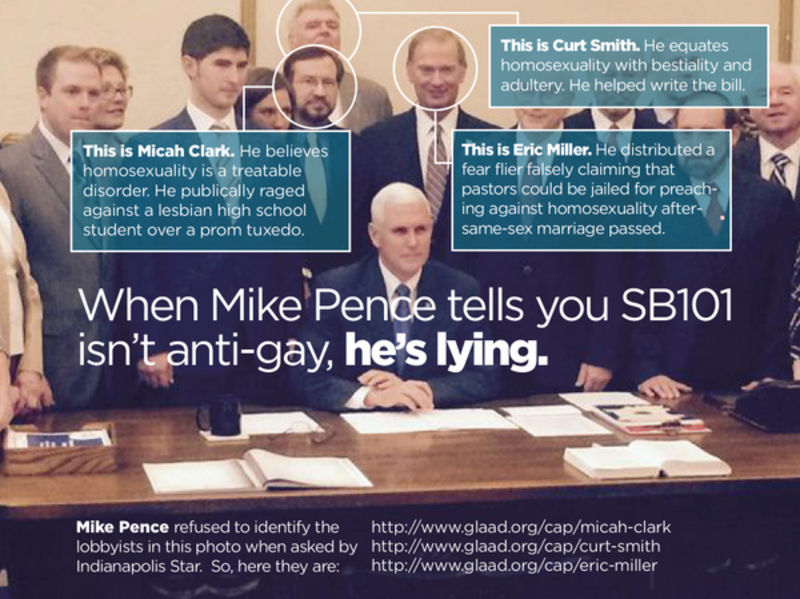
As GLAAD alertly pointed out, Governor Pence was surrounded by anti-gay activists when he signed the bill:

GLAAD Pence

This is res ipsa loquitur, and doesn’t speak well for the Governor’s candor or intelligence.

2. Context matters. The original laws of this sort (the Federal law signed by President Clinton is also called the Religious Freedom Restoration Act) were part of the left’s long range pro-drug strategy, like medical marijuana. It was essentially a hippie law designed to create a slippery slope to recreational drug legalization by allowing fringe religious groups, specifically Native American tribes, to use peyote in tribal ceremonies. Now you understand why Clinton signed the bill.

Oops. Excuse me if I enjoy the spectacle of the clever members of the Church of the Perpetually Stoned—including the ACLU, which once supported such laws as long as they pointed the way to their young lawyers being able to have their Saturday night joints legally but now opposes them—being hoisted on their own petard.

“When the federal government adopted a religious protection act in 1993, same-sex marriage was not on the horizon,” whines the New York Times. Well, competent, well-considered, properly drafted, responsibly passed laws don’t suddenly become unbearable, then fine, then unbearable again with every shift of the cultural winds. The intent of the law was never to protect mainstream religions, but cloaked itself in language that did. It backfired.

3. That being stipulated, the good states need to read their own laws before they start grandstanding. Connecticut Governor Dan Malloy just announced on Twitter that he plans to sign an executive order banning state travel to Indiana in response to its Religious Freedom Restoration Act. Yet Connecticut, hippie enclave and bedroom community of rich, white, liberal New Yorkers that it is, happily jumped on the religious freedom train with a law of its own, one that, as the Federalist points out, makes discrimination on the basis of religion easier than the Hoosier version, which only prohibits the government from substantially burdening religion. Connecticut’s law does not include the word “substantially,” meaning that all government-enacted burdens on religion are theoretically illegal.

I wonder how Malloy is going to ban government travel to Connecticut? Is the theory that the same law can be good when liberal states pass it and evil when those bad conservative states pass it? It is more likely that the governor hasn’t looked at his own state’s law.

4. The hysteria being stirred up over the supposed horribles Indiana’s law will lead to is irresponsible. Jonathan Adler explains on The Volokh Conspiracy: Continue reading

Sooner Ethics Quiz: Abuse Free Speech Rights, Or Ignore Them?

http://www.youtube.com/watch?v=hpNeHMlJiD4

David Boren, the president of the University of Oklahoma, announced that two students would be expelled from the school for leading a racist chant that was preserved on a video and went viral on YouTube. The video shows tuxedo-clad men from the Sigma Alpha Epsilon fraternity  on a bus chanting :

There will never be a nigger at SAE
You can hang him from a tree
But he’ll never sign with me
There will never be a nigger at SAE

Who would want to be in a house with these assholes?

 The national fraternity apologized and closed the OU chapter. That was a proper response. (Tell me again what’s good about fraternities.) First Amendment specialist Eugene Volokh, however, pointed out on his blog that the expulsion was unconstitutional:

First, racist speech is constitutionally protected, just as is expression of other contemptible ideas; and universities may not discipline students based on their speech. That has been the unanimous view of courts that have considered campus speech codes and other campus speech restrictions …The same, of course, is true for fraternity speech, racist or otherwise…Likewise, speech doesn’t lose its constitutional protection just because it refers to violence — “You can hang him from a tree,” “the capitalists will be the first ones up against the wall when the revolution comes,” “by any means necessary” with pictures of guns, “apostates from Islam should be killed.”

To be sure, in specific situations, such speech might fall within a First Amendment exception. One example is if it is likely to be perceived as a “true threat” of violence (e.g., saying “apostates from Islam will be killed” or “we’ll hang you from a tree” to a particular person who will likely perceive it as expressing the speaker’s intention to kill him); but that’s not the situation here, where the speech wouldn’t have been taken by any listener as a threat against him or her. Another is if it intended to solicit a criminal act, or to create a conspiracy to commit a criminal act, but, vile as the “hang him from a tree” is, neither of these exceptions are applicable here, either.

Hey, Oklahoma…Rodgers and Hammerstein just called. They’re officially changing the name of the musical and the song to “North Dakota!”

Your Ethics Alarms Ethics Quiz:

Which is the greater ethics breach: the students abusing their First Amendment rights, or the University of Oklahoma violating them?

Continue reading

KABOOM! ARGHHH! How Can This Happen In The United States? How Can Any University Think This Is Legal, Fair, Ethical Or Rational? How Can A UNiversity That Acts This Way Be Trusted To Teach Anyone Anything, Other Than How To Be A Fascist?

Thank-you, University of Tulsa...

Thank-you, University of Tulsa…

I really didn’t need another KABOOM! so soon after the last one.

From The Foundation For Individual Rights in Education, with my brainless reactions in bold and brackets:

TU suspended student George “Trey” Barnett last October for three Facebook posts [ It’s unethical and probably illegal to punish Barnett for his own Facebook posts…] published by his husband that criticized another student and two TU faculty members. […but it is beyond belief for the school to punish him for what someone else, regardless of who, posts to his page.] None of the Facebook posts came from Barnett’s account; the statements were posted by his husband, who either tagged Barnett or posted them directly to Barnett’s Facebook page. Barnett’s husband later submitted a sworn affidavit attesting to his sole authorship of the posts. Nevertheless, shortly after TU professor Susan Barrett filed a complaint against Barnett arguing that Barnett could not “avoid responsibility” because someone else was responsible for the posts. [This is Kafaesque. Do these even people know how Facebook works? ] TU Senior Vice Provost Winona Tanaka imposed eight restrictive interim measures against Barnett. The sanctions included suspending his participation in certain courses and activities and even barring him from speaking about certain individuals. [University administrators can not bar whom a citizen may speak to; only judges can do things like that, and only rarely.]

Without affording him the hearing he was entitled to under TU’s University Student Conduct Policies & Procedures, and despite his husband’s affidavit, Tanaka found Barnett responsible for “harassment.” Tanaka also found Barnett guilty of retaliation and violating confidentiality requirements for speaking about the disciplinary charges with his husband—who was also his exculpatory witness. [ What??? WHAT??? Due Process? Rights of the accused? Procedures? Policies? ]

Less than two months before Barnett was set to graduate, Tanaka not only suspended him until at least 2016 but also permanently banned him from receiving a degree in his major even upon his re-enrollment. Barnett was forced to wait two months for TU to respond to his appeal, which the university summarily denied on January 9 without explanation—leaving Barnett unable to earn his theater degree as planned. [ All of this for what someone else wrote on the student’s Facebook page! My key question in ethics scenarios is “What’s going on here?” What’s going on here? I have no idea. An illicit relationship between the apparently fat faculty member Barrett and Tanaka? Insanity?]

…TU has also threatened … its independent student newspaper, The Collegian, which this week reported on Barnett’s suspension and criticized his treatment. The Collegian reports that after contacting TU administrators for comment, student reporters were told by TU’s director of marketing and communications that if “anything that the university deems to be confidential” is “published or shared, (that) could violate university policies.” The university refused to explain what might constitute “confidential” information and, come press time, the journalists were unsure what action the university might take against them. [ OK, let’s just stipulate that the University of Tulsa doesn’t accept the principles underlying the First Amendment. I will await its next abuse of power being aimed at impending worship requirements and a ban on assembly.]

Continue reading

Ethics Quiz: Is It Time For A “Let’s Tweet Insults About Chip McGee Day”?

Meet Chip McGee!

Meet Chip McGee!

At Bedford (New Hampshire) High School, several students were not pleased with Superintendent Chip McGee’s announcement via his Twitter feed that classes would resume the day following the school’s cancellation for snow. They responded with tweets of their own, some that were not especially pleasant. McGee, as one would expect a mature adult to be, especially one overseeing the education of children, was philosophical. saying, “Kids said some very funny, clever things. And some kids stood up and said, ‘Hey, watch your manners.’ That was great. And some kids — a few — said some really inappropriate things.”

Yes, kids will be kids. McGee then suspended those latter students for up to four days.

“It’s been a really good exercise in issues of students’ right to speech, on the one hand, and students’ and teachers’ rights to an educational environment that’s conducive to learning,” McGee explained to the Constitutionally ignorant. “Kids have the right to say whatever they want about me [and] The First Amendment right means you can say what you want, (but) it doesn’t mean that you are free of repercussion. It can’t disrupt what we’re doing in school … If something disrupts school, and it (occurs) outside school, we not only can take action, we have to.”

McGee  hopes that the punished students will learn from this incident about “the line” of decent and appropriate commentary. “You only learn that by checking where it is, and having something happen when you cross it,” he said.

Good ol’, wise ol’ Chip McGee. He has no idea what the hell he’s talking about.

The students are absolutely guaranteed of speech without “repercussion,” if the speech is off school grounds and the repercussion is from a school official who takes offense. The school has no authority to punish students for what they post on Twitter, from their homes, none at all, unless it relates directly to action at school itself, such as organizing a school disruption. A student opinion of the superintendent or his decisions? That’s 100% protected speech. I can find that right to free speech Chip mentions right there in the Constitution, but search as I might, I can’t locate in the Bill of Rights the provision describing the “students’ and teachers’ rights to an educational environment that’s conducive to learning” that extends to what a student says and writes outside of school. Where is that “right,” Chip?

Chip speaks in the measured tones of a caring educator, but he acts like a petty tyrant who is eager to abuse his position and power to punish anyone who dares to displease him in what they say or think.

No merely insulting or uncivil tweet is going to disrupt school, and if that’s Chip’s claim, he has a rather tough burden of proof to demonstrate it. Nor does a public school—that’s the state, you know— have the right to effectively censor speech by punishing content. If the speech isn’t libelous or a credible threat, Chip McGee’s reasonable remedy consists of asking to speak with the Tweeter and express his hurt and disappointment, or perhaps consulting with the student’s parents, who do have a right to limit online speech when their children are the speakers.  As an educator, he might explain to the student that insulting authority figures who you must relate to by flaming them on mass social media is neither wise, civil, nor a good habit. He might even  suggest that an apology is in order. He may not, however, abuse his power and position to constrain the free speech of those students and others by inflicting punishment. Chip McGee, who has the young minds of children within his power to lead or mislead, needs to learn this basic civics lesson, as do other tin god educators, and I’m sure there are many, who similarly itch to punish students for exercising their speech rights in the privacy of their homes.

Thus this somewhat atypical Ethics Alarms Ethics Quiz question to ponders:

Should we declare a “Let’s Tweet Insults About Chip McGee Day”?

Continue reading