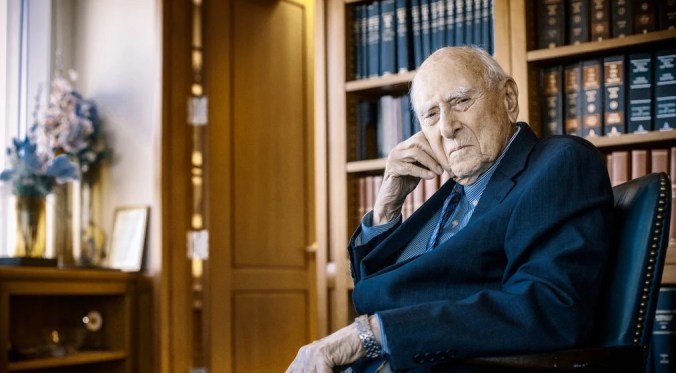
The discussions regarding Joe Biden’s age-related decline reminded me of a post that had been languishing on the runway since mid February. It was prompted by a tip from Neil Doer (I think it was Neil) who pointed me to this article about a well-respected federal judge in Brooklyn, Jack B. Weinstein who was retiring after more than a half-century on the bench. He’s 98 years old, and it seems like he’s been an outstanding judge. My position was and is, however, that it is unethical for a judge, and indeed any professional, to continue in a position of responsibility at such an advanced age.
Obviously, I would apply that principle to politicians and leaders as well. This is another area where professional sports, especially baseball, provides useful case studies that can be instructive. Players who were great at 25 are also better when they are 40 than the more average players, whose natural decline as the result of aging will usually cause them not be able to perform at an acceptable standard by late middle age. The great player often will still be good, but almost no player (almost) will be as excellent in his late 30s and early 40s as he was in his prime. As the financial benefits and other perks of playing major league baseball have increased over time, fewer aging greats are willing to go gentle into the good night of retirement. Their last years are often sub-par, certainly for them, or worse, but they will not voluntarily retire. Check the records of Miguel Cabrera, Pete Rose, Willy Mays, and Mickey Mantle, to name just a few.
Famously brilliant and contrary judge Richard Posner took the unpopular position among his colleagues that federal judges ought to have a mandatory retirement age. He recommended 80, but in his own case, when everyone expected him to stay until the bitter end, he retired at 78, because, he said, it was time. I’m not convinced that 80 isn’t still too old, but at least it’s a limit.
I remember well my one meeting with Antonin Scalia at a bar function not long after he had joined the Supreme Court. He was relaxed and jovial, and when I asked him how long he thought he’d stay on the Court, he laughed and said that he couldn’t imagine staying until they “carried him out,” like so many other justices. He said it was important to leave the bench “while you still have most of your marbles.,” and to him, this meant before 80. He said he would stay about ten years.
Antonin Scalia died while still on the Court, in his 20th year of service, just short of his 80th birthday.
Here, from 2009, is “Age and the Judge.”
___________________________________________
 Ethics Alarms