Ethics Hero: Judge Edward J. McCarthy

What this issue need is sunlight...

What this issue needs is sunlight…

As a parent of a former Russian orphan, I have been disturbed by the deterioration of the international adoption environment there and elsewhere. We have a son who was healthy from the start, and our adoption process, while chaotic (we were rushing against a deadline, as the Russian government was in the process of blocking all American adoptions), was handled openly and legally. Now my wife and I read about true horror stories involving abused children, cruel parents, and unscrupulous agencies and brokers here and in Russia. Except for the very worst cases, most of these never crack though the relative trivia on cable news.

In New York, a court has been ordered by a New York Judge, Edward J. McCarthy, to open proceedings about one such horror story. Adoption proceedings are always closed to the public and press, put the judge has ruled that these proceeding must be open, because… Continue reading

Ethics Hero: Judge Richard Posner

Sure, you have a right to think there's something wrong with that, but the state has no business acting as if it thinks so too.

Sure, you have a right to think there’s something wrong with that, but the state has no business acting as if it thinks so too.

Because Judge Richard Posner of the 7th Circuit Court was appointed by Ronald Reagan, he is usually describes as a conservative judge. He’s better described as an unusually smart, articulate, thoughtful and courageous judge, and in responding to oral arguments  lawyers for Wisconsin and Indiana defending their state’s marriage bans, he proved it.

I have frequently attempted to draw a distinction between those guided by archaic religious morality that causes them to regard same-sex marriage as sinful, and the attempt to use the government, which must not be guided by religion to make such marriages illegal. Morality doesn’t have to be defended by logic—God works in mysterious ways, you know—but laws do. A complete evisceration emanating from a place of authority of the specious and often absent reasoning behind gay marriage bans was much needed, and knowing that he risked criticism as a “judicial bully” for doing so with gusto, Judge Posner came through.

Here is a sampling of the barrage he placed on Indiana Solicitor General Thomas Fisher and Wisconsin’s assistant attorney general Timothy Samuelson: Continue reading

“When Will They Ever Learn?” Department: “Baby Emma” Déjà Vu

Preston and Baby Wyatt

Preston and Baby Wyatt

Once again, an unmarried father is trying to get the courts to award him custody of his child after the mother handed the child off to adoptive parents. This issue was recently examined by the U.S. Supreme Court in the case of Adoptive Couple v. Baby Girl, and on Ethics Alarms two years ago in its examination of the “Baby Emma” drama. Now it is in the news again, as Preston King, the 19-year-old father of “Baby Wyatt” fights for his child in the California courts

The details of these cases vary, as do the state laws governing them. In the Baby Emma case, for example, among the complexities were the fact that the state of the couple’s residence, Virginia, recognizes an unmarried father’s right to custody, while the state where the adoption took place, Utah, does not. All the cases have  in common a conflict between rights, law and ethics. Continue reading

Your Introduction To “Private Re-Homing”

Puppy, child, what's the difference? The point is make it someone else's problem, right?

Puppy, child, what’s the difference? The point is t0 make it someone else’s problem, right?

Every time you see a national newscast take up valuable time telling us about Miley Cyrus, the Kardashians, Chelsea Clinton or the White House waterdogs, think about Inga, or Quita, victims of the increasingly common practice of underground adoption known as “private re-homing,” in which adopted children are traded around like dogs or kittens, and abused dogs and kittens at that.

I don’t have a lot of commentary about this horrible practice. My life was a little bit happier before it was brought to my attention. In the history of Ethics Alarms, perhaps the most upsetting story I have had to write about was the horrific conduct of Torry Hansen, a Tennessee mother who adopted a Russian child and then, finding that she couldn’t cope with his problems, put him, alone, on a plane bound for Russia with a note pinned to his jacket. I wrote that post with tears in my eyes; it upsets me to write about it now. Yet something very like what Hansen did to her son is being done via the internet, frequently and with little interference from the government or anyone else. I wish I didn’t know about this—no, that’s not quite right. I wish this wasn’t a feature of our society, so I wouldn’t have to know about it, much less write about it. Continue reading

In Connecticut, A Surrogate Mother Triggers An Epic Ethics Train Wreck

Crystal Kelley and...somebody's baby

Crystal Kelley and…somebody’s baby

There is no field of ethics more murky or subject to conflicting interpretations than bioethics, and few issues in bioethics are as confusing as those involving surrogate mothers who decide that they should have some say regarding the fate of the child that grows in their bodies. CNN has reported on the most perplexing such scenario I’ve every encountered, so perplexing that I can’t unravel the ethical rights and wrongs of it.  I wonder if anyone can with confidence. I’ll just summarize the main features and some of the issues raised; you will need to read the whole, stunning story to fully appreciate this train wreck’s sweep and carnage.

I. Crystal Kelley, a single mother who had endured two miscarriages, wanted to help another couple conceive, but mostly wanted the $22,000 fee since she was out of a job. She contracted with a couple seeking their fourth child, and was implanted with two previously frozen embryos. One survived. Ethics issue: Did Kelley tell the parents about her miscarriages?

2. Five months into her pregnancy, tests showed the baby Kelley was carrying had serious medical problems, though the child had a chance at survival. The couple said that they wanted Kelley’s pregnancy terminated because they didn’t want the baby to suffer. Ethics issues: Is that a valid reason to take an unborn child’s life? Was it the real reason? Was the real reason that they were unwilling to pay for and endure all the necessary medical treatmenst, or that they wanted nothing less than a “perfect” baby? Does it matter what the real reason was? Continue reading

Justice Is Served: Torry Hansen Gets The Bill

Look out for that sword!

Two years ago, Ethics Alarms featured the story of Torry Hansen, the Tennessee adoptive mother who couldn’t handle her adopted Russian child, so she pinned a note on him and sent him back to Russia, alone, on an airplane. I wrote:

“Sending an innocent child back to the orphanage, like he was a defective toaster returned to Walmart, is the ultimate betrayal, as unforgivable as treason, and far, far worse than adultery. A child who, in Justin’s case (his Russian name had been Artyom), was neglected by his alcoholic mother and taken by the state, sent to an orphanage and given to an American mother, has been rejected again and abandoned. I cannot imagine what this would do to a child. I cannot imagine allowing anyone’s child to endure this, least of all my own.

“Her son was making her life impossible. She couldn’t handle the stress; she looked into the future and saw only problems. Check: I understand. I empathize with Mrs. Hanson completely, for we knew when we adopted our son that this was a possible scenario. Again, it doesn’t matter. Sending an adopted child back to Russia is not an option, because it is absolutely wrong, like murder, like torture, like sacrificing one human being to save another. Never. Absolutely never. Nothing can ever justify treating a child—your own child— like that.”

Now CBS has reported that Hanson will have some consequences of her actions in addition to being roundly detested by every adoptive parent in the world (like me) and being a permanent member of the Bad Mothers Hall of Infamy. Continue reading

Comments of the Day: “UNICEF’s Unethical War Against International Adoption”

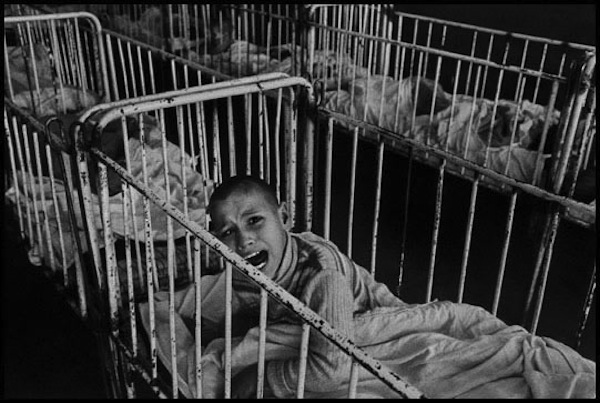
A Rumanian child in an orpahanage for "incurables," circa. 1990, enjoys his "heritage."

A post that is a year old recently attracted two important comments, thanks to a link to the essay from another website. The topic is international adoption, an issue that I have a special interest in as the parent of an adopted son who was born in Russia. I have seen first hand the conditions described in these posts, and when I wrote the original article, I was unaware of the substantial movement opposing international adoption, a misguided effort with tragic consequences to the children these people supposedly want to protect. I am aware of it now. It is an especially tragic example of what happens  when tunnel vision and ideology causes individuals to lose perspective and objectivity.

I am taking the unusual step of pairing two comments as the Comment of the Day.  They arrived together, and compliment each other well. You might want to read the original post, “UNICEF’s Unethical War Against International Adoption.”

Here are the Comments of the Day, by Mel and Holly F. Continue reading

The Ethicist, the Farkel Family, and the Perils of “Maybe”

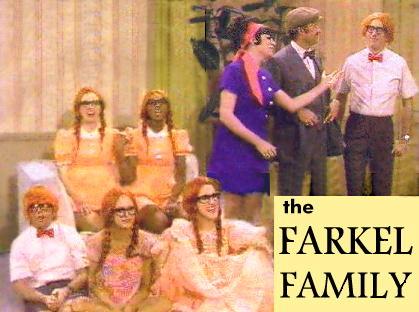
This photo is completely relevant to this post, but if you are under 50, you probably haven't a clue why. Pity. See below for an explanation.*

One of the reasons I started the Ethics Scoreboard, and continued with Ethics Alarms, was my frustration with the ethics profession’s reluctance to render useful opinions on complex ethical problems…unless, of course, the ethicist was being paid for them. Instead, ethicists are prone to issue obtuse and jargon-filled discussions allowing for every possible eventuality and interpretation, usually concluding with vague, equivocal pablum that allows the ethicist to avoid criticism and accountability. The result of this craven preference for “maybe” as the answer to every dilemma is that ethics are rarely included in public discourse or media coverage, as it solidifies its reputation for being technical, ambiguous, and pointless.

A perfect example of the reticence to make a clear choice occurs in this week’s installment of “The Ethicist,” the New York Times Magazine’s ethics column. An understandably anonymous inquirer writes that he unknowingly fathered a child with a married woman in his neighborhood, who raised the child as the offspring of her and her husband.  The mother asked the biological dad to have no contact with the girl, and he has complied. Now he asks, “Does she have a right to know her true parentage upon reaching adulthood? Sooner? Over the objection of the mother? Only when the husband dies? Who can make these decisions and when?” Continue reading

The “Baby Emma” Saga Revisited: The Core Issue

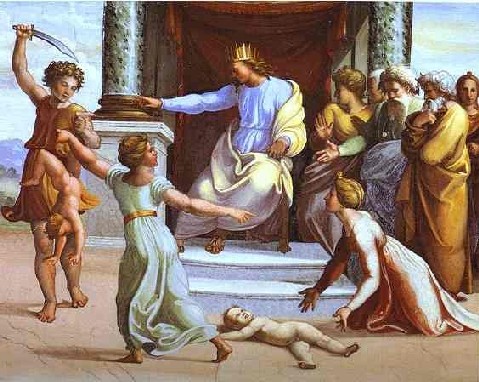
Didnt King Solomon have a case like this once?

When the mother of the child an unmarried father co-created with her decides that she doesn’t want to/ can’t raise the child and doesn’t trust the father to raise her, is it ethical to put said child up for adoption without notifying or consulting the father?

That is the ethical issue the “Baby Emma” incident, first discussed here in an earlier post, ultimately raises. It is a question that I did not discuss in that post, focusing instead on the father’s conduct and his current plight, as self-described on his “Baby Emma” website. I made three ethical assessments, each of which are self-evident:

1. The whole situation would have probably not occurred if John Wyatt and Baby Emma’s mother had been married before conceiving a child.

2. Both of them were irresponsible to plan on having a child together without formalizing a mutual commitment to form a family and raise the child together…that apparently archaic institution known as “marriage.”

3. The mother betrayed John’s trust, deceived him, and treated him unfairly.

I also suggested that, absent a marriage, it is fair and reasonable that the mother of a newborn be able to put the child up for adoption if she deems that course better for the child than being raised by the child’s father. I did not say that was the law, or even that I would vigorously oppose a law that directed otherwise, as Virginia’s law does. I only stated that my own belief is that incentives for irresponsible parenthood are unwise. I have been asked why I focused on the issue I did, rather than the other ethical issues raised by the controversy. It was because the issue was brought to me with the presumption that John Wyatt, the father, was a blameless and unequivocal victim in the matter. My ethics alarms sounded: he has significant ethical accountability for the mess, and I explained why.

As to the answer to question above, I can only say this: it depends. The conduct of Baby Emma’s mother is mysterious and extreme. Did she panic? Did she have a mental break? Why would a lifetime friend and partner of a man conceive a child, pretend to plan to raise her with him, and then secretly negotiate to have the baby adopted and taken out of state?

I see many scenarios that could be behind her decision, which fall into three distinct categories: ethical, unethical, and too close to call: Continue reading

Love Isn’t Enough: the “Baby Emma” Saga

Too bad Baby Emma's father didn't see "Juno" first...

This, from the birth father’s perspective, is the strange story of “Baby Emma,” a newborn whisked out of Virginia by her mother to be adopted by a couple in Utah, which has unusual laws that seem to circumvent fathers’ rights in others states:

“My name is John Wyatt,  the birth father of Baby Emma Wyatt,  born February 10, 2009 in Woodbridge, Virginia.  I have never held my daughter in my arms or even been allowed to see her in person.  My daughter has never had her Daddy hold her and say “I love you” to her, or hug her and kiss her.  Baby Emma and I have been denied those precious moments together.

“Imagine this happening to you: as a 20 year old, you have been friends with the mother since second grade and you have dated since middle school. You anxiously make preparations with the mother of your child, your childhood sweetheart,  for the arrival of your new baby.  You go to the doctor’s appointments, you rub the mother’s belly and feel your baby moving and kicking in the womb.  Both of you pick out the name.  It’s so exciting, you can hardly wait for the arrival of your new baby!! You look forward to what you expect to be the happiest moment of your life, to be with the mother and baby at birth…Both of you make plans on raising the baby together.  Continue reading