“The Good Wife” Jumps The Ethics Shark

jumping the shark

I saw this coming several seasons ago- that the once ethically challenging CBS legal drama “The Good Wife” was on the way to strapping on Fonzie’s old water skis and jumping the old Ethics Shark. Sure enough, after being able to watch the show irregularly and being either confused or disappointed when I did, I finally got a chance to watch an entire episode last night. The Shark has been officially jumped and TGW is no longer bothering to check with its legal ethics consultants. This is known as “The David Kelley Syndrome,” as all of that producer’s legal dramas, “The Practice,” “Ally McBeal,” “Boston Legal,” etc, begin plausibly and end up in the Legal Ethics Twilight Zone as the writers run out of ideas.

In last night’s episode, “Cooked,” Good Wife Alicia’s defendant was charged with making GHB. He claims innocence because he wasn’t making authentic GHB, but a GHB-like substance,without the same chemical compound as GHB itself and thus less dangerous.  Alicia explains the law to him, which is that he would be better off if his intent was to make GHB but he  ended up with the pseudo GSB by mistake, instead of successfully making the possibly illegal GHB-like drug intentionally.  She says that he needs to be clear which he did, and tells him to tell the truth.

This is the common, much criticized defense lawyer tactic called “The Lecture” in the novel “Anatomy of A Murder.”  A lawyer is bound to explain the law to his or her client, and that sometimes means educating a client regarding how to “remember” what happened.

Then Alicia discovers that her defendant isn’t who he claims to be. He’s an FBI agent, and he’s part of an FBI sting to prove the judge in the case is taking bribes. She says she’s going to tell the judge about his false identity (and also that the charges were fake) so he tells her and that if she blows his cover, he’ll tell the judge that she suborned perjury by  giving “The Lecture.” She backs off, and agrees not to tell the judge.

Suspend her.

1. If she has a personal interest (Rule 1.7) that conflicts with her duty to protect client confidences (Rule 1.6), like her conflicting duty as an officer of the court to report a fraud on the court, a.k.a. THE WHOLE CASE, then the least she must do is withdraw under Rule 1.16. Continue reading
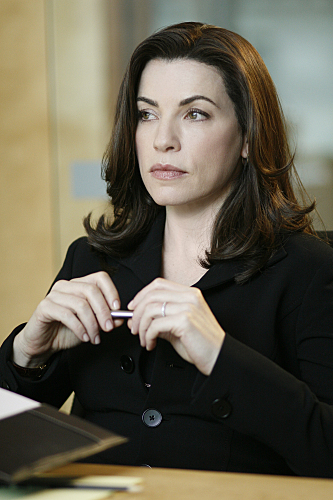
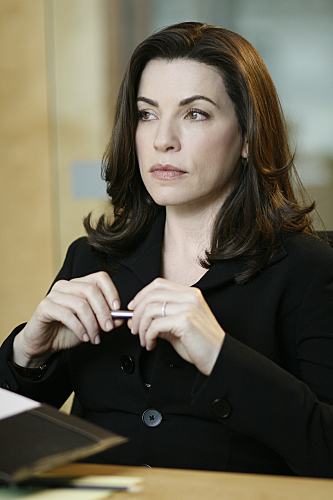
Legal Ethics Train Wreck on “The Good Wife”

Oh, Alicia, Alicia...what have they done to you?

The CBS legal drama “The Good Wife” continues to show the seamy side of big firm legal practice, with heroine Alicia Florrick’s firm, Lockhart, Gardner and Bond, its adversaries, and even Good Alicia herself violating legal ethics rules with abandon, and at an accelerating rate, based on recent episodes. There is nothing wrong with this as entertainment, as long as the Rules themselves are not being misrepresented (they aren’t), the misconduct isn’t being presented as ethical (it isn’t, though it is sometimes hard to tell), and viewers don’t get the idea that this is how most law firms behave. Unfortunately, like most legal shows, “The Good Wife” fails in this important realm. I work with many large law firms, and they are all very aware on the ethical lines, bold or fuzzy, that they must not cross, and take their obligations seriously.

The most recent episode of “The Good Wife,” entitled “Getting Off” included a full-fledged ethics train wreck sparked by the firm’s habitually unethical adversary, the fecund Patti Nyholm. In the middle of representing the defendant hospital in a lawsuit brought by a Lockhart, Gardner and Bond, Nyholm is fired by her firm and removed from the case. With a twinkle in her eye, she approaches none other than the Lockhart firm to represent her in a multi-million dollar lawsuit against her former firm for discrimination and wrongful termination, on the theory that it fired her because she was pregnant. Continue reading

I’m Worried About “The Good Wife”

Shape up, Alicia.

CBS’s “The Good Wife” seems to be getting more cavalier with its ethics breaches, a disappointing trend. Showing the ethical fudging that undoubtedly goes on behind the scenes at major law firms (on occasion) is appropriate; treating major violations with a shrug is not. I know it is tempting for the show to assume it has the intelligent legal TV show championship sewed up, since “the Defenders” is a joke and “Harry’s Law” is a disgrace, but it’s standards have been high, and it is dispiriting to see them flag with such missteps such as…

  • Prosecutorial misconduct casually brushed off as nothing. When Alicia asks why a videotape  is so much clearer than the one the prosecutor’s office turned over as evidence, she is told that what she received before was a copy of a copy of a copy–“just to mess with you.” Continue reading