Major League Baseball Asks What This “Integrity” Is That We Speak Of…

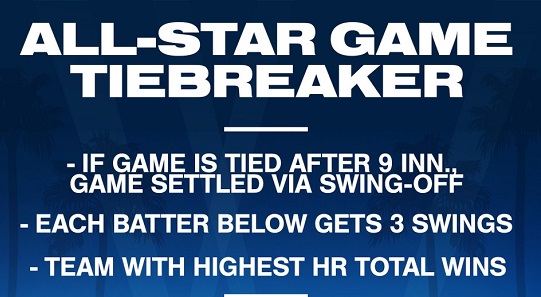
Even though the stupid All Star Home Run Derby was the night before, last night’s Major League Baseball All Star Game, which was allegedly baseball at its best, was decided by another home run derby, this one called a “swing-off.” The game’s nine innings ended in a tie, see, after an unprecedented comeback by the American League, which had trailing by six runs with just three innings to go against the National League’s best pitchers. This set up the game for a thrilling finish, like, say, Carlton Fisk hitting the ball out in the 12th inning of Game Six of the 1975 World Series, but no.

The 95th All-Star Game in Atlanta was settled by a “home run swing-off” to settle the tie. Worse still, the game’s MVP award was given to Kyle Schwarber of the National League, based on how he performed in the “swing-off” (I can’t believe I’m writing this), not in the part of the night known as “a baseball game.”

By the time Rob Manfred, the Worst Baseball Commissioner Ever Not Named Bud Selig , is through making up rules and gimmicks, baseball fields will have fun obstacles—you, know, gnome heads, water hazards and little twisty chutes?—like in miniature golf. He wants to make the game entertaining for people who are bored by baseball….you know, like him.

All of this is because the mega-millionaire players stopped wanting to actually play hard in the iconic exhibition game—might get injured, lose a big contact—and managers were pressured into not playing to win but rather treating the game like an elementary school Halloween parade, where every kid in costume gets a moment in the metaphorical sun (the games aren’t played in the daytime anymore, like they were when kids could watch their favorite players). So pitchers never pitch more than an inning, maybe two for the starters, and players all get an at-bat, but that means that if the game ends in a tie, one or both teams will have no players left. Behold! The stupid “swing-off,” which is even less baseball than the “zombie runner” gimmick used to break ties in the regular season. It had never been used before.
Continue reading

All-Star Election Cheaters: The Boston Red Sox and the San Francisco Giants

The Major League Baseball All-Star Game team voting by the fans is hardly a model of fair democracy. Most fans vote for their favorites rather than the best qualified players, and are not very informed even about their favorites. They also are guided more by loyalty than analysis, choosing local heroes over more accomplished players from another team. In other words, it’s basically the same as political elections.

Well, there are other factors that make the All-Star Game voting less than admirable. You can vote up to 25 times from each e-mail address, giving an edge to computer geeks. The teams in the biggest cities and with the best attendance have an advantage over the rest, because there are more of their fans voting. And players on teams like the Phillies, Dodgers, Red Sox, and Yankees that are on national TV a lot, along with last season’s World Series adversaries, the Texas Ranger and the San Francisco Giants, have more name recognition nationwide, giving their players another unfair edge.

Still, it is an election, the votes count, and the various franchises should be trying to uphold whatever minuscule smidgen of integrity the current system has. The Boston Red Sox and the San Francisco Giants, however, don’t think they have enough advantages in the  All-Star voting already, and have found a loophole in the rules that allows them to cheat. Continue reading

Deriliction of Duty at the MLB All-Star Game.

This week’s Major League Baseball All-Star Game got the lowest TV ratings in the history of the so-called “mid-summer classic,” which proves that Lincoln was right: you just can’t fool all the people all of the time—even when they are baseball fans. The All-Star Game was originally devised as a dream competition in which the best players from the American and National League would play a game that was hard-fought and full of the spectacular exploits of the best players alive. For decades it was like that, too, until sky-rocketing salaries and America’s culture of celebrity turned a large proportion of the players into egomaniacal, self-promoting monsters. Continue reading