Ethics Hero, I Guess: High School Runner Zach Hougland

cross country

Today got an e-mail from an Ethics Alarms participant who hasn’t been by in a while. He commented that he was finding the blog too depressing. Almost immediately after that, another reader sent me this story.

In Iowa, Davis County High School runner Zach Hougland had already won his race, thereby becoming district cross country champion, his school’s first. As he was taking congratulations from his coach and track team mates, he saw another school’s runner stumble and fall, then remain motionless. Hougland rushed back on the track, scooped him up and tried to help him to the finish line.  He said, “It was about 15 meters from the finish line.  I did it for seven meters, so he had about eight left.  I knew I couldn’t help him finish so I just gave him a push and told him ‘You can do it!'” Continue reading

Slate: ‘How Dare A Billionaire Donate $400,000,000 to Harvard?’

See, Ozmandias? You should have opted for school of engineering.

See, Ozmandias? You should have opted for the school of engineering.

Slate’s article by Jordan Weissmann, its senior business and economics correspondent, about the largest donation ever made to Harvard University is one of those monstrosities that has great value as an ethics test. If you think his argument is reasonable, then you need help.

Essentially, the Slate piece is the ultimate example of an unethical argument I have focused on before, which can be summarized as, “If you give to what you care about rather than what I care about, then your donation is unethical.”

Unless your contribution is to ISIS, or isn’t really a contribution but an attempt to buy access for your own purposes (like with, to pick an example out of the air, a donation to the Clinton Foundation), there is nothing unethical about a $400,000,000 donation, which is what John Paulson just gave to Harvard University’s endowment for the School of Engineering and Applied Sciences. The school will be renamed after Paulson, which Weissman also finds repugnant. The title of the piece: “Billionaire’s Ego Donates $400 Million to Harvard.”

Let me pause here to note that I refuse to give my money to Harvard, which solicits me regularly. The university is rich, I’m not, and I prefer to give my charitable gifts to Georgetown Law Center, specifically to the student theatrical organization I founded there, which like all theater groups, needs funds. I am sure Weissman finds my contribution unethical as well, because, really, what good are the arts compared to what he has decreed is worth giving to as the “more pressing causes in the world”?  As he sees it, that is, but that’s all that matters.

Let me go through Weissman’s many objections that cause him to sneer at Paulson’s charity:

1. “Gestures to Ivy League schools …inevitably have as much to do with the giver’s ego as their sense of altruism.” Yes, and so do almost all philanthropic donations, regardless of source and objective. The motto in fundraising (I was a professional fundraiser for a decade) is that donors give money for their purposes, not yours. People who give a lot of money to good causes like to have some recognition, and they deserve it.  Apparently Weissman believes that the only ethical donations are anonymous ones, because that’s modest. I’m impressed by anonymous gifts, though they often have selfish motivations as well: the donors don’t want to be hounded by more fundraisers. Nevertheless, that lack of modesty is so trivial as a flaw in large charitable contributions that to harp on it is perverse. Successful people tend to have egos that are often in proportion to their accomplishments. The construct of the left is, we know, that accomplishments and success are just randomly distributed fruits of privilege, ergo the self-esteem that often results from such success is as unsavory as the privilege that generates it.

This is, to be blunt, un-American crap.

2. Harvard “does not strictly need more money, especially compared to the financially strapped colleges that typically educate lower-income students.” First of all, this is demonstrably false. Harvard does need more money if it is going to expand and improve its School of Engineering and Applied Sciences, secure that school’s financial health in perpetuity, and do so without sacrificing other objectives it deems important. Harvard also educates lower-income students, the best and brightest of them, and thus the best resources money can buy are expended on the students most likely to make the best use of them for the benefit of society. Weissman believes this is wrong, and that the 400,000,000 should be given to lesser schools, with less of a track record of spending money wisely, while educating less promising students.

I am in sympathy with that argument to some extent. The marginal utility of all that money is less at Harvard than anywhere else, and I can envision the donation having a far more sweeping impact elsewhere: giving it to Sweet Briar, for example. That does not mean there is anything wrong in any way with bolstering Harvard’s School of Engineering and Applied Sciences. The donation is an unequivocal, absolute good.

The money could have been spent “better”? That’s your opinion. It’s not your money. Shut up. Continue reading

Reminder: It’s A Wonderful Ethics Movie!

It's_a_Wonderful_Life

I’m watching “It’s A Wonderful Life,” Frank Capra’s ultimate ethics movie. Don’t forget to review its ethics dilemmas, conflicts and conundrums with the handy

Ethics Alarms Complete “It’s A Wonderful Life” Ethics Guide.

Ethical Feline Of The Year: Tara the Cat

The rescuer and  the rescued (photo from KERO, Bakersfield)

The rescuer and the rescued (photo from KERO, Bakersfield)

You may have seen this video already, but as I may never again have the opportunity to honor a member of one of nature’s least ethical creatures for exemplary ethical conduct, here is the amazing tale of Tara the Cat.

In Bakersfield, California, four-year-old Jeremy Triantafilo, who is mildly autistic, sat on his bicycle outside his family’s home when the neighbor’s chow-labrador mix, who “doesn’t like children or bicycles” according to his owners, escaped the yard through an open gate , saw the boy, and attacked him. Surveillance footage shows the dog grabbing the boy’s leg and pulling him to the ground, and beginning to shake him. The Triantafilo family cat, Tara, saw the attack and charged to the rescue, leaping on the dog and chasing him off.

The boy’s father posted the video of the jaw-dropping episode to YouTube, and you can see it below.

I have had cats and lived with cats, and one cat in particular, my wife’s Siamese, broke my heart when he died. Nonetheless, cats are nature’s sociopaths, charming but ultimately self-centered,  cruel and lacking in empathy. They are not pack animals or group oriented, and “loyalty” is not one of the characteristics that anyone would say distinguishes the species. There is a reason why the film “Cats and Dogs,” which posited that the two rival creatures were really alien races of superior intelligence secretly battling for dominance on Earth, cast the cats as the villains. Cats can’t be trusted, and there is no such thing as an ethical cat.

Or so we have always been told.

Tara (the video is not a hoax) is either an outlier, or this is just one more example of how scientists don’t understand animals as much as they think they do. She clearly places herself in danger to rescue the most vulnerable member of her family. The cat assessed what was happening, set out to rescue the child, and did it efficiently and well.

I have never heard of such a thing. There are other YouTube videos that show cats engaging in ambiguous conduct that is termed a rescue, but such episodes always involve the cat protecting itself or its general vicinity from an intruder. At first, I thought Tara’s video was staged, like “The Incredible Journey.” So far, it doesn’t appear to be.

Thus we have to conclude that, contrary to lore, conventional wisdom and propaganda from the Ministry of Dogs, cats—some cats, one cat, this cat—are capable of  conduct that in a human we would regard as altruistic, ethical and courageous acts. Tara not only rescued a little boy from serious harm, she also elevated the status and reputation of cats everywhere.

Now that’s an Ethics Hero.

And here’s the astonishing video:

__________________________

Facts: Daily Mirror, ABC

Update: “The Kidneys of Orlac”

He will die, not with his boots on, but with his kidneys in...

He will die, not with his boots on, but with his kidneys in…

One of the best threads Ethics Alarms has ever hosted occurred in response to the November 2013 post, “The Kidneys of Orlac,” which discussed the strange case of the Ohio death row resident who wanted to donate his organs to ill relatives. The issue generated an Ethics Quiz, a follow-up poll (“The Amityville Kidney”) involving the related issue of whether the recipient of a murderer’s organs had a right to know their creepy origin, and a terrific Comment of the Day, which was just one of the COTD-worthy submissions.

I had forgotten about the story until Mark Draughn raised it again at Windy Pundit in the context of criticizing bioethicists, one of whom had what Mark considered a particularly misbegotten argument against the transplants (I agree with Mark about that argument, but I also oppose giving condemned prisoners the privilege of donating organs to loved ones, or anyone at all.) This led me to review original post, which led me to re-read the comments.

I also discovered the resolution of the dilemma, which occurred at the end of last month. Ronald Phillips will not be allowed to donate his organs, because he wouldn’t have enough time to recover from the operation before his execution.  Ah, yes, the old “You have to be in tip-top shape before we can kill you, or it isn’t really punishment”  Catch 22! Ethics, you see, had nothing to do with the bureaucratic resolution here, just the letter of the law, rules, and bureacrats refusing to look for the best solution in an anomalous situation, rather than the one they could reach on auto-pilot. As a result, nobody made a reasoned determination about what is right, or what capital punishment really signifies, or apparently even tried. That is how so many government decisions are made, and that, my friends, is far scarier than having the kidneys of a killer.


Fundraising Ethics Controversy in Michigan! Naming Buildings After Big University Donors: Ethical or Not?

Enron-Field

I worked in the development (capital fundraising) office of Georgetown University for many years, and am well aware of the sausage-making that goes into attracting big donations. Thus the controversy that recently erupted in Michigan is of interest both for its ethical content and the way it dances around inconvenient truths.

With the college student’s wonderful knack for avoiding the obvious, the student newspaper of Grand Valley (Michigan) State University declared ethics war on what it called “billboards”: buildings and lecture halls named after corporate and individual donors. With naivete and boundless ignorance of the world of philanthropy and non-profit fundraising, the editorial declared (among other things)…

  • “What’s next? Will we turn Lake Huron 133 into the “Amway Lecture Hall?” Will the backs of our chairs have plaques dedicated to the lower-level donors?” COMMENT: For enough money, of course the university would rename the hall. Why should it care what a lecture hall is called, if it can avoid having to raise tuition? As for the backs of seats: did the editors do any research at all? Opera companies, theaters, museaums and other non-profit entities do exactly this. So what?

Continue reading

Gift Horse Ethics: The Babe, The Splendid Splinter, and The Ethics Of Self-Promoting Virtue

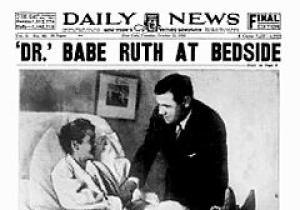
sick child and-babe-jpgBaseball slugger Babe Ruth was famous for visiting hospitals and orphanages to give kids a thrill. Babe always had reporters in too to record his noblesse oblige , of course. He was an orphan himself, and nobody should doubt the Bambino’s genuine dedication and generosity when it came to kids. He just wasn’t going to let his good deeds go unnoticed.

Other baseball greats, notably Ted Williams, made most of his visits without fanfare or publicity, and he didn’t tip off the press. “The Splendid Splinter” wasn’t visiting kids in cancer wards because he wanted his fans to know what a good guy he was. He did it because he wanted to make sick children feel better.

Was the Babe less ethical than Williams? Did his self=promotion take the ethical sheen off of his good deeds? This is the issue raised by the activities  of the  “Magician Prankster” who calls himself “Magic of Rahat” on YouTube and Twitter. He recently posted a video called “Homeless Lottery Winner” showing him playing  a prank on a homeless man, who ends up with $1,000. He is understandably grateful:

Slade Sohmer however, on HyperVocal, is hearing ethics alarms: Continue reading

Michael De Beyer, Like Don Bedwell, An Exemplary Ethics Hero To Inspire Us

Mathis and hero

Writing about my favorite Ethics Hero of all time, Don Bedwell, in 2005, I began, “There are special and rare people whose ethical instincts are so pure and keen that they can make the rest of us feel inadequate.” Like Don Bedwell, Micheal De Beyer is such an individual.

Brittany Mathis, 19, works for De Beyer at his  Kaiserhof Restaurant and Biergarten in Montgomery, Texas, . Her mom and older sister work at the restaurant as well, so she would describe her boss as a family friend. In December, Brittany learned that she has a 1.5 inch brain tumor  She can’t afford to find out whether the tumor is benign or malignant, but her father died from a similar tumor years ago, so her situation is dire. She doesn’t have health insurance.

De Beyer has decided to sell his restaurant, which he opened more than 15 years ago and has an estimated worth of $2 million, to pay for whatever medical treatments are necessary to save Brittany’s life. “I’m not able to just sit by and let it happen,” De Beyer told a local paper. “I couldn’t live with myself; I would never be happy just earning money from my restaurant knowing that she needs help.” Continue reading

Mark Clemishire And The One That Got Away

Big Fish

Letting a fish you’ve caught swim off to be hooked another day doesn’t exactly place you in the altruism big leagues with Oscar Schindler,  but one takes one’s ethical opportunities as they arrive. For Mark Clemishire, a fly fisherman from Skiatook, Oklahoma, this qualifies as exemplary ethics, and attention should be paid.

It was about a month ago that  Clemishire was plying his craft in Lake Taneycomo, Missouri, and after an epic battle, caught a monster rainbow trout he immediately dubbed Troutzilla. Measured at 31 inches long with a girth of 22 inches, Troutzilla almost certainly weighed more than 20 pounds, which easily surpassed the existing record for a rainbow trout. To get credit for his achievement, a big deal for a serious fly fisherman, Clemishire’s trout had to comply with Missouri Department of Conservation rules that required the catch to be weighed on department certified scales. But instead of etching his own name in the record books, embracing immortailty and a place in the Fly Fishermen’s Hall of Fame, if there is such a thing, Mark had some photos taken of him posing with his Catch of the Day, and let Troutzilla go free. Continue reading

To Get Your Christmas Ethics Off To The Right Start…

its-a-wonderful-life-collage-73136

…the Complete Ethics Alarms “It’s A Wonderful Life” Ethics Guide is here.

Just in case you forgot!