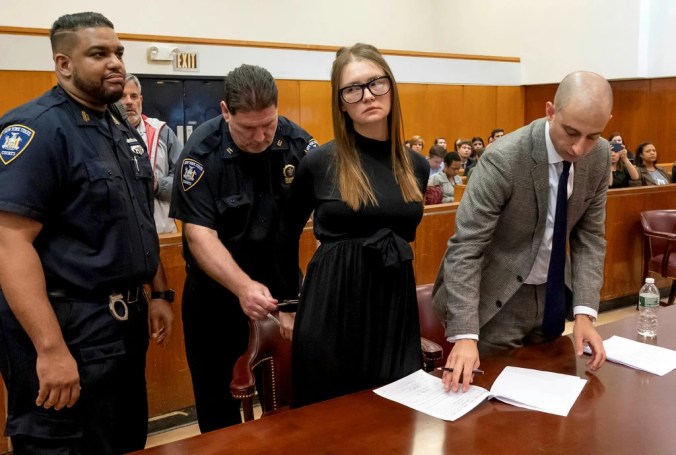
A New York jury this month found Anna Sarokin guilty of grand larceny in the second and third degrees and other charges that netted her a sentence of 4-12 years in prison. In previous years before being caught, she posed as “Anna Delvey,” a fictional German heiress with a trust fund, and parlayed her scam into a luxury life-style of long stays in boutique hotels, a closet full of designer clothes, and late-night parting with Manhattan’s glitterati.
Sorokin, 28, was really an attractive Russian immigrant with brass. She ducked bills, conned the trusting, , and once tricked a bank employee into giving her $100,000 she never intended to pay back. She couldn’t have done any of this for so long or as successfully if she weren’t young and comely, and also a stone-cold sociopath. I’d guess her story will soon be made into at least a Lifetime cable movie, if not a big budget vehicle for Jennifer Lawrence.
Anna is also a fick, that rare species chronicled on Ethics Alarms that openly revels in unethical wickedness. In two interviews with the New York Times, she made it clear that she’s a shameless predator, telling the paper yesterday after her sentencing,
“The thing is, I’m not sorry. I’d be lying to you and to everyone else and to myself if I said I was sorry for anything. I regret the way I went about certain things.”
She’s still playing her con. Anna says she always intended to pay back the hotels, a private jet company and the banks she said, which she cheated out of more than $200,000. She just missed bilking a hedge fund into giving her a $25 million loan.
Well, yes, if you want to get technical about it, she had falsified some bank records, but only because she was in America and has big dreams. Don’t all Americans? She wanted to start a $40 million private club, and potential investors pushed her to open it before they put up their own money. If you think about it, it all was really their fault, not poor Anna’s.
Sorokin said was always fearful that she was vulnerable to men who would “cheer me on” and then seize control of her vision for the club, which she called the Anna Delvey Foundation. “My motive was never money,” she said. “I was power hungry.”
Oh! Well that’s all right, then!
If her friends thought she had millions of dollars, it was just a misunderstanding. She said she never told anyone she had that kind of money. If they just jumped to conclusions—well, how is that her fault?
At least she has some self-awareness, telling the times, but unapologetically, “I’m not a good person.”
Yet the Times published a long essay sympathetic to Anna Sorokin, a head-exploding piece (for me, so be careful if you read it) titled in the print version—I warned you—“Women Take The Cosmic Fall For Male Greed.” It is a solid contender for the most unethical feature of the year, with rationalization-stuffed statements like these:
- “Real justice,” in this instance, is the prospect of more than 15 years in prison for defrauding wealthy acquaintances and financial institutions of $200,000, the sum of which would barely allow you to buy a studio apartment in Queens. “She stole from banks,” one of the prosecutors argued during the trial as if to suggest she had taken oatmeal from the mouth of a baby. “She tried to steal from a hedge fund.”Setting aside the dubious rhetorical gambit of soliciting sympathy for banks and hedge funds, Ms. Sorokin was clearly going to take a fall even if so many other white-collar villains still had their freedom.”
(I confess: after reading that idiotic paragraph a week ago, I stopped and filed the article to return to when my cranium had healed.)
- “Here is where we might recall that only one financial executive in the country, Kareem Serageldin, was ever sent to prison in conjunction with the collapses of moral judgment that caused the undoing of the global economy in 2008. Accused of concealing hundreds of millions of dollars in losses of mortgage-backed securities, to inflate his bonus at Credit Suisse, he also faced real justice. He was sentenced to 30 months.”
All of which has nothing to do with Sarokin, or gender. Sarageldin made a plea deal, and got one because there was not a clear route to convicting him under existing laws. Sarokin’s crime, in contrast, was as old as the hills, and she embraced it with gusto.
- “Increasingly, it seems, the law has provided an able hand to a culture that takes perverse, outsize pleasure in spectacles of female desperation. Like many young women, Ms. Sorokin had an insatiable desire to be something that she wasn’t: in her case, someone other than the daughter of a Russian HVAC salesman. She had come to New York without the pedigree or capital that buoys you in a city poisonously obsessed with status. New York is a transactional place, and Ms. Sorokin had nothing to trade, so she made herself into a rich, clubby, entrepreneurial German and lied and cheated a system already allocating so many unfair advantages….”
If you are keeping count, just these three paragraphs employ all or whiffs of these rationalizations from the Ethics Alarms list, with more to come:
1. The Golden Rationalization, or “Everybody does it”
2. Ethics Estoppel, or “They’re Just as Bad”
2 A. Sicilian Ethics, or “They had it coming”
6. The Biblical Rationalizations
“Judge not, lest ye not be judged,” and “Let him who is without sin cast the first stone.”
13A The Road To Hell, or “I meant well” (“I didn’t mean any harm!”)
19A The Insidious Confession, or “It wasn’t the best choice.”
22. The Comparative Virtue Excuse: “There are worse things.”
23 A. Woody’s Excuse: “The heart wants what the heart wants”
38. The Miscreant’s Mulligan or “Give him/her/them/me a break!”
48. Ethics Jiu Jitsu, or “Haters Gonna Hate!”
55. The Scooby Doo Deflection, or “I should have gotten away with it!”
63. Yoo’s Rationalization or “It isn’t what it is”
68. The Volunteer’s Dodge, Or “You Don’t Pay Me Enough To Be Ethical!“
The hopelessly muddled ethics of the writer, regular Times columnist Ginia Bellafante is independently valuable as a throbbing example of how woke sensibilities distort and rot basic concepts of justice and the rule of law. She is, in fact, more of an ethics corrupter than the smug sociopath heading to jail. Bellafante is telling Times readers that a predator is really a victim, because of her gender.
I wonder how many people believe her?
_________________________________
Source: New York Times
 Ethics Alarms