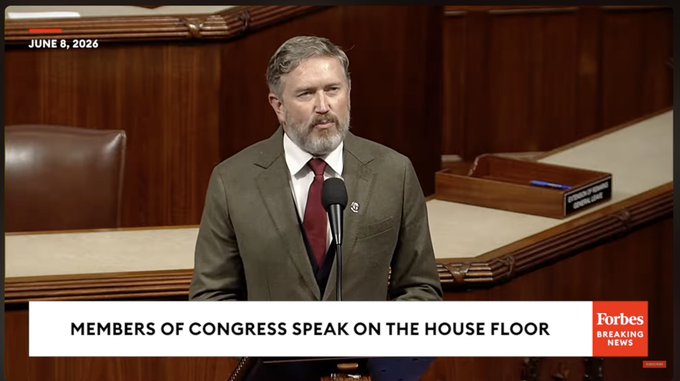
If You Wondered If President Trump’s Elimination of Rep. Thomas Massie’s Chances Of Being Re-Elected To Congress Was Ethical and Necessary, Wonder No More…

Massie, a libertarian Republican from Kentucky, emerged as a troublesome anti-Trump rebel motivated substantially by his opposition to Israel. He was defeated in an expensive Republican primary battle decided when President Trump endorsed his opponent: it was so expensive because anti-Jewish and anti-Isreal haters from both political parties gave generously to keep Massie on Capitol Hill. Among his fans are—no surprise— Al Jareeza, the Arab news agency, and ex-MAGA boob-turned-full-time-publicity-whore-Trump-basher Marjorie Taylor Greene. Marjorie, you may recall, claimed that the Rothschilds may have caused California wildfires using secret space lasers, and refused to support the bipartisan Antisemitism Awareness Bill in 2024, arguing that the measure could convict Christians for the Bible account that Jewish leaders handed Jesus over to to be crucified. I’m not a believer in guilt by association, but in the case of Marjorie Taylor Greene I could be persuaded to make an exception. Now to be fair, Massie is smarter than Marjorie.

But then so is my coffee mug.

Massie blamed AIPAC and “Zionists” for his defeat, and today, with nothing to lose, he took the House floor to deliver an alleged remembrance of the victims of the 1967 friendly fire attack by Israel on the USS Liberty during the Six-Day War. Thirty-four U.S. sailors were killed and another 171 wounded in the incident which, like the 9-11 attacks on the Twin Towers and the Pentagon, is a favorite of anti-Israel conspiracy theorists. An investigation—more than one, in fact— concluded that the tragedy was the result of mistake by Israeli forces in believing they were attacking an Egyptian ship. Israel took responsibility for the disater within hours of the incident on June 8, 1967, officially apologized and later paid millions of dollars in restitution to the families of victims and to wounded survivors.

Never mind. Anti-Semites like Taylor Greene, Massie and lots and lots of powerful Democrats are convinced that the incident was one more plot by those evil Jews.

Again, this occurred in 1967. Why would a U.S. Congressman decide that it needs to be rehashed now, in 2026? I’ll give you three guesses, and the first two don’t count. We said things like that in 1967.

Morning Ethics Warm-Up, 5/15/2018: Alito Gets One Right, Ellison Deceived, And An Ancient, Unethical Tactic Works Once Again…

To a glorious morning, Ethics-Lovers!

1. Bad Alito, Good Alito.  As I briefly noted yesterday (and hopefully will do in detail today), Justice Alito authored an unethical and embarrassing dissent defending a lawyer who deliberately betrayed his client by telling the jury that he had killed someone his client denied killing. Bad Alito. However, the arch-conservative jurist also authored the majority opinion in Murphy v. National Collegiate Athletic Association, in which the SCOTUS majority struck down a virtuous but unconstitutional law, and did so clearly and well.

These are, I think, my favorite Supreme Court opinions, where the Court ignores the motives and objectives of a law and simply rules whether the legislature is allowed to behave like that. I don’t know, but I would guess that most of the majority feel the way I do about organized sports gambling: nothing good can come of it, and a lot of harm is inevitable. One they get the green light, I’m sure that as many states will take over sports gambling for its easy revenue as now prey on its poor, desperate and stupid with their state lottery scams. Everyone involved–sports, fans, athletes, states, the public’s ethical compass—is going to be corrupted by letting the sports betting genie out of its bottle: just watch.

Nevertheless, the Professional and Amateur Sports Protection Act, a 1992  law known as PASPA, should have been struck down decades ago; I’d love to know why it took so long. No, it did NOT ban sports betting, though this is what far too many news reports tell you. Congress can ban sports betting directly if it chooses to, as it is interstate commerce. This isn’t in dispute. What it did in 1992, however, was to order states not to pass laws states have a constitutional right to pass. The distinction matters. From SCOTUS Blog, which is usually the best source for analysis of these things:

The 10th Amendment provides that, if the Constitution does not either give a power to the federal government or take that power away from the states, that power is reserved for the states or the people themselves. The Supreme Court has long interpreted this provision to bar the federal government from “commandeering” the states to enforce federal laws or policies. [The] justices ruled that a federal law that bars states from legalizing sports betting violates the anti-commandeering doctrine…

…In a decision by Justice Samuel Alito, the court began by explaining that the “anticommandeering doctrine may sound arcane, but it is simply the expression of a fundamental structural decision incorporated into the Constitution” – “the decision to withhold from Congress the power to issue orders directly to the States.” And that, the majority continued, is exactly the problem with the provision of PASPA that the state challenged, which bars states from authorizing sports gambling: It “unequivocally dictates what a state legislature may and may not do.” “It is as if,” the majority suggested, “federal officers were installed in state legislative chambers and were armed with the authority to stop legislators from voting on any offending proposals. A more direct affront to state sovereignty,” Alito concluded, “is not easy to imagine.”

…The court also rejected the argument, made by the leagues and the federal government, that the PASPA provision barring states from authorizing sports betting does not “commandeer” the states, but instead merely supersedes any state laws that conflict with the provision – a legal doctrine known as pre-emption. Pre-emption, the majority explained, “is based on a federal law that regulates the conduct of private actors,” but here “there is simply no way to understand the provision prohibiting state authorization as anything other than a direct command to the States,” which “is exactly what the anticommandeering rule does not allow.”

Got it.

Good decision. Continue reading