Rubin-Jackson Revisited: Gibbs’ Rules #6 and The Harmful Apology

Sam Rubin is no Jethro Gibbs. Unfortunately.

Sam Rubin is no Jethro Gibbs. Unfortunately.

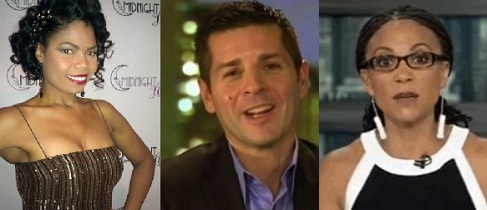
Samuel Jackson’s reckless and unjustified attack on KTLA entertainment reporter Sam Rubin (which, incredibly, continues to be misrepresented by most of the news media, internet and social media) is an excellent example of how relatively trivial incidents can teach important ethics lessons. One of those lessons I did not discuss in the previous post about this episode involves the phenomenon of the gratuitous or needless apology.

To briefly recap: Rubin’s celebrity guest, Samuel L. Jackson, falsely and obnoxiously accused Rubin of confusing him with another black actor, Laurence Fishburne, thus asserting that Rubin 1) thought all blacks looked alike 2) was impliedly a bigot or racist as a result, 3) was  unprepared  for the interview, and 4) was unprofessional and should lose his job. Rubin apologized twice, first during Jackson’s unprovoked rant (for Rubin had not confused him with Fishburne, and it was Jackson who was confused and unprepared for the interview), and later, to everyone else, after headlines that his “racist mistake” had justly provoked Jackson were being repeated everywhere. Rubin said:

“We start right now with the beauty and the occasional pain of live television. First and foremost, I do know who Samuel L. Jackson is. I’ve interviewed him several times over the years, but never quite like the conversation we just had. I indicated to Samuel that I’d seen him during the Super Bowl, and he thought that I had confused him with the commercial Laurence Fishburne had done for a car company. Of course a “Captain America” ad had also run during the Super Bowl, but I immediately felt so dumb, I didn’t bring that up — and he gave me the shellacking that was well deserved. I pride myself on the fact — that unlike a lot of people who do this kind of work — more often than not, I really do know what I’m talking about. But I didn’t 30 minutes ago, and I’m really embarrassed about it, and I very much apologize to Samuel L. Jackson and anyone else who was offended for what was a very amateur mistake.”

This kind of apology, a coerced, false apology for conduct that warrants no apology, regret or forgiveness at all, does not appear on the Ethics Alarms Apology Scale, because while it looks and sounds like an apology, it is something else entirely. The Apology Scale ranks the intent, sincerity, honesty and effectiveness of apologies for actual wrongdoing or harm. The coerced and false apology is wrongdoing that causes harm, and is the product of wrongdoing itself. Continue reading

Melissa’s Apology, Take #2: Much Better!

Melissa finally realized that this photo isn't funny.

Melissa finally realized that this photo isn’t funny.

I posted earlier about the sub-par apologies offered by the infamous MSNBC Three, who decided to indulge their hate for Mitt Romney and Republicans by ridiculing the fact that Romney’s family now includes an adopted African American infant. Either Melissa Harris-Perry got a Martin Bashir memo, or she sincerely decided that she had not adequately communicated regret for the ethically indefensible segment. What she delivered, on the air this time rather than through Twitter, arguable qualifies as a Level #1 apology [“An apology motivated by the realization that one’s past conduct was unjust, unfair, and wrong, constituting an unequivocal admission of wrongdoing as well as regret, remorse and contrition, as part of a sincere effort to make amends and seek forgiveness.”]:

“Without reservation or qualification, I apologize to the Romney family. Adults who enter into public life implicitly consent to having less privacy. But their families, and especially their children, should not be treated callously or thoughtlessly. My intention was not malicious, but I broke the ground-rule that families are off-limits. And for that I am sorry. Also, allow me to apologize to other families formed through trans-racial adoption, because I am deeply sorry that we suggested that interracial families are in any way funny or deserving of ridicule. On this program, we are dedicated to advocating for a wide diversity of families. It is one of our core principles. And I am reminded that when we are doing so, it must always be with the utmost respect. We’re genuinely appreciative of everyone who offered serious criticisms of last Sunday’s program, and I am reminded that our fiercest critics can sometimes be our best teachers.”

Harris-Perry deserves special credit for the last sentence. She didn’t have to say that, and it is an excellent point for her to make, especially on her network, where some critics have been told that someone needs to shit in their mouths. Continue reading

The Fifth Annual Ethics Alarms Awards: The Best of Ethics 2013

Ethics Story 2013

I decided to start with the Best in Ethics this year, in contrast to other years, on the theory that it would get things off to a positive start in 2014. What it did, instead, was make me realize how negative Ethics Alarms was in 2013. Either there wasn’t much positive going on in ethics, or I wasn’t seeing it. My thanks to those of you who send me nominations for Ethics Heroes (and other stories); even when I don’t write about them, they are valuable. Please keep them coming. In the meantime, I pledge to try to keep the jaundice out of my eye in 2014. Things just can’t be as dire as they seemed last year.

Could they?

Here are the 2013 Ethics Alarms Awards for the Best in Ethics:

Most Important Ethical Act of the Year:

The U.S. Supreme Court declared the Defense of Marriage Act unconstitutional, paving the way for the universal legalization of gay marriage. Yes, it was a legal decision, but it was also based, as all such culturally important decisions are, on a societal recognition that what was once thought to be wrong and immoral was, in fact, not. This is ethics, an ongoing process of enlightenment and wisdom about what is right and wrong, and the U.S. Supreme Court did its part. Continue reading

Update: Apology Scores For The MSNBC Vicious Three

deanpia

Several readers have asked for the Ethics Alarms Apology Scale scores for the three MSNBC creeps who decided to use a loving, non-political family photo featuring Mitt Romney’s newly adopted grandchild as an opportunity to sneer at the family, Mitt and the GOP, and engage in some unprovoked race-baiting. It was such an ugly display that decent human beings a) would never have engaged in it at all and b) wouldn’t have required a wave of criticism to wash over them to realize apologies were in order, but they did. Why? Because they are hateful people, unsavory and loathsome. As such, I really had decided that mucking around in MSNBC swill wasn’t worth a second post, but since you asked, here are the scores. The best apologies are in category #1…no danger of that with this sorry trio.

Apology 1: Dean Obeidallah Continue reading

The Ethics Duncehood Of WaPo Blogger Eric Wemple, And Martin Bashir’s Forced Apology For, Uh, Saying That Someone Should Defecate In Sarah Palin’s Mouth

When is an apparent #1 class apology not good enough? Well, in the case of the matter at hand, there are two reasons.

The apology in question came from Martin Bashir, who, as I mentioned in a previous post, used his MSNBC show to suggest that Sarah Palin’s overblown analogy between the financial burden on future generations created by U.S. debt and actual slavery warranted her having to submit to someone expelling excrement into her mouth, and urinating on her as well. He really did say this. On the air. Carefully and deliberately.

See? Yet suddenly, after the weekend, Bashir was contrite, and delivered as elegant and sincere-sounding apology as one could imagine:

“I wanted to take this opportunity to say sorry to Mrs. Palin and to also offer an unreserved apology to her friends and family, her supporters, our viewers, and anyone who may have heard what I said. My words were wholly unacceptable. They were neither accurate, nor fair. They were unworthy of anyone who would claim to have an interest in politics, and they have brought shame upon my friends and colleagues at this network, none of whom were responsible for the things that I said. I deeply regret what I said, and that I have learned a sober lesson in these last few days. That the politics of vitriol and destruction is a miserable place to be, and a miserable person to become. And I promise that I will take the opportunity to learn from this experience.” Continue reading

The Allen Brauer Tweets: Rendering A Sincere And Credible Apology Impossible

 Hellspawn and Public Louse, Amanda Carpenter. Nice disguise!

Hellspawn and Public Louse, Amanda Carpenter. Nice disguise!

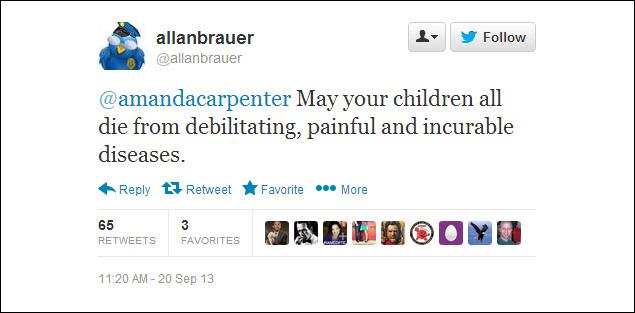
The Communications Chair for the Sacramento Democratic Party, Allan Brauer, sent a series of cruel and uncivil tweets assailing Sen. Ted Cruz aide Amanda Carpenter for her own Twitter missive cheering on GOP opposition to gun control, the President’s Syrian policy—whatever it is—and the Affordable Care Act. After some online drama, he apparently regretted his rash and hurtful words,  and sent Carpenter this apparently heartfelt apology:

“Hi- am truly sorry for my tweet. I was very upset and lashed out. Your kids are not fair game either. My apologies.”

She graciously accepted. How could anyone quarrel with this resolution of the incident?

Here is how: Brauer, who has a record of social media viciousness, made it very clear in the course of the  controversy launched by his commentary that he didn’t regret what he had said at all. Here was his first tweet:

Brauer tweet

After being swarmed by various Twitter users who protested his language and sentiments, Brauer followed up with these well-chosen and unrestrained statements to them and his Twitter followers: Continue reading

Ethical Apology Of The Month: Ryan Braun—Finally

Better late than never, Ryan...I'd almost given up on you.

Better late than never, Ryan…I’d almost given up on you.

Ryan Braun, the 2011 National League MVP who was suspended for the rest of this season for his use of illicit performance enhancing drugs and accepted that suspension without protest or appeal, has released a statement admitting steroid use and apologizing to all, including the testing sample collector whom he had earlier implicitly accused of trying to frame him with a false positive.

I think this ranks as a #1 on the Ethics Alarms Apology Scale, and we don’t see those very often from public figures. That apology is defined as…

An apology motivated by the realization that one’s past conduct was unjust, unfair, and wrong, constituting an unequivocal admission of wrongdoing as well as regret, remorse and contrition, as part of a sincere effort to make amends and seek forgiveness.

Already, critics are taking pot-shots at Braun’s statement. This is, I believe, one reason people so seldom give full apologies: they are never accepted by so many angry pundits, who pick them to pieces. Baseball fans and others in the game have a lot of reasons to be furious with Braun, it is true. His genuine apology comes late, after a terrible one, and there is probably some truth to the theory that he or his PR advisors saw an opportunity to contrast his conduct with that of Alex Rodriquez, who is continuing to deny his PED use and is forcing steroid-hating fans and players to watch him play anyway, while he appeals and collects 5 figures in compensation per at bat. Braun is no Ethics Hero, for his options were limited. Nonetheless, I see nothing to criticize in his apology, and we want to see more apologies that rank at the top of the scale, we need to applaud them when they appear.

Here is Braun’s statement: Continue reading

“How To Make An Unethical Apology” by Rev. David Brassfield, Apology Innovator

What Rev. Brassfield regards as "Christ-like"

What Rev. Brassfield regards as “Christ-like”

Apologies are fascinating, because they are so seldom honest, benign, sincere, and genuinely contrite. Rev. David Brassfield just submitted one that might serve as a classic in the category of backhanded, insincere, bilious apologies, and a useful template for high-placed jerks in search of inspiration.

Before revealing the good Reverend’s masterpiece, some background is in order. In the  wake of the deadly tornado that devastated the area around Oklahoma City,  Brassfield printed and distributed an attack on local atheist groups to parishioners  attending his Newalla Church of Christ, alleging that they proved their deficits in morality, character and community support by failing to join with various church groups in relief efforts.

He wrote in part,

“….They claim believers in God are blind and only they see the truth. But, in fact, they only see themselves. Helping others is beneath them. Ironically, they greatly resemble a religious group of Jesus’ day: the Jewish leaders, who talked a good game but did nothing. We should dread the day if those who reject God and the church Jesus built become a majority in this land. …If the “proof is in the pudding,” then those anti-God groups have left a bad taste in the world’s mouth. Thanks be to God that because of the love and sacrifice of his son, believers in God have felt compelled to come from all places to give of themselves freely.”

As Emily Litella would say, “Never mind!” The pastor was dead, dead wrong. Local atheist groups had organized, pitched in, and done their part to assist in relief efforts. A humble apology was called for. This is what Reverend produced. As usual, bolded and bracketed asides are me: Continue reading

Jonah Lehrer Shows Us A Level One Apology: Remorse, Regret, Contrition. Sincerity? Who Knows…

The-Remorse-Of-OrestesWhen we last looked in on writer Jonah Lehrer last summer, he had detonated his career and credibility with a series of incidents of serious professional misconduct that led to his ignominious firing from The New Yorker, where he once was regarded as a rising star. First he was caught plagiarizing himself, recycling a previously published work as an original  essay for the magazine. That led to an investigation showing that this was not the first time he had taken such an unethical short-cut. Finally, it was discovered that he had fabricated Bob Dylan quotes in his best-selling book about, ironically enough, creativity. When confronted about this, Lehrer lied. Soon he was out of a job and condemned to the limbo reserved for writers who deceive their readers: Jason Blair, Stephen Glass, James Frey, Janet Cooke, and others. It is not a pleasant or profitable place to be.

Lehrer was recently invited to speak to a gathering at the Knight Foundation, and chose the forum to deliver an apology for his conduct. It would be difficult, I think, to deliver a better one. On the Ethics Alarms Apology Scale, the most ethical apology, at the top of the scale, is this one:

1. An apology motivated by the realization that one’s past conduct was unjust, unfair, and wrong, constituting an unequivocal admission of wrongdoing as well as regret, remorse and contrition, as part of a sincere effort to make amends and seek forgiveness.

That is exactly what Lehrer delivered to the Knight Foundation, and through his blog, the rest of us. He said…

“..I am the author of a book on creativity that contained several fabricated Bob Dylan quotes. I committed plagiarism on my blog, taking, without credit or citation, an entire paragraph from the blog of Christian Jarrett. I also plagiarized from myself. I lied to a journalist named Michael Moynihan to cover up the Dylan fabrications.

“My mistakes have caused deep pain to those I care about. I am constantly remembering all those people I’ve hurt and let down – friends, family, colleagues. My wife, my parents, my editors. I think about all the readers I’ve disappointed, people who paid good money for my book and now don’t want it on their shelves.I have broken their trust. For that, I am profoundly sorry. It is my hope that, someday, my transgressions might be forgiven.

“I could stop here. But I am convinced that unless I talk openly about what I’ve learned so far – unless I hold myself accountable in public – then the lessons will not last. I will lose the only consolation of my failure, which is the promise that I will not fail like this again. That I might, one day, find a way to fail better.

“The lessons have arrived in phases. The first phase involved a literal reconstruction of my mistakes. I wanted to have an accounting, in my head, of how I fabricated those Dylan quotes. I wanted to understand the mechanics of every lapse, to relive all those errors that led to my disgrace. I wanted to understand so that I could explain it to people, so that I could explain it in a talk like this. So that I could say that I found the broken part and that part has a name. My arrogance. My desire for attention. My willingness to take shortcuts, provided I don’t think anyone else will notice. My carelessness, matched with an ability to excuse my carelessness away. My tendency to believe my own excuses.

“But then, once I came up with this list of flaws, and once I began to understand how these flaws led to each of my mistakes, I realized that all of my explanations changed nothing. They cannot undo what I’ve done, not even a little. A confession is not a solution. It does not restore trust. Not the trust of others and not the trust of myself. What’s more, I came to see that my explanations were distracting me from the more important reality I need to deal with.

“Because my flaws – these flaws that led to my failure – they are a basic part of me. They are as fundamental to my self as those other parts I’m not ashamed of. This is the phase that comes next, the phase I’m in now. It is the slow realization that all the apologies and regrets are just the beginning. That my harshest words will not fix me, that I cannot quickly become the person I need to be. It is finally understanding how hard it is to change.

“Character, Joan Didion wrote, is the willingness to accept responsibility for one’s own life. For too long, I did not accept responsibility. And by not accepting responsibility – by pretending that all of my errors were accidents, that my carelessness was not a choice – I kept myself from getting better. I postponed the reckoning that was needed.

“There is no secret to good decision-making. There is only the obvious truth: We either confront our mistakes and gain a little wisdom, or we don’t and remain a fool.”

You can read the whole speech here. Continue reading

When Late Is As Bad As Never: The Thalidomide Apology

Such a nice apology to the Thalidomide victims! Why no applause?

Harald Stock, Chief Executive of the Gruenenthal Group, has issued the company’s first apology and acknowledgment of responsibility for its role in manufacturing Thalidomide, the drug taken by pregnant women for nausea in the ’50’s and ’60’s. The women who took the drug, primarily in Europe, gave birth to children with deformed limbs or no limbs at all.  Stock  apologized to the surviving mothers and to their children, saying,

“We ask for forgiveness that for nearly 50 years we didn’t find a way of reaching out to you from human being to human being. We ask that you regard our long silence as a sign of the shock that your fate caused in us.”

Wow, that’s some case of shock—50 years! And the shock affected not just the executives of the company that were around when the drug was distributed without adequate testing and so-called “flipper babies” were being born in the thousands, but two generations of subsequent Gruenenthal management too. Let’s translate this apology, shall we? Continue reading