The Alabama U.S. Senate Republican Run-Off: The Worst Choice Ever [UPDATED]

And you thought having to choose between Hillary and Donald Trump was bad!

The upcoming Republican run-off for the special election to choose a successor to Alabama previous GOP Senator Jeff Sessions, now U.S. Attorney General, is as bad as it gets. Whoever wins is certain to be elected in super-red Alabama over Democrat Doug Jones, but one GOP candidate is corrupt and absurd, and the other is absurd, a fanatic and a habitual scofflaw. Both can be counted upon to immediately lower the ethical and intellectual level of the U.S. Senate, and normally I would assume that only electing a horseshoe crab or some other lower species could do the latter, while nothing short of sending Hillary Clinton back there could accomplish the former. That Alabama voters would allow their state’s seat in the U.S. Senate to depend on a run-off between these two examples of the worst of the U.S. politics bestiary doesn’t merely show that the state is backwards, it shows that its voters deserve one of these jerks. The rest of us, however, do not.

Let’s look at the two contestants, shall we? First current Senator Luther Strange, whose best feature is his name. Allow me to save you a click by re-posting a substantial section from February’s post about him:

When the Senate confirmed Jeff Sessions as U.S. Attorney General in hearings that may be best remembered as the time Elizabeth Warren earned the fawning admiration of feminists by behaving like a mean-spirited jerk, it meant that Alabama’s Republican governor got to appoint his successor. There wasn’t much discussion in the news media about who this might be, because it’s hard for journalists to inform the public properly when it is concentrating on bringing down the President, per the orders of their Eldritch Progressive Masters—sorry, I’ve got Dr. Strange stuff rattling around in my brain now—but there was some interesting speculation in Alabama.

You see,  Republican Governor Robert Bentley is fighting to avoid  impeachment as the result of a sex scandal, and one that called his honesty into question as well.

An official fired by Bentley alleged that the Governor had engaged in an extramarital affair with his senior political adviser, Rebekah Caldwell Mason. An audio recording surfaced in which Bentley told a woman named “Rebekah” that he “worr[ied] about loving you so much” and that “[w]hen I stand behind you, and I put my arms around you, and I put my hands on your breasts […] and just pull you real close. I love that, too.” At a press conference, Bentley apologized for the comments but denied having an affair and stated that his relationship with Mason was purely platonic.

Sure.

Bentley invaded the Ethics Alarms Rationalizations List, saying that  he “had made a mistake” by saying “inappropriate things” to his aide, and apologized to Mason , her family and to the people of Alabama. On April 5, 2016, an impeachment resolution against Bentley was filed in the State Legislature, which appointed a special counsel to lead an investigation into the impeachment charges. Then, in November, Alabama Attorney General Luther Strange asked that the investigation be halted pending “related work” by his office. This was widely interpreted to mean that Strange, also a Republican but not an ally of Bentley’s, was overseeing his own investigation of whether charges should be brought against Bentley.

Trump was elected President on November 8, and ten days later he announced his intention to nominate Alabama Senator Jeff Sessions as U.S. Attorney General. On December 6, 2016, Strange announced that he was a candidate for the soon to be vacant seat, meaning that he would run in the 2018 election, if he wasn’t appointed to fill the vacancy by Bentley.

With the wolves gathering at  his door, however, that’s exactly what Gov. Bentley did. He appointed the man who was overseeing his current impeachment investigation to the U.S. Senate, thus creating a vacancy in the Attorney General’s post. Then he appointed a new AG named Steve Marshall (no relation), who many doubt will vigorously pursue an indictment against the governor.

Can you say, “Appearance of impropriety”?

I can’t imagine a better example of how the law can’t anticipate everything, making ethics indispensable.   There is an Alabama law prohibiting a governor from appointing himself to fill a U.S. Senate vacancy, but nobody foresaw a situation where a governor facing impeachment would interfere with the investigation by appointing a political adversary and the Attorney General overseeing the investigation to fill the slot. This is entirely legal, and spectacularly unethical.

Some in the state wonder if Strange’s request to the legislature wasn’t part of a deal with the Governor, in anticipation of a Sessions departure.  “He definitely slowed down the impeachment process, which put the governor in a place to actually appoint him. That’s the problem we have,” said Ed Henry, the legislator who brought the original  impeachment motion to a vote.  “He stopped an impeachment process and then in turn accepted the nomination to the Senate. I believe the damage is already done.”

For this to have been a pre-arranged  quid pro quo would have required that Strange and Bentley both believe that Trump would win, however. Hmmmm. Maybe they were in league with the Russians too…?

Yet it requires no conspiracy theory to conclude that for Strange to accept Bentley’s appointment makes him complicit in a sequence of events  that appears corrupt. It is too redolent of the Roland Burris affair, when now jailed former Illinois governor Rod Blagojavich was caught selling a Senate appointment. Burris swore in an affidavit  that he had no contact with the governor prior to his appointment to a Senate seat he had no qualifications for, and then as soon as he was safely on office, suddenly remembered that he had met with “Blago.”

The newly minted Senator Strange, had he been an ethics hero—and shouldn’t we be able to expect our elected officials to be ethics heroes?—could have foiled Bentley, inspired Alabamans, and proved that he would be a worthy Senator when he ran in 2018, if he had simply turned down the appointment, saying,

‘I am grateful and honored that Governor Bentley felt that I was qualified to represent the citizen of Alabama in the U.S. Senate. However, I feel I would betray the trust of those same citizens if I were to accept the post under these circumstances. As the lawyer for the people, I am obligated to undertake and oversee a fair and objective investigation of serious allegations against the Governor, and this raised a conflict of interest for me, pitting my personal political ambition against my duties in my current position. Moreover, should I accept the Governor’s offer, it would raise doubts regarding the functioning of the legal system as well as my personal integrity. Therefore I must decline the appointment.’

Nah.

Now, however, the Senator has proven himself unworthy of his new job by accepting it.

Strange!

Now normally I would say that anyone—Kathy Griffin, Jimmy Kimmel, Dormammu—is a preferable U.S. Senate choice than this shameless, ambitious hack. Roy Moore, however, is a piece of work. The one-time kickboxer and full time fundamentalist Christian fanatic first warranted Ethics Alarms notice as an Incompetent Elected Official in 2014, and his recognition came that late only because I viewed his stand-off over displaying the Ten Commandments in his court room and trying to turn Alabama justice into a theocracy too ridiculous to write about (and Ethics Alarms didn’t exist then.) Continue reading

Morning Ethics Warm-Up, 9/16/17: Amazon Purges Reviews For Hillary, Equifax Must Die, Making Literature More Diverse, And The Red Sox Get Away With It…

GOOD MORNING!

1 “It would be wonderful, wouldn’t it?”

This is the response that the widow of writer Roald Dahl to a reporter’s suggestion that Charlie, the hero of Dahl’s “Charlie and the Chocolate Factory” (aka “Willy Wonka and the Chocolate Factory:) should be made black in a future “reworking” of the book. Recently Mrs. Dahl has claimed that Charlie was originally supposed to be black, but that her husband changed the character before the book was published. She blames his agent, who was, she says (none of this is more than hearsay) afraid that the book wouldn’t sell as well in American with a black hero. She blames “American sensibility.”

No, it wouldn’t be wonderful to start changing the races (and inevitably, genders and sexual orientations) in “reworkings” of literary classics. It would be unethical and irresponsible, as well as a defilement of the author’s visions and creations. Whatever the reason was, and we cannot know it regardless of what Mrs. Dahl now claims, Charlie was white in Dahl’s book. If he had wanted his book to be about a black child, or a little girl, or a Muslim transsexual, the author would have made it so. If someone obsessed with tribal identity politics wants to write a new adaptation under their own name so we can jeer and mock him or her, swell. But it isn’t any more “wonderful” to “rework” Dahl’s own story this way than it is to make Bob Cratchit black, or Captain Ahab black, or Bigger Thomas in “Native Son” Asian-American.

Of course, a stage or film adaptation of the book can cast it any way it chooses.

2 The major business ethics story this past week has been that data security breach by credit giant Equifax. An estimated 143 million Americans now face identity theft for the rest of their lives because the company wasn’t competent to be in the business it was in. It’s that simple. The ways in which Equifax blundered into allowing all this data to be hacked are legion, with more revelations almost daily. My personal favorite is that it neglected to install a patch that would have made its files more secure, delaying for months for no good reason.

Business analysts point out that despite this massive demonstration of ineptitude, the company is not likely to suffer more than the cost and inconvenience of a class action lawsuit or five. The companies that pay Equifax weren’t harmed by the breach, just the lives of the credit-seekers who they use Equifax to check. Nobody seems to think that even this massive misconduct will put Equifax out of business.

The company has dumped some executives, and will probably dump some more, reorganize, and padlock that barn door securely now that the horse has fled. TooLate. The company is untrustworthy, and more than that, companies like Equifax that gather personal information about innocent citizens need to be scared sick about what will happen to them if they can’t keep the information from falling into malign hands. Equifax needs to be put out of business. Its leaders and management need to be imprisoned, fined so severely that they are reduced to eating cat food, or blacklisted so their future employment is limited to bait shops and traveling carnivals. Continue reading

Were AG Sessions’ Comments In Las Vegas Unethical?

Ethics Scout Fred points me to a little noted episode in the increasingly fraught existence of Attorney General Jeff Sessions, and asks whether the AG’s comments crossed ethical lines.

Let’s see…

During a speech about two weeks ago in Las Vegas in which he called for harsher prosecution of criminals and cooperation from local authorities as the federal government cracks down on illegal immigration, Sessions segued to the Cliven Bundy prosecution, and said, cryptically, of Nevada Acting U.S. Attorney Steven Myhre,

“I’ve got to tell you, it’s impressive when you have a tough case, a controversial case, and you’ve got the top guy leading the battle, going to court, standing up and defending the office and the principles of the law. I’m not taking sides or commenting on the case. Just want to say that leadership requires, a lot of times, our people to step up and be accountable.”

Supporters of the Bundy-led armed stand-off with federal authorities think that the Trump administration may sympathize with their anti-government stance, but Trump administration prosecutors are still seeking penalties for Bundy and his group.

Fred notes that “while Sessions is not responsible for how others take what he says, at least no more than any public speaker,  the effect of his remarks was to encourage lawbreakers,” based on the statement by Ashley Jones, a producer for radio show host Pete Santilli. Santili, a Bundy ally, is incarcerated pending trial in the case. Jones pronounced Sessions’ comments “a victory for us.”

Comments: Continue reading

Morning Ethics Warm-Up: 7/3/17

Good Morning!

1. “He was right, dead right, as he sped along, but he’s just as dead as if he were wrong.” This was a refrain (from an actual epitaph) my Dad used to recite to hammer the principle into my head: being right is often not enough. I wonder if Chris Christie ever heard it? The Governor of New Jersey is vacationing with his family at a state beach he closed to the public , along with all state parks, as a result of a budget stand-off with the legislature. Technically and legally, he has every right to do this, since governors of the state have the use of a residence on that beach, and the detail that watches it when the Governor is in residence is not affected  by the government shut-down. Christie, in his trademark blunt manner, has responded to criticism by saying, in essence, “I’m governor and you’re not.” He’s right that he’s not taking a special privilege by using his residence when the beach is closed to the public. He’s right that he has no alternative to closing government services when the legislature doesn’t meet the statutory mandate for approving a budget. It doesn’t matter: he also has a duty to preserve trust in the government and democracy. His vacation in a place that he’s made off-limits to the public, no matter what the justification, has the appearance of impropriety, and more than an appearance of arrogance and a broken ethics alarm.

2. The big story yesterday—I can’t believe I’m writing this—was the President tweeting a silly tricked-out video purporting to show him wrestling CNN. This was, to anyone not determined, due to a near fatal level of confirmation bias and the Trump Hate Brain And Conscience Eating Amoeba, to interpret every word and act by this President as evidence of evil, a joke. Sure, it was also gloating, and trolling, and sophomoric, and unpresidential but the long, long list of talking heads and pundits who solemnly pronounced  this foolishness as “advocating violence against journalists” all revealed themselves as untrustworthy, dishonest, or hysterical. This kind of incompetent reaction is why Trump keeps doing this.

Our broken news media will have to be torn down before it can be restored to the objective and non-partisan institution a healthy democracy has to have to survive. If President Trump’s japery accomplishes this—I would prefer journalism to come to its senses internally, but that clearly is not going to happen—that’s a rich silver lining to the cloud of his Presidency. Continue reading

Responsible And Necessary: The Appointment Of A Special Counsel

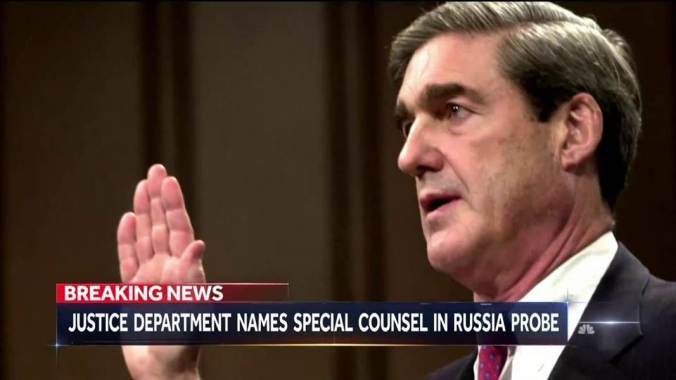
The Justice Department appointed Robert S. Mueller III (above), a former F.B.I. director, as special counsel to handle the Russia probe.

I am reading conservative pundits fuming over this development for a number of reasons, some of them valid and troubling. However, there is no good argument to be made that a Special Counsel isn’t necessary now.

Assistant Attorney General Rod Rosenstein explained his decision to make the appointment (remember, he is acting AG in the Russian investigation, because Jeff Sessions was bullied and hectored into recusing himself, also unavoidable):

“In my capacity as acting Attorney General, I determined that it is in the public interest for me to exercise my authority and appoint a Special Counsel to assume responsibility for this matter.My decision is not a finding that crimes have been committed or that any prosecution is warranted. I have made no such determination. What I have determined is that based upon the unique circumstances, the public interest requires me to place this investigation under the authority of a person who exercises a degree of independence from the normal chain of command.”

Exactly. As for the last sentence, President Trump has no one to blame but himself. His own, typical, blundering, blathering ways created this atmosphere—that and “Deep State” leaks calculated to undermine him, and a news media feasting on those leaks like sharks on chum.

It is being argued that you can’t appoint a special prosecutor unless there is a finding that crimes have been committed. Here are the relevant sections of the law:

§ 600.1 Grounds for appointing a Special Counsel.

The Attorney General, or in cases in which the Attorney General is recused, the Acting Attorney General, will appoint a Special Counsel when he or she determines that criminal investigation of a person or matter is warranted and –

(a) That investigation or prosecution of that person or matter by a United States Attorney’s Office or litigating Division of the Department of Justice would present a conflict of interest for the Department or other extraordinary circumstances; and

(b) That under the circumstances, it would be in the public interest to appoint an outside Special Counsel to assume responsibility for the matter.

§ 600.2 Alternatives available to the Attorney General.

When matters are brought to the attention of the Attorney General that might warrant consideration of appointment of a Special Counsel, the Attorney General may:

(a) Appoint a Special Counsel;

(b) Direct that an initial investigation, consisting of such factual inquiry or legal research as the Attorney General deems appropriate, be conducted in order to better inform the decision; or

(c) Conclude that under the circumstances of the matter, the public interest would not be served by removing the investigation from the normal processes of the Department, and that the appropriate component of the Department should handle the matter. If the Attorney General reaches this conclusion, he or she may direct that appropriate steps be taken to mitigate any conflicts of interest, such as recusal of particular officials.

I don’t read the law so narrowly. The law requires that there be a determination that a criminal investigation is warranted, not that crimes have been committed. Continue reading

Ethics Q & A On Obama’s Speaking Fees

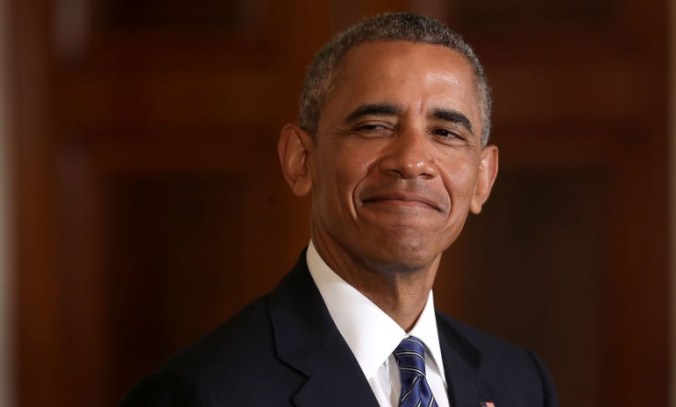
Former President Barack Obama received a $400,000 speaking fee for an appearance at an A&E Network event  yesterday, just as controversy was building over Obama accepting the same fee to appear at a Wall Street firm’s conference.

What’s going on here?

The ex-President is cashing in, that’s what’s going on here. This has become standard operating procedure for former POTUSes, beginning with Gerald Ford, who was showered with criticism by Democrats and the news media for signing with the William Morris agency and picking up what was at the time considered obscene speaking fees from corporations and foreign governments. Ford’s fees are dwarfed by Obama’s, but then Barack is a much better speaker than the late President Ford was. (Almost anyone is.)

Jimmy Carter showed admirable restraint by not devoting his post-Presidency to enriching himself off of his years in office, but Ronald Reagan took some mega-fees to speak abroad. The Clintons, as we know too well, instantly went from rags to riches by selling their celebrity, an exercise that was especially dubious because Hillary was on the rise. Obama’s speaking fees are just one more step along the cashing-in path that both he and Michelle had already begun traveling with the astounding 65 million dollar deal the couple signed to write their biographies.

Some questions and answers on the ethics of Obama’s payday:

1.  Is Obama ‘s acceptance of all this money ethical?

In a vacuum, it’s hard to argue that it isn’t. He set a fee, and someone is willing to pay it. Hillary’s fee was $250,000; if she can get that much for her dry-as-toast delivery as a former Senator, Secretary of State and First Lady, Obama’s a bargain at $400,000. As a private citizen, he has the same right any of us do to sell his books and speeches at whatever the market will bear.

I, for example, get $37.56 for an hour long speech, and am glad to get it..

2. But it isn’t in a vacuum, right?

Right. Obama still has power and influence; he still promises to be a voice in the Democratic party. He’s not exactly a private citizen, and no ex-President is. Taking such a large payment from a Wall Street firm, after all of Obama’s rhetoric (and that of Bernie Sanders, the non-Democrat now being paraded as a leader of the Democratic party) condemning Wall Street has the decided whiff of hypocrisy about it. Not only, that, but as with Hillary Clinton and Bill, the payment of such jaw-dropping amounts for minimal service natural raises questions of pay-offs. Obama’s administration famously sought no criminal sanctions for Wall Street executives despite their  role in what Obama called “driving the economy into a ditch.” How do we know this wasn’t part of an installment payment to Obama for services already rendered, a quid pro quo? We don’t.

It is also hard to make sense out of those fees if they aren’t paying for something more than an hour long speech.

3. So these fees create “the appearance of impropriety?” Continue reading

Comment Of The Day: “Ethics Dunce, Judicial Division: Arkansas Circuit Judge Wendell Griffen”

The post about the absurd Arkansas judge who saw nothing wrong with taking part in some anti-death penalty protest theater shortly after halting some scheduled executions. Can we say “objectivity”? Sure we can!

The impetus for Steve-O-in NJ’s Comment of the Day was what could be called dicta in the original post about the dubious role models for judicial conduct currently sitting on the U.S. Supreme Court.

Here is Steve-O-in-NJ’s Comment of the Day on the post, Ethics Dunce, Judicial Division: Arkansas Circuit Judge Wendell Griffen:

I agree that SCOTUS needs an ethics code, but, in all fairness, did Eisenhower, Kennedy, Johnson, or Nixon ever attack the SCOTUS or a decision in a speech or an address? FDR was far more politically powerful than Obama ever could hope to be, but even he knew when to back off the SCOTUS. That said, I wonder if he knew from the get-go he was going to break the 2-term tradition and just wait the court out, as justices either died or retired and he replaced them with like-minded judges.

What do you think of an age limit for Federal judges, setting either 70 or 75 as a mandatory retirement age? Although Article III judges serve for the term of their good behavior, arguably that Article didn’t conceive of Federal Judges living well past 70 regularly and living and serving into their 80s and 90s uncommon but now certainly not unheard of. If we can revisit Presidential terms of office, which we already have, if we can revisit the Electoral College, which we already have once and some are asking us to again, and if many vocally want us to revisit both the First and especially the Second Amendments, all of these due to changing circumstances (breach of the 2-term custom, the emergence of political parties, alleged hate speech, and the evolution of firearms beyond single shot muskets) then arguably we can revisit Article III as well.

Continue reading

Ethics Dunce, Judicial Division: Arkansas Circuit Judge Wendell Griffen


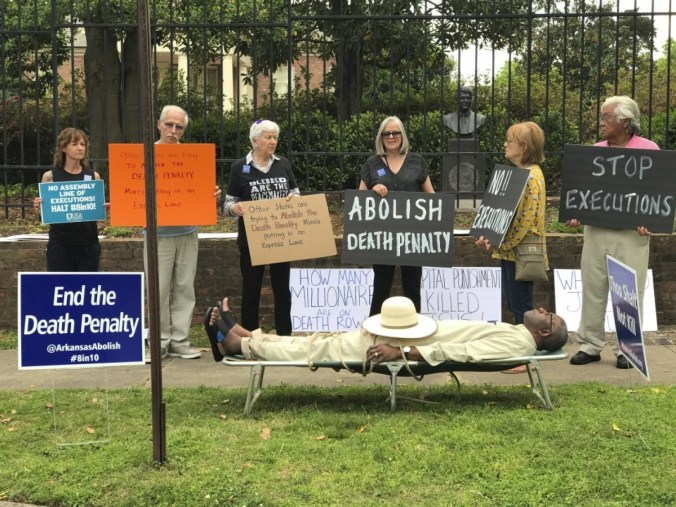
That’s the judge lying down. At least he wasn’t wearing his robe…

Arkansas circuit judge Wendell Griffen granted a temporary restraining order last week halting the Arkansas Department of Corrections from executing seven condemned prisoners within eleven days as it had planned, as Griffen barred the use of one of the ingredients in the lethal drug “cocktail.” A federal judge followed up quickly with anothee order likewise barring Arkansas from proceeding to execute anyone with a lethal injection. Mission accomplished,  Judge Griffen decided to reward himself by attending an anti-death penalty rally in which he participated with elan, playing a condemned prisoner lying prone on a lawn chair as if it was a gurney.

What fun! And what an idiot! No ethics alarms went off, despite the fact that he was flagrantly displaying his bias against the death penalty immediately after interfering with the state’s law enforcement based on a fair and objective interpretation of the law.

State officials were outraged, and argued that Griffen’s conduct proved that he was not capable of impartiality in capital cases. Ya think?

Yesterday the Arkansas Supreme Court pulled Griffen from all pending death penalty and lethal injection protocol cases. It also referred him to the state’s Judicial Discipline and Disability Commission to determine whether he violated the Code of Judicial Conduct.

Good. Continue reading

Ethics Dunce: Treasury Secretary Steve Mnuchin


Treasury Secretary Steve Mnuchin has pledged “not participate personally and substantially in any matter that has a direct and predictable effect on the financial interests” of his financial holdings, without obtaining an official waiver for doing so. He also had advance notice of how a Trump administration figure could breach ethics rules when Kellyanne Conway, in the course of criticizing organized boycotts of First Daughter Ivanka Trump’s merchandise line, blurted out  “Go buy Ivanka’s stuff!” during an interview on “Fox & Friends.”  The Office of Government Ethics and members of   the House Oversight Committee urged disciplinary action for Conway’s clear, if probably inadvertent, ethics violation. (None occurred. It should have.)

Never mind. During a C-Span broadcast interview last week, Secretary Mnuchin was asked for a movie recommendation (this was a set-up, but an easy one to duck), and said,

“I’m not allowed to promote anything that I’m involved in. So I just want to have the legal disclosure, you’ve asked me the question, and I am not promoting any product. But you should send all your kids to ‘Lego Batman.’ “

HAHAHAHAHA!!! ‘I’m not supposed to do this because it’s unethical, but I’ll do it anyway, because ethics rules are silly, the President doesn’t care about them, and besides, Kellyanne got away with it, and so will I!’ Continue reading

Ethics Quote Of The Day: Charlotte Hogg, Ex-Bank of England COO

“However, I recognise that being sorry is not enough. We, as public servants, should not merely meet but exceed the standards we expect of others. Failure to do so risks undermining the public’s trust in us, something we cannot let happen. Furthermore, my integrity has, I believe, never been questioned throughout my career. I cannot allow that to change now. I am therefore resigning from my position. I will, of course, work with you through any transition.”

—-The Bank of England’s chief operating officer and incoming Deputy Governor for Markets and Banking, Charlotte Hogg, in her letter of resignation over criticism regarding a possible conflict of interest and her failure to report it.

Charlotte Hogg, a senior Bank of England official who had been named a deputy governor, resigned this week after a Parliament committee found that she had failed to disclose a potential conflict of interest: her brother held a senior position at Barclay’s during her time at the central bank. Hogg insisted that she never breached her duties or passed along any confidential information to her brother, but she had helped draft an industry ethics code of conduct policy required a disclosure of such conflicts. This creates doubts about her integrity, judgment competence, as well as the appearance of impropriety.

The Parliamentary committee recently issued a report finding that Ms. Hogg’s professional competence “short of the very high standards” required to be deputy governor, adding that her failure to disclose her brother’s role was a “serious error of judgment.”

This is one of my favorite kinds of conflicts, because it may be only appearances at stake. What if, as is often the case (sadly), Hogg and her brother are estranged? What if she doesn’t speak to him? What if they hate each other? Never mind: the public, not knowing this,  will suspect that she might use her position to favor him or his bank, so disclosure is crucial to maintaining public trust. Not disclosing, in contrast, raises suspicions. Why didn’t she let everyone know about her brother? What was she hiding? Continue reading