Here is a controversy that I was completely ignorant of, and I am embarrassed to admit it.
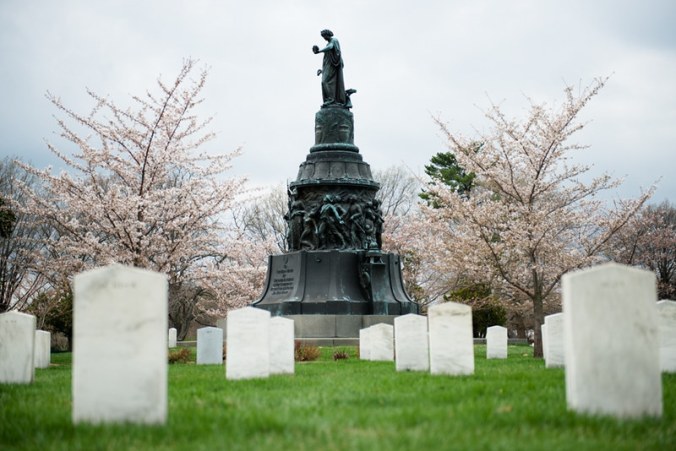
One more bi-product of the George Floyd Freakout, ‘The Great Stupid’ that has washed over the land like the Great Molasses Flood of 1919, and the Stalin-esque attempt to airbrush American history, including the toppling of statues honoring certain distinguished Americans who were not sufficiently psychic to absorb the lessons and accumulated ethics wisdom of those with the advantage of a century or more additional history and human experience, was the Naming Commission, established by the 2021 National Defense Authorization Act in the throes of all of the above malign influences. It’s official mission is to recommend removal of “all names, symbols, displays, monuments, and paraphernalia that honor or commemorate the Confederate States of America.” The Commission extended its reach to the Reconciliation Monument at Arlington National Cemetery, which is located in the special section known as Section 16. The monument, which you see above, is scheduled to come down.
Of all the many times I have visited Arlington—my father and mother are buried there, also my grandfather, and Dad loved to take me on tours of the place as he checked out his future residence, especially when he was taking part in the annual Battle of the Bulge veterans ceremonies—I never saw this section. It has a fascinating history.
Arlington was established as a burial ground for the Union military dead. Indeed, Montgomery Meigs, the Quartermaster General of the U.S. Army who was responsible for the burial of soldiers, ordered Robert E. Lee’s Arlington estate to be turned into a cemetery so Lee could never return there. Meigs had his son, an early casualty of the war, buried literally on the Confederate leader’s doorstep as a statement of contempt and defiance. No Rebel combatants were permitted on the sacred grounds.
However President William McKinley, himself a Medal of Honor recipient for his heroism at the Battle of Antietam, announced that the U.S. government would commit to honoring the Confederate dead, saying in a speech in Atlanta that “sectional feelings no longer holds back the love we feel for each other. The old flag waves over us in peace with new glories.” Congress authorized Confederate remains to be buried at Arlington National Cemetery in 1900, and in 1906, the construction of a monument was commissioned to represent the nation’s acceptance of the Confederacy back into the nation, healing of the deep wounds of civil war. 1903 saw President Theodore Roosevelt send a floral arrangement to the Section 16 to commemorate Confederate Memorial Day, and began a tradition that has been regularly observed since, with President Obama expanding the practice to laying two floral wreaths, one at the Confederate Memorial, the other at Washington, D.C.’s African American Civil War Memorial.
This week the Republican Congress has sent a letter of protest to the Defense Department, demanding that preparations to remove the monument cease, and pointing out that the purpose of the memorial is not to honor the Confederacy, but to stand for national unity, reconciliation, and peace.
Your Ethics Alarms Ethics Quiz of the Day is…
Should the Reconciliation Memorial be removed along with the remains of the Confederate soldiers buried in Section 16?
Continue reading →

 Ethics Alarms