The Anti-Smoking Zealots Go To A Show

…and it really looks cool in the stage lights!

Once again I am embroiled in a battle with bullies, in this case bullies whose motivation I support, but whose application, attitudes and methods I both oppose and despise. The bullies are the anti-smoking zealots. I am very happy with the culture’s success in discouraging smoking, and most of the government’s efforts to make smoking expensive and difficult, though I would support the U.S. being straightforward and just banning tobacco products. The bullies, however, buy tickets to the theater company that employs me as its artistic director, and that theater produces only written or about the 20th Century, especially the middle of it, when people smoked a lot. This often requires some smoking on stage, at the discretion of the director and the requirements of the plot. Whenever this happens, I catch hell. And I give it right back. Continue reading

Ethics Dunce: The Internal Revenue Service

Question:

What is the monetary value of something that can’t be sold?

Answer:

Nothing.

That’s an easy one.

So why is the IRS claiming that the heirs of the New York art dealer Ileana Sonnabend  owe $29.2 million in taxes on an art work that U.S. prevents from ever being converted into cash? Continue reading

The Beautiful Lie!

Irony! Stupidity! Symmetry!  Elegance! Chutzpah! Redundancy!

Ahhhhh! Breathtaking!

Yes, this amazing lie, by the California State University System, has it all. This is the Sistine Chapel of lies, the Mona Lisa of mendacity, a true masterpiece of the liar’s art.

Consider…this is “Sunshine Week,” the annual campaign to raise awareness about the essential nature of open, honest and transparent government. So to celebrate,  CSU’s  public affairs office falsely announced on Monday that it had won the 2012 Sunshine Award for most transparent government website in the nation. It had not. It isn’t even eligible to win such an award.

Sunshine Review, the national nonprofit organization that sponsors the annual awards, has confirmed that this would be impossible, since they “do not grade state universities or colleges at this time, so it would be impossible for Cal State to have won an award.” Sure enough, the system is not included on the list of winners available online.

Why would the university system of the Sunshine State lie about receiving the Sunshine Award from the Sunshine Review, and do it on Sunshine Week, no less?  Clearly, this was a once-in-a-lifetime opportunity to good to pass up. It may be unethical, but in the annals of lying, it’s beautiful!

[Thanks to James Taranto for the tip.]

Photography Ethics on Trial

Two photography technology ethics cases erupted this week.

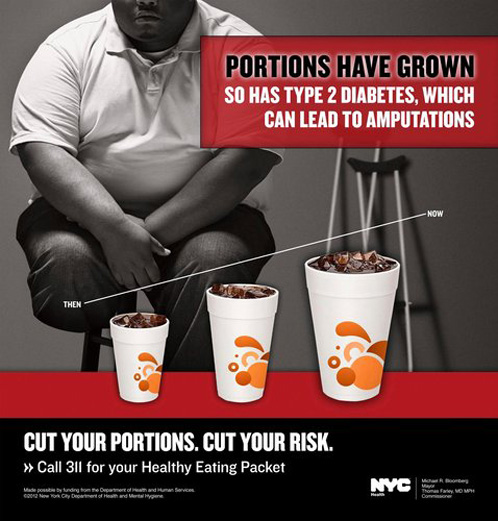
The Case of the Fake Amputee: A recently unveiled New York public health campaign warning against Type 2 diabetes uses a photo of an overweight man who is missing his leg.  The man, however, had both legs when the photo was taken. One was digitally removed to make it appear that his right leg had been amputated. The American Beverage Association, fighting the city’s efforts to reduce consumption of sweetened soft drinks and fast food, seized on the photo to press its case. “Clearly, the straight facts don’t support their singular attacks on our products, so they keep falling back on distortions and scare tactics that are over the top,” association spokesman Chris Gindlesperger said in a statement. “That’s disappointing.”  Well, diabetes does increase the risks of amputations, and a fake amputee is no more scary than a real amputee. Real amputees do exist; having a graphically-created one doesn’t change the accuracy of the ad’s message one bit. What does the association’s argument have to do with the photo-manipulation? Nothing. Continue reading

Standards of Decency: Where Ethics Belongs, and Law Does Not

If this is the Super Bowl half-time show, will the FCC fine the network?

Slate legal columnist Dahlia Lithwick drives me crazy on a regular basis, but she hit a home run with her tongue-in-cheek account of the oral argument before the Supreme Court regarding the constitutionality of the Federal Communications Commission’s indecency policy, which has broadcast networks shivering in their boots over the possibility of another “wardrobe malfunction” at the Super Bowl or another trash-mouth star saying “fuck” as she picks up an Academy Award. The particular topic before SCOTUS was momentary nudity in TV drama, such as walrus-like actor Dennis Franz’s mega-butt flashing by our horrified eyes on “NYPD Blue.” In an Ethics Hero-worthy moment, attorney Seth Waxman, representing ABC, showed the Court how absurd and arbitrary it is to try to regulate taste and decorum in art. Lithwick writes: Continue reading

Now Here’s A Terrible Idea: Mandated Disclosures for Photoshopped Images of Celebrities!

And if you look real closely at the lower left corner, you'll read, "The model for Venus was a short, middle-aged bald man named Gino. His appearance was altered by the painter in the creation of this painting."

Here is another candidate for enshrinement in the Pantheon of Well- Intentioned But Terrible Ideas.

In an article published Monday in the journal “Proceedings of the National Academy of Sciences,” Dartmouth researchers Hany Farid, a professor of computer science, and Eric Kee, a doctoral student, propose a rating system of publicly displayed photographs of models, actors and celebrities to let viewers know exactly how and how much an image has been altered by photoshopping, airbrushing or other means.

“Impossibly thin, tall, and wrinkle- and blemish-free models are routinely splashed onto billboards, advertisements and magazine covers,” the two write. “The ubiquity of these unrealistic and highly idealized images has been linked to eating disorders and body-image dissatisfaction in men, women, and children.” In the interest of limiting the damage caused by unrealistic images of human beauty, the researchers argue that graphic images should include labels that disclose  “geometric adjustments” such as slimming legs, hips and arms, as well as adjusting facial symmetry—reducing a nose in size, or slightly enlarging eyes.  Users of such photos should also flag photometric adjustments that change the appearance of skin tone, blemishes and texture, such as wrinkles, dark circles under the eyes or cellulite, say the researchers.

Please, for the love of God, nobody introduce these guys to Sarah Deming and her lawyer, who are suing the distributers of the film “Drive” because the trailer was more exciting than the movie. And let us all remember this proposal when we are tempted to pooh-pooh accusations that the government is regulating creativity, commerce, art and enterprise right out of existence, and with them, individual liberty as well.The tea parties should use Farid and Kee’s article for recruitment. Continue reading

Hitler’s Paintings, Dirty Money, and an Ethics Quiz

A Hitler masterpiece during the artist's controversial "Care Bears" period

As readers here probably know, I don’t do much commentary on Swedish ethics, but this intriguing story touches on a couple of Ethics Alarms topics of continuing interest: so-called dirty money and political correctness.

Sweden’s debt collection agency had planned to sell seven paintings by that noted 20th Century artist Adolf Hitler to bring the government some extra cash to pay off debts. A genuine Hitler can fetch $40,000 or more on the global art market. The intended sale never happened, because the agency concluded that the paintings were fakes, but never mind: what is ethically provocative is that Stockholm’s Jewish association protested that it would be morally offensive for the government to make money off of Hitler’s artistic labors. “It is symbolically unfortunate that people earn money on these items,” said the group’s spokesperson. Continue reading

Henry James, Mis-Matched Neighbors and the Naked Silhouette

Like most people, I grew up being told that it was dangerous to hitch-hike, because of the many predatory drivers waiting to pounce, and also never to pick up hitch-hikers, because some of them were serial killers. I always seemed to me that the odds favored an eventual convergence in which a psychopathic motorist picked up a murderous hitch-hiker. I wonder what happens then.

Neighbor disputes are often like this: pure chance places very different  people side-by-side, one an inconsiderate boor, and the other an intolerant jerk. We know what happens then: exactly what has happened in Great Falls, Montana.

Brian Smith objects to the large decal on neighbor Shanna Weaver’s car. The decal portrays a white silhouette of a naked woman. To him, it’s pornography, and he objects to have to look at it.  “My upbringing dictates that the human body is a sacred thing, not something that should be put on display,” Smith said. Weaver, however, is not inclined to remove it. “It’s my freedom of speech, which he can’t take away,” Weaver says. “It’s no different than the mud flaps that you see on trucks.”So Smith filed a complaint against Weaver for violating the local anti-pornography ordinance, which was a stretch. [In an earlier version of this post, it wa stated that Weaver sued him for harassment, and was thrown out of court. That was in error, and Ethics Alarms apologizes for its mistake.] Continue reading

Civility, Stupidity, Art, and “The King’s Speech”

"Frankly, my dear, I don't!" (United Airlines version)

I was stunned and amazed to find that United Airlines was uncharacteristically showing a good movie on my six-hour flight, the Academy Award-winning “The King’s Speech.”

Good, and in the case of “The King’s Speech,” arguably great, movies, however, are owed some respect.  If United is going to show it, United has an obligation to be fair to the film and fair to its audience by not showing it in a manner that diminishes the movie’s quality or the audience’s enjoyment. Thus I was also stunned and amazed when the famous sequence in which the Duke of York, soon to be King George VI, angrily demonstrates that he does not stammer when swearing by shouting “Fuck!” repeatedly, was mangled by United’s language police. Continue reading

Ethics Dunce and Apologist for Cultural Rot: New York’s 92nd Street Y

Complete cultural and intellectual rot in America gets ever closer, thanks to people who think and act like the honchos at New York’s 92nd Street Y.

It sponsored an evening of conversation between art critic and New York Times Magazine writer Deborah Solomon and Steve Martin, who is many things: a comedy writer, a wit, a banjo player, a slapstick comic, a serious actor, a novelist and a playwright. (Also a second-rate Inspector Clouseau.)  In this case, it was the novelist Martin who had come to chat; Martin’s new novel, An Object of Beauty, has just hit the book stores to rave reviews. But the sold-out audience of 900 and pay-per-view television audience apparently didn’t want or expect to hear THAT Steve Martin…they wanted the one with the arrow through his head and “happy feet.” So many of them complained, some in e-mails send during the event, and after the subdued and erudite session was over, that the Y sent them refunds, with this note: Continue reading