Morning Ethics Warm-Up, 3/20/18: Life, Death, Fairness, Dissonance And Sanity

1 Let’s see more of such Ethics Heroes, please… In Upper St. Clair, Pennsylvania,  John Orsini, has gone to court to stop his ex-wife from allowing their son, 17-year-old Antonio, from playing high school football in his senior year. Antonio has already suffered at least three concussions. Antonio’s mother and John’s ex-wife, Janice, says that her son understands the risks, and that doctors have OK’d his continued play.

But he doesn’t understand the risks—apparently neither do those doctors—and he is considered a minor under the law because teenagers are prone to poor reasoning and impulsive decisions…especially when they have incipient brain damage.

CNN is eager to hear his position on gun control though. But I digress..

Says the CBS news story: “John contends that after these concussions and sub-concussive hits, medical research shows that Antonio would be in grave danger if he continues to play football.” He contends? There is no contention: that is fact.

“I’m trying to save his future. I’m trying to save his life,” he said of his son.

Janice and her attorney issued a statement, saying in part,

“The mother and her 17-year-old son have reasonably relied upon the input and opinions of his treating physicians and medical providers, and have considered the state mandated safety and concussion protocols followed by the school district, in deciding whether it was appropriate for him to continue to participate in football.”

John believes the court will side with him.  “If you have a significant indication that the child is being placed in harm’s way, and it’s brought to court to protect the child, it’s the court obligation to do so,” he says. I wouldn’t be so sure. This is football country, and football fanatics are in denial. They’ll get thousands of children’s brains injured before they are through.

“I’m hopeful that my son will just go on, get a good education and lead a healthy life. That’s all I want,” said John, whose other two sons no longer speak to him over this conflict.

Good luck.

Let’s hope Anthony is given then chance to grow smarter than his mother.

2. Let’s see, which Trump Derangement news media story should I post today? Every day, every single day, I have literally dozens of biased, vicious, stupid, unprofessional and blatantly partisan mainstream media news reports and pundit excesses to flag as unethical. Here, for example, is a New York Times columnists advocating for Rex Tillerson to betray all professional ethics, confidentiality, trust and responsibility by revealing everything he heard or saw as Secretary of State that could undermine Trump’s administration. It’s called, “Burn it down, Rex.”

Let me repeat: for journalists to set out to intentionally poison public opinion against the elected President of the United States by manipulation and hostile reporting is unethical and dangerous. This conduct has been the single largest ethics breach in the culture for more than a year, and one of the worst in U.S. history. In strenuously condemning journalism’s abdication of its duty to support democratic institutions and to remain objective and responsible, I am not defending Donald Trump. I am attempting to defend the Presidency itself.

Today I pick…this: Continue reading
Ethics Quote Of The Week, And A Few Related Diversions

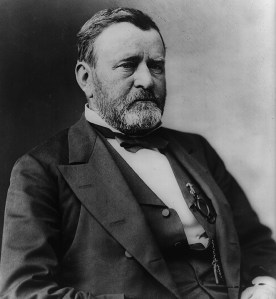
My son is named after this President, incidentally.

The quote itself is by Ron Chernow, the historian who authored the recent well-reviewed biography of out 18th President, “Grant,”  “Hamilton,” the biography that inspired, we are told, the mega-hit musical. and “Washington” (won’t somebody send a copy to the fools at Christ Church?) was given to an interviewer as his description of another book, the Philip Roth’s historical novel  “The Plot Against America”:

[A] democracy can be corrupted, not by big, blaring events, but by a slow, insidious, almost imperceptible process, like carbon monoxide seeping in under the door.

Some random thoughts on this statement, which I believe is exactly right, and a lot more interesting than the more frequently used analogy about boiling a frog slowly:

  • Grant, as Chernow’s book (among others of recent vintage) documents, was present at one of those points when democracy seemed to be in the process of being poisoned, and acted forcefully.

By 1868, when Grant was elected to succeed Andrew Johnson, who had done everything he could to allow the South to resist extending civil rights to the newly freed slaves, the KKK had evolved into a powerful terrorist organization that referred to itself as  “The Invisible Empire of the South.” Under the  Klan’s first  “Grand Wizard,” the brilliant former Confederate cavalry general  Nathan Bedford Forrest, whites from all classes of Southern society joined the Klan’s ranks. They attacked and punished newly freed blacks for crimes like  behaving in an “impudent manner” toward whites, brutalized the teachers of  schools for black children, and burned schoolhouses. It also terrorized and often murdered Republican party leaders those who voted for Reconstruction policies.  In Kansas over 2,000 murders were committed as the 1868 election approached; in Louisiana, a thousand blacks were killed in the same period.

Grant entered office knowing that the Civil War victory could come apart. He made some bad appointments–Grant was naive about politics and trusted too easily—but his choice as Attorney General, Amos T. Akerman, was masterful. With Grant’s support, and the with the help of the newly created Justice Department under Grant, he vigorously worked to enforce the Fifteenth Amendment, which gave the vote to black men in every state, and the First Reconstruction Act of 1867, which placed tough restrictions on the South and closely regulated the formation of their new state governments. Between 1870 and 1871, the Republican Congress passed and Grant signed into law the Enforcement Acts, which made it a crime to interfere with registration, voting, officeholding, or jury service by blacks. Congress also passed the Ku Klux Klan Act, which allowed the government to act against terrorist organizations.

  • When I was growing up and becoming interested in the Presidents, a life-long passion that led me to both law and ethics, Grant was routinely listed as one of the worst in the line. All one heard from historians was about the financial scandals that rocked his administration. Grant’s great success in subduing the Klan was literally never mentioned. The main Presidential historian then was Arthur Schlesinger Jr., a member of Jack Kennedy’s inner circle. His job as he saw it was to minimize the contributions of any Republican President, like Teddy Roosevelt (“near great” in his rankings), Eisenhower (“below average”) and Grant (“failure’). Meanwhile, Woodrow Wilson, who dragged the U.S, into the first World War, botched the Versailles Treaty and who actively revived the Klan, being a stone-cold racist, was “great.” Naturally, I believed all of his distortions, which were largely those of the historians at the time, then, as now, often partisans and propagandists. It took me a while to realize that this had been my first encounter with the Left attempting to alter present perception by controlling the past.

That is one of the major sources of Chernow’s carbon monoxide today, except that the disinformation now emanates from the schools, colleges, and the news media. Continue reading