Hall of Fame Ethics… Rock and Roll Hall of Fame,That Is

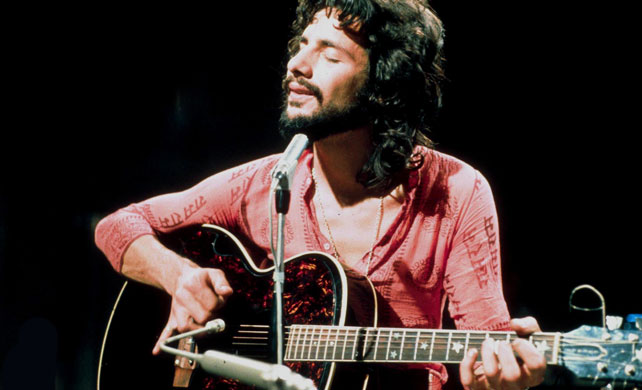
Cat Stevens

Conservative blogress Kathy Shaidle pleaded with voters not to enshrine Yusuf Islam, a.k.a Cat Stevens, into Cleveland’s Rock and Roll Hall of Fame, and then, when they added him anyway, expressed her disgust. Her objections were not based on music criticism (as would be justified with nominees like Yes), nor on Cat’s honor blocking more worthy nominees (like, say, The Zombies). She objects to Yusuf Islam on political and ethical grounds, complaining that during his activist days and perhaps even now, he qualified as a Muslim radical.

It doesn’t matter. Cat Stevens belongs in the Rock and Roll Hall of Fame because of his art, not his character. His character is irrelevant to the reach, influence and value of his art, as are his politics. The Rock and Roll Hall of Fame makes no pretense of making difficult measurements of an artist’s character, unlike the Major League Baseball Hall of Fame in Cooperstown, which has come up on Ethics Alarms frequently. Baseball players are cultural icons and societal heroes, whose symbolic exploits on the field of play evoke and inspire young people as well as the rest of us, embodying positive traits like courage, perseverance, fortitude, sacrifice, team play, loyalty, honor, fairness and honesty. As derided as it is by sportswriters and jaded fans who would like to see both the baseball Hall and its rosters filled with enabled and highly paid cheaters, felons, thugs, miscreants, deadbeat dads, and worse—like those of professional football and basketball—the character clause holds baseball players, at least those who want to be remembered as great ones, to a higher standard. And that higher standard is relevant to the game they play and our appreciation of it.

The character of artists, however, are simply accompanying trivia to the artist’s contributions to society. If there was a character clause in the Crooner’s Hall of Fame, Frank Sinatra and Bing Crosby might be barred from entry, meaning that it would then be the Imitators of Frank Sinatra and Bing Crosby Hall of Fame. For entrance to the Classical Composers Hall of Fame, Mozart and Wagner (and a lot more) would need to buy a ticket. Don’t get me started on the Novelist’s Hall of Fame, or the Hall of Fame for American Playwrights. Beautiful, transcendent, moving and immortal works have issued from ugly, warped, cruel and diseased minds, and it has always been thus, in Rock and Roll as well as every other art form. Picking on Cat Stevens, among all the others, smacks of anti-Muslim bigotry to me. Sure, I hated Cat’s politics; I hated John Lennon’s politics too.

It’s the art, and only the art, that matters.

______________________________

Sources: PJ Media 1, 2
Well, Let’s Kill All The Lawyers, Then!

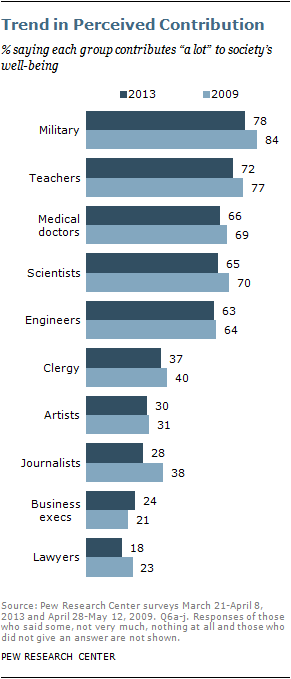
One reason why democracy doesn’t seem to be working very well is that the public is becoming increasingly ignorant about what makes it work at all. Evidence of this trend comes by way of a provocative study by the Pew Research Center, which polled the public regarding which professions it believes contribute the most to society.

The results can be found in this press release, this summary, and this article in The Careerist, but here is a snapshot:

Worth study

Continue reading

Hilary Swank Gets Nelly Furtadoed. And It’s Still Wrong

What's that, Mr. Kadyrof? You want me to give you a private ethics seminar for a half-million bucks? What!!! I am outraged! I spit on your filthy lucre! KIDDING!!!!!

I seriously considered taking the Ethics Alarms post on singer Nelly Furtado posted here in March and substituting actress Hilary Swank’s name for Furtado, and Chechen despot Ramzan Kadyrov for now-deceased Libya dictator Muammar Gaddafi. It is the same controversy and issue with the same result: an American performing artist sells her performing talents to a brutal foreign leader, and is bullied and shamed by human rights advocates and media critics into apologizing profusely and donating the large fee ( a million dollars in Furtado’s case, a reported half-million for Swank) to charity.

This was wrong in March, and it’s wrong today.

Earlier this month, Swank and other celebrities attended Kadyrov’s birthday bash in Chechnya. She was working. But while every other corporation and contractor, as well as the United States itself, can do business around the world without being held to the impossible standard of only accepting morally exemplary customers, Swank, like Furtado, Mariah Carey and others before her, was targeted for not doing the bidding of human rights activists and sacrificing her livelihood to be their billboard. The bully in this case in the Human Rights Foundation, which unethically brutalized Swank to achieve publicity for its own mission—a worthy one to be sure, but not so worthy that it justifies a PR mugging with a $500,000 loss to its victim. Continue reading

“Glee” Ethics

Now that I know I’m not the only one to be a bit troubled by the gleefully unethical practices of the absurdly talented high school students in the performance choir chronicled in the Fox TV series “Glee,” I will conquer my fear of rampaging “Gleeks” and say so.

In addition to the annoyance of the teens being played by 30-year-olds, their absurdly accomplished performing skills, and most of all, the speed with which they arrange, choreograph and master complex musicals numbers that a no professional performing group could equal in less than a week of twelve-hour days, there is this: the students regularly violate the copyright laws by using music, lyrics and exact copies of video choreography in their numbers.

Yes, the producers of  “Glee” are really paying the artists involved; that’s not the point. The problem is that the show’s conceit contributes to an attitude among younger Americans (and a lot of old ones, like “The Ethicist,” Randy Cohen) that stealing intellectual property from artists is OK, everybody does it, and it is standard procedure. This encourages an unethical and illegal practice by glamorizing it, and also misinforms viewers who may not know that what the “Glee” kids do could involve big fines and serious legal problems in the real world. Continue reading