Political Correctness Delusions #3: A Grovelling TV Anchor, An Archaic Term, A Dishonest Apology, And…The Redskins

And by the way, what is this "hair" they were discussing?

And by the way, what is this “hair” they were discussing?

Really, creating this kind of singled-handed, one passenger Ethics Train Wreck takes some kind of talent; I’m just not sure what to call it.

Here is how Atlanta CBS affiliate morning show host Michelle Burdo managed to turn a hair care segment on her morning broadcast into a controversy for the station, a self-proclaimed racial incident, a pathetic example of political correctness groveling, and, on top of it all, a demonstration of the lack of courage, skill  and candor that now infects her profession:

1. In a hair treatment feature on Monday’s installment of Better Mornings Atlanta, Burdo said to her African American guest, “Let me tell you something. I’m not a colored woman but I have kinky hair just like her and when you straighten it every day, it’s…” I’ll let you guess what it is; I don’t really care. The point is that she said the dreaded “colored woman” phrase that was the approved genteel and sensitive word for African-Americans by the 1920s at least. The phrase was out of favor by the Sixties, although blacks and whites of earlier generations would still use it, like older Americans today will still call women girls, gals, broads and similar anachronisms of a less gender-sensitive time. Continue reading
Ethics Hero, Thanksgiving Division: Scott Stuckey, Manager of Atlanta’s Omni Hotel

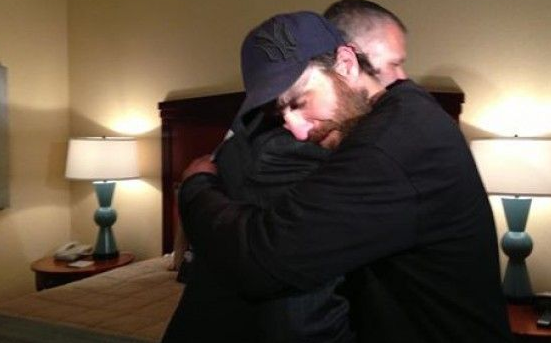
Scott Stuckey gets hugged by a grateful non-criminal Joel Hartman was homeless and surviving in Atlanta by dumpster diving, but when he found a lost wallet with the owner’s identification and credit card inside, he was determined to do the right thing. The wallet obviously belonged to a tourist, so the 36-year-old man checked the hotels in downtown Atlanta until he found out that the tourist (from France, for a conference) was staying at the Omni Hotel.

After Alanta’s Omni manager Scott Stuckey saw the surveillance video of Hartman—who looked as destitute as he was— turning in the wallet to the hotel’s  security guards, he decided that a reward was in order.  Hartman had given them a fake name, so it took some effort to track the shy good Samaritan down. Stuckey and his staff searched for a week, leaving messages with other homeless people that the Omni wanted to thank the man who recovered its guest’s stolen wallet. Eventually Hartman heard about their quest, and showed up at the hotel. He was shocked at what Stuckey had planned for him. Hartman was told that he would be the Omni’s guest in a luxury room through the Thanksgiving holiday with complimentary room service. The hotel also  gave him $500.

I think the gesture by Stuckey and the Omni was kind, appropriate, and in keeping with the spirit of the holiday….but: Continue reading

Further Reflections On The Cheerleading Prosecutor (and an Ethics Pop-Quiz!)

"By the way, counselor, nice work last Sunday..."

“By the way, counselor, nice work last Sunday…”

I wrote the post about Ina Khasin, the Fulton County assistant district attorney in the morning yesterday as I prepared for a morning ethics session for new D.C. lawyers, and had not made up my mind about whether there was or was not a legitimate “Cheerleading Prosecutor Principle” by the time I posted it. I returned to my keyboard late in the day to read the comments on the post, and finally had a chance to consider the issue carefully, benefiting from the varying perspective of the commenters. My conclusion is that for a prosecutor to indulge herself by moonlighting in a high-profile, frivolous and cognitive dissonance-generating activity like NFL cheerleading is not only weird (Ick!) but also irresponsible, and yes, unprofessional.

I’m pretty sure I’m right, too. Continue reading

Is There A “Cheerleading Prosecutor Principle”? Apparently Not.

irina-k-falcons

Fulton County (Atlanta) Assistant District Attorney during the week, sultry, pom-pom-waving Atlanta Falcons cheerleader on the weekend, attorney Ina Khasin (That’s her, above) has, at least so far, dispelled my suspicions that there would be “Cheerleading Prosecutor Principle” along the theory behind the “Naked Teacher Principle” and its relatives, which is that when one’s  sex-related internet images clash dramatically with the expectations and duties of one’s profession, one’s days in that profession are numbered. Apparently Khasin shares some of those suspicions, since she cheers under the (sort of) alias “Irina K.” If there’s nothing about the activity that anyone would find inappropriate, why hide the name?

Now I am assuming this is all in the open, approved by her superiors, and no longer an issue. I am also assuming that there might just be some kinds of cases that the DA’s office might not want prosecuted by a professional cheerleader. In any event, Khasin has dewn a bright line between being a lawyer-cheerleader and being a lawyer-dominatrix, which, as you will recall from this story, didn’t work out so well.

This is clearly not the “ick factor” for me, and perhaps more of a “Humunahumuna!” Factor, but I am not yet certain that professional cheerleading is in fact compatible with the ethical obligations of a prosecutor. I am very sure that it would not be consistent with the dignity and decorum requirements of a judge.

I think I’ll just have to look at the evidence for a while…

__________________________

Facts and Graphic: Above the Law


Ethics Dunces: Atlanta Braves Fans

The Atlanta Braves lost the first ever National league Wild Card play-off game, 6-3, to the St. Louis Cardinals, thanks primarily to their own atrocious fielding (the Braves made three costly errors.) Nonetheless, many fans felt they “wuz robbed” because of a bizarre play in the 8th inning, when the Cardinals were rescued from a bases loaded, one out situation after the game’s left field umpire, Sam Holbrook, apparently feeling that he had to do something to justify being on the field (regular season games don’t have left field umpires), called the infield fly rule on a pop-up that landed safely in the outfield. The infield fly rule is designed to prevent sneaky double plays, and is called when an easy pop-up might be intentionally dropped by an infielder. Thus the ball is an out whether it is caught or not.

There were three problems with the call. First, it was called very late in the play, after it was evident that the Cardinals fielders might not catch it. Second, given its placement, letting the ball drop to try to get a double play really wasn’t an option. And, third, as I noted, the ball landed in the outfield, which an infield fly is not supposed to do. The Braves argued the call, to no avail.

Then the Braves fans at Turner Field, perhaps primed by left-over anger at the NFL’s departed replacement refs, proceeded to act like total jackasses by throwing every piece of junk and debris they could get their hands on down onto the field. Continue reading

Ethics Quiz: Apologies For A Sandusky Joke?

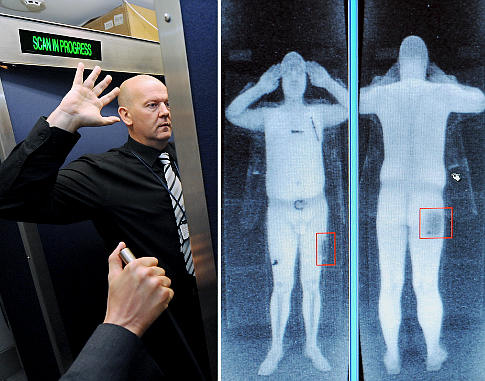
My uneasy relationship with the TSA continues.

Yes, I've sunk so low that I actually seek this out...

Today I was returning home from Atlanta, and its monster of an airport has one the cattle pen systems for going through security–a long, ling, line to all gates that keeps dividing and dividing, ultimately sending you down one of about 20 chutes to be scanned, stripped and yelled at. It is difficult to pick your chute, but in my case, it is crucial: Atlanta doesn’t have the full-body scanning devices in every line, and without it, I get gated, beeped, and sexually molested, thanks to my artificial hip.

It took ducking under a couple of barriers, but I finally got to an x-ray conveyor belt near a scanner, and had removed my laptop (separate bin) belt, jacket and shoes (not allowed in a bin in some cities, allowed in others) and lined them all up with my bag and brief case when an agent (none too politely) told me that they were closing that line, and directed me to another one, two lanes over. I lugged the three bins, bag and brief case over to that line, only to discover that it didn’t have a scanner.

That did it. I erupted at one of the agents, telling her that I did not care to be felt up at 8 in the morning, thanks, and had made a good faith effort to direct myself to a scanner, being foiled by the agent and by the fact that there are no signs warning people like me where a testicle massage is the only option.

“Why aren’t there signs?” I asked.

“I don’t know. There should be,” she said, as she helped me move my stuff to a scanner accessible line. “You should write the TSA and the airport.”

I laughed bitterly. “I’m sure that will do a lot of good. Do you all jsut like feeling up passengers? Is that the reason?”

A woman behind me laughed and said, “It sure seems like it!”

“Well, you know,” I said to her, “I hear Jerry Sandusky is trying to get a job as a screener!”

Her guffaw was interrupted by 7’8″ TSA agent, who said, loudly, “No he’s not, and I’m offended by that statement.”

My response, after a second’s consideration, was this: “I’m sorry I offended you. But I’m not apologizing.”

Your ethics quiz of the day: Should I have apologized? Continue reading

Atlanta Parents’ Verdict: Cheating’s No Big Deal; Grades Are What Matter!

Atlanta's integrity is burning, and its students are the victims

Here is one reason American education is in the sorry state that it is.  And speaking of sorry states, how about that Georgia?

After  revelations of a massive conspiracy among teachers and administrators across Atlanta’s schools to fix the scores on state-mandated tests, parents at least one of the schools vocally supported the teachers involved. At a town hall meeting, parents praised the education their children received from the cheaters.

“We’ve been extremely pleased with the instruction my children have received,” said Quinnie Cook-Richardson, a parent at the West Manor Elementary School. Her child’s teacher had him reading within a year, she said. “They are an example of what is right with Atlanta Public Schools.” Cook-Richardson was among a many parents who defended the school, teachers and  the principal who has been asked to resign as a result of the scandal.

Why are parents defending cheating school personnel? They are defending them because the parents don’t care about cheating, ethics or integrity; they just care about their children getting good grades on the tests. They care about results and credentials and their children succeeding, and if cheating helps, that’s just fine with them. This why their children cheat, as they almost certainly do and will; it is also why the teachers and administrators cheated. It isn’t the culture of the schools that is corrupt;  it’s the culture of the entire community, parents and students included.

And are we so naive that we can believe that this corrupt culture, in which education is seen as nothing but marks on a transcript, and values like integrity and honesty are seen as impediments to “education” rather than  part of it, is confined to a few schools, or Atlanta, or Georgia?

This our nation’s culture in 2011.

We had better start recognizing it, and repairing it.

Fast.

Comment of the Day: “Ethics Dunce: Guitarist Carlos Santana”

Michael has posted the Comment of the Day regarding my post of Carlos Santana’s criticism of Georgia’s new anti- illegal immigration law. The post expresses my continuing amazement and dismay at the strong support for illegal immigrants in the media and in segments of the public, which I view as both irrational and impossible to defend without recourse to rationalizations and dishonesty. In his comment, Michael is less critical of these defenders as he explores the factors that could make reasonable people oppose efforts to crack down on illegals.

“I can understand why reasonable people are against laws that punish illegal immigrants. I understand your conviction that a law should be either enforced or repealed, but sometimes a law is a bad law that, for whatever reason, legislators cannot or will not turn into a good law (given your frequent posts criticizing Congress, you can understand why some bad laws are not changed). When such a bad law is in place, there is often sympathy for those who break it because reasonable people conclude that, if they were in the same position as those who break the law, they would break the law as well. Continue reading

Ethics Dunce: Guitarist Carlos Santana

Legendary rock guitarist Carlos Santana thought it was appropriate to lecture a ballpark full of Atlantans when he was  honored with a “Beacon of Change” award at Sunday’s MLB Civil Rights Game at Turner Field. Pronouncing Georgia’s  new immigration law just signed into law by Georgia Gov. Nathan Deal “anti-American,” the Mexican-born Carlos Santana said,“I represent the human race. The people of Arizona, the people of Atlanta, Georgia, you should be ashamed of yourselves.”

Dear Carlos: If you can't say something responsible about immigration, please just shut up and play.

Later, he told reporters , “This is about fear, that people are going to steal my job. No we ain’t. You don’t clean toilets and clean sheets, stop shucking and jiving.”

Santana is entitled to express his opinion; he is even entitled to express stupid and ignorant opinions. But when he uses his fame, name recognition and a forum given to him as an honor to express a stupid, ignorant and irresponsible opinion, that is intolerable. Continue reading

If Teachers Cheat, What Will Students To Do?

In Worcester, Mass, test scores at the Goddard School of Science and Technology have been tossed out because  school staff “reviewed student work on the assessment, coached students to add to their responses, scribed answers or portions of answers that were not worded by students, and provided scrap paper for students to use during tests,” according to the state commissioner of Elementary and Secondary Education.

School Superintendent Melissa Dillon wanted to make sure these findings weren’t misunderstood, and wanted to make certain nobody got the idea that her teachers were cheating. “The state did not use the term cheating, so I’m not using the term cheating,” she said. School Committee members agreed. “Calling it cheating I think is a little harsh,” committee member Jack L. Foley said.  He described the problem as “probably too much coaching.” Continue reading