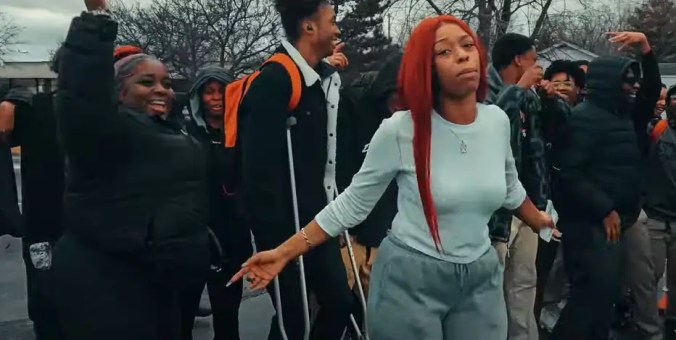
No, Taylor Preparatory High School, There Is No “Rap Singing Teacher Principle”

I want to credit esteemed EA commenter JutGory for both the headline and the pointer. He properly identified this ethics tale out of Detroit as an important contrast to the “Naked Teacher Principle” and its many variations. The NTP et al. (like the the “Drag Queen School Principal Principle,” “the Porn Actor University Chancellor Principle,” and many others) holds that if you are a teacher or in some other position that requires the respect and trust of your employers and stakeholders, having photographs of you appearing naked or in other sexually provocative conditions appear on line justifies your separation from your job and leaves you no leave to complain.

Domonique Brown, however, a recent “Teacher of the Month” at Taylor Preparatory High School, did not have any naked photos or anything close on the web. She was fired from her job as a history teacher because the school learned that she had a second career as a rising rap artist named “Drippin’ Honey.” Brown had proven herself to be a skilled and popular teacher for seven years, and is pursuing a master’s degree and a doctorate. But when a parent alerted the school in an anonymous complaint last October that Domonique was also a rap artist, she found her fitness to teach being questioned.

Continue reading

Further Reflections On The Cheerleading Prosecutor (and an Ethics Pop-Quiz!)

"By the way, counselor, nice work last Sunday..."

“By the way, counselor, nice work last Sunday…”

I wrote the post about Ina Khasin, the Fulton County assistant district attorney in the morning yesterday as I prepared for a morning ethics session for new D.C. lawyers, and had not made up my mind about whether there was or was not a legitimate “Cheerleading Prosecutor Principle” by the time I posted it. I returned to my keyboard late in the day to read the comments on the post, and finally had a chance to consider the issue carefully, benefiting from the varying perspective of the commenters. My conclusion is that for a prosecutor to indulge herself by moonlighting in a high-profile, frivolous and cognitive dissonance-generating activity like NFL cheerleading is not only weird (Ick!) but also irresponsible, and yes, unprofessional.

I’m pretty sure I’m right, too. Continue reading

Avocations, Conflicts of Interest, and Country Joe West

Some employers are troubled by the avocations and outside activities of employees, a concern that often deserves a  defiant “none of your business” in response. However, sometimes the concern is justified, such as when the avocation adversely reflects on the individual’s reputation to the extent that it harms his or her ability to perform, or when the avocation actually interferes with the job, such as a when a recreational rugby player keeps missing work because of injuries. Another problem is when the avocation creates a conflict of interest in which conduct that may be good for the avocation undermines the job.

The latter is exemplified by Major League Umpire Joe West, who fancies himself a country music singer and songwriter when he isn’t calling balls and strikes. As nicely narrated on the blog “It’s About the Money,” West has long been the most flamboyant and combative of umps, as proven by the fact that a lot of people know his name. Umpires aren’t supposed to be stars, celebrities or personalities: if you notice a particular umpire, it is almost always because he has made a mistake.  They are important, however. Their acuity of sight and judgment are called upon many times in every game, and can make a significant difference in scores, standings, championships and careers. Like judges, they have to be trusted, and their integrity above suspicion. “The Common Man,” who wrote the blog post, believes that West’s singing career, such as it is, creates a conflict of interest that undermines that trust, and worse, warps his judgment on the field. Continue reading