Ethics Dunces: Atlanta Braves Fans

The Atlanta Braves lost the first ever National league Wild Card play-off game, 6-3, to the St. Louis Cardinals, thanks primarily to their own atrocious fielding (the Braves made three costly errors.) Nonetheless, many fans felt they “wuz robbed” because of a bizarre play in the 8th inning, when the Cardinals were rescued from a bases loaded, one out situation after the game’s left field umpire, Sam Holbrook, apparently feeling that he had to do something to justify being on the field (regular season games don’t have left field umpires), called the infield fly rule on a pop-up that landed safely in the outfield. The infield fly rule is designed to prevent sneaky double plays, and is called when an easy pop-up might be intentionally dropped by an infielder. Thus the ball is an out whether it is caught or not.

There were three problems with the call. First, it was called very late in the play, after it was evident that the Cardinals fielders might not catch it. Second, given its placement, letting the ball drop to try to get a double play really wasn’t an option. And, third, as I noted, the ball landed in the outfield, which an infield fly is not supposed to do. The Braves argued the call, to no avail.

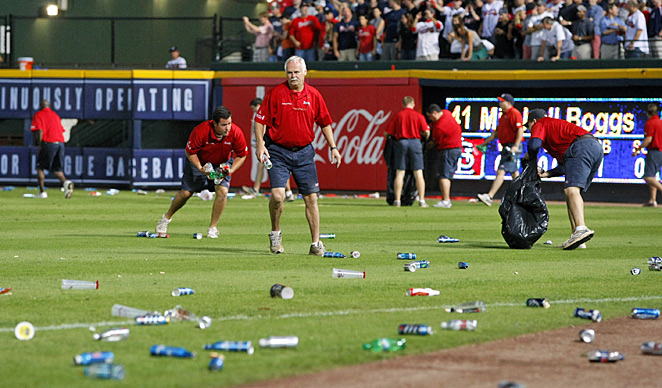
Then the Braves fans at Turner Field, perhaps primed by left-over anger at the NFL’s departed replacement refs, proceeded to act like total jackasses by throwing every piece of junk and debris they could get their hands on down onto the field. Continue reading

Ethics Dunce: Major League Baseball

MLB Wild Card play-off, 2020

I dislike baseball’s play-offs, especially the fact that a team that finished second over a 162-game season can still win the World Series and be called a champion. I really dislike the addition of a second “wild card” team to the post-season formula this year, which theoretically means that a team can finish third and end up as a champion. Yes, I know this is the way it has been for decades in football, basketball and hockey, but they are lesser sports, after all.

Baseball’s rules for the new one-game play-off between the wild-card teams, however, marks a new low in baseball’s integrity. Since it the single game is a separate play-off round, the suits who run the game have decided that managers can devise a unique 25 player roster for that game alone, and reconstitute the team if it goes on to the next round, a three-out-of-five series. The practical effect of this rule is that two teams will face each other not only bearing insufficient resemblance to the teams that actually earned the play-off slot, but will also play with a roster that would be disastrous over the course of  a season. Continue reading

Wild Card Ethics and Cultural Expectations

Bad ideas are contagious, especially popular ones.

Major League Baseball just expanded the number of teams that qualify for post-season glory from eight to ten. Yes, there are ethical calculations involved in this, whether baseball cares or not. Supposedly, questions of fairness were part of the reason for the change, though I doubt it—in pro sports, the engine of change is always profit. And whether the change results in more fairness or less depends on what you consider fair—or perhaps whether you are sleeping intents in various U.S. cities.

Sports is such a big part of our cultural consciousness that what the National Pastime calls fair and just cannot help but influence cultural standards. Before 1969, there were two leagues of eight, then ten, Major League teams, and the two teams with the best records in each league met in the World Series. It was a simple meritocracy, with just 10% of the teams being allowed to advance after the regular season. Oh, there was always complaining about how the rich Yankees got into the Series more often than not, while the Senators, Phillies, Astros and A’s never did, but nobody camped out in the middle of Manhattan to protest baseball talent disparity. If you lived in one of the smaller Major League cities you just scaled back expectations, that’s all. And if, by some miracle, you won, then victory was all the sweeter, because you had bucked the odds by being harder working, stronger, better. Continue reading