Little League Ethics: A Bat Flip Controversy Goes To Court

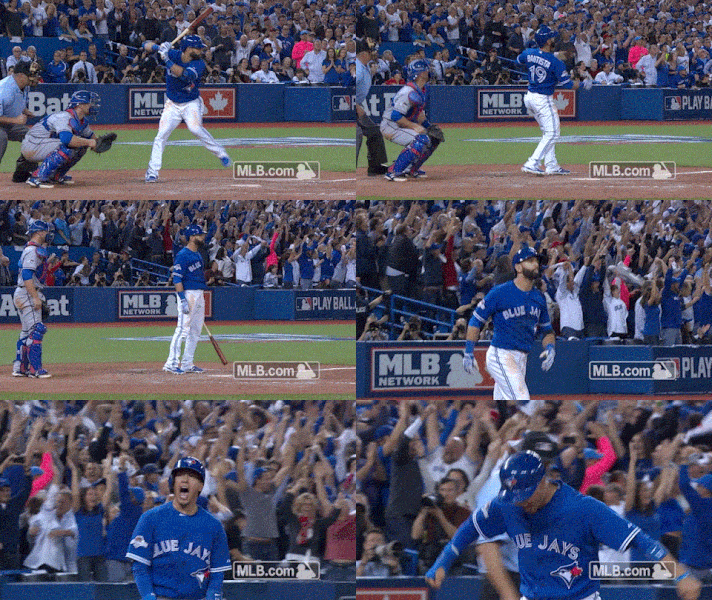
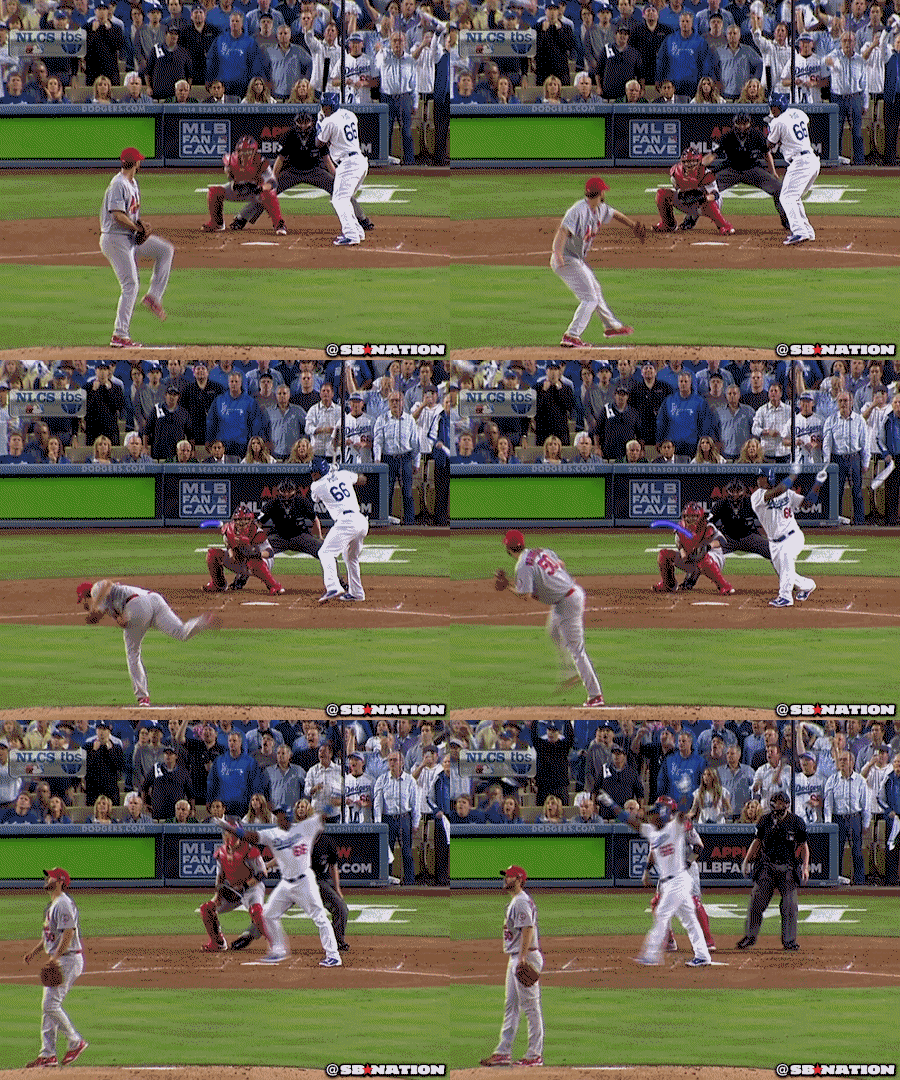
Little Leaguer Marco Rocco of Haddonfield, N.J., 12-years-old, hit a majestic home run in a Little League tournament game against a team from Harrison last week. Marco emulated what many big league players do in similar moments of triumph: he flipped his bat into the air to celebrate as he began to circle the bases. His homer put his team up 8-0 and a step closer to the Little League World Series.

But Marco was ejected from the game, and, by the Little League rules, the ejection included a one-game suspension for the next game too. Marco’s innocent bat flip meant he would would be barred from playing in a showdown against Elmora Township, with a the New Jersey state Little League title on the line. Marco’s father was told that in the umpire’s judgment, his son broke a rule that “At no time should ‘horseplay’ be permitted on the playing field.” No rule mentions bat-flipping.

So Mr. Rocco, who is a lawyer, filed a motion asking a New Jersey court for a temporary restraining order, and got it. The judge that Marco could play, in the next game, which took place yesterday, holding that “Little League is enjoined from enforcing its suspension.”

Continue reading

Major League Baseball Asks What This “Integrity” Is That We Speak Of…

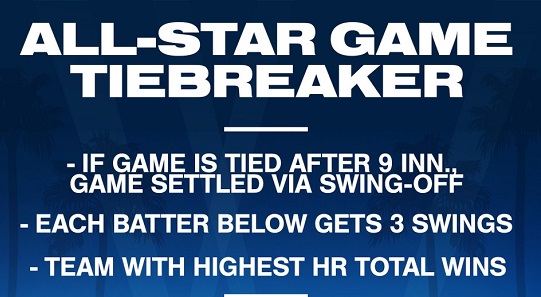
Even though the stupid All Star Home Run Derby was the night before, last night’s Major League Baseball All Star Game, which was allegedly baseball at its best, was decided by another home run derby, this one called a “swing-off.” The game’s nine innings ended in a tie, see, after an unprecedented comeback by the American League, which had trailing by six runs with just three innings to go against the National League’s best pitchers. This set up the game for a thrilling finish, like, say, Carlton Fisk hitting the ball out in the 12th inning of Game Six of the 1975 World Series, but no.

The 95th All-Star Game in Atlanta was settled by a “home run swing-off” to settle the tie. Worse still, the game’s MVP award was given to Kyle Schwarber of the National League, based on how he performed in the “swing-off” (I can’t believe I’m writing this), not in the part of the night known as “a baseball game.”

By the time Rob Manfred, the Worst Baseball Commissioner Ever Not Named Bud Selig , is through making up rules and gimmicks, baseball fields will have fun obstacles—you, know, gnome heads, water hazards and little twisty chutes?—like in miniature golf. He wants to make the game entertaining for people who are bored by baseball….you know, like him.

All of this is because the mega-millionaire players stopped wanting to actually play hard in the iconic exhibition game—might get injured, lose a big contact—and managers were pressured into not playing to win but rather treating the game like an elementary school Halloween parade, where every kid in costume gets a moment in the metaphorical sun (the games aren’t played in the daytime anymore, like they were when kids could watch their favorite players). So pitchers never pitch more than an inning, maybe two for the starters, and players all get an at-bat, but that means that if the game ends in a tie, one or both teams will have no players left. Behold! The stupid “swing-off,” which is even less baseball than the “zombie runner” gimmick used to break ties in the regular season. It had never been used before.

Continue reading

Ethics Quiz: The Non-Star All-Star Game Selection

This is fun: a different kind of MLB annual All-Star Game ethics controversy! We’ve never seen this one before: usually the controversies over baseball’s “mid-summer classic” (This is All-Star Game week, with the teams taking a break around Wednesday’s game televised on Fox News.) involve fairness in the selections (there are always more deserving players than the limited rosters can hold, whether every team should have at least one representative even when that means selecting a mediocre player having a so-so season, whether there was bias in the selection of the reserves, whether aging great players should be included on the squad because they really are the players the fans want to see, whether the fan voting system is absurd, stuff like that. (Some past controversies are discussed here,)

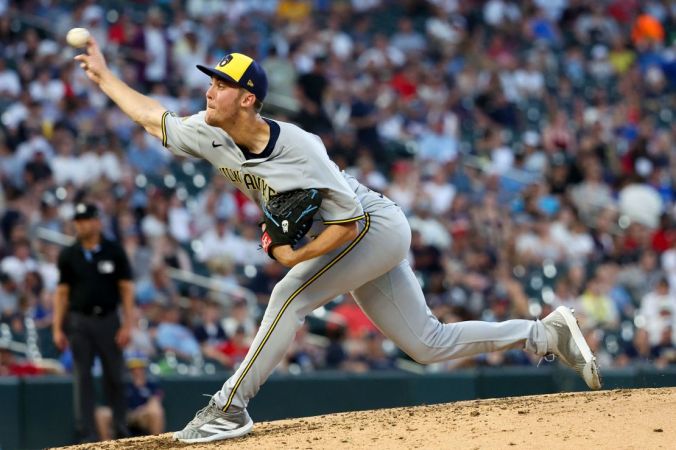
Never this, however: MLB added Milwaukee Brewers rookie Jacob Misiorowski to the National League All-Star team last week. “Who?”you well may ask? Misiorowski is a highly touted rookie who has only been in the major leagues for about a month. He’s been the starting pitcher in just five games, and now holds the record for fewest games ever played in by a player making an All-Star team—by a lot. Wails Yahoo Sports,

“The main goal of the Midsummer Classic is to recognize the players who have performed at a high level through the first half of the MLB season. With that, it also allows fans to see the stars of the game they might not watch on a regular basis. But by adding Misiorowski to the NL All-Star roster, MLB has sent a message to players that not only does the game not matter, but performance doesn’t matter, either.”

Misiorowski is what baseball jargon refers to as a “phenom.”

He’s viewed as a future superstar, and has looked like it, beginning his career with 11 perfect innings, no hits, no walks. Nobody had done that in the history of the game, He regularly tops 100 mph on his fastball, which has been clocked as speedy as 103. Yes, he’s an exciting newcomer who may do great things…eventually.

But picking him for the All-Star Game is like, oh, let’s pick an absurd hypothetical, like giving a Nobel Peace Prize to a newly elected U.S. President before he’s actually done anything related to peace at all. Not that such a thing could ever happen….

Your Ethics Alarms All-Star Ethics Quiz of the Day is…

Is it unethical for Misiorowski to be selected for the All-Star Game?

Continue reading

Ethics Dunce: NY Mets Catcher Luis Torrens

If you play a sport professionally and make 1.5 million dollars to do it as Luis Torrens does, you are obligated to know the damn rules. Torrens, if he knew them, forgot one of them in the play above that occurred yesterday in the Mets’ game against the Atlanta Braves.

You see, baseball players can not use their equipment or uniforms to affect the movements of a baseball. One’s bare hand, sure; one’s foot even. A player’s glove, of course, is used to catch the ball. But not equipment or parts of the uniform. A player can’t legally catch a ball in his hat, for example. Players have thrown their gloves at home run balls to deflect them back on the field, and a special rule forbids even that.

With runners on second and third, a pitch in the dirt from Mets starter Paul Blackburn forced Torrens to slide to block the ball from rolling away and allowing the runners to advance. But as he hustled over to the ball, the catcher used his mask to stop it from rolling further before grabbing it with his glove.  The umpires declared that Torrens had violated MLB Rule 5.06(b)(3)(E), declaring that it is illegal when “a fielder deliberately touches a pitched ball with his cap, mask or any part of his uniform detached from its proper place on his person.” The Braves runner on third was awarded home plate, scoring an unearned run, and the runner of second advanced to third base.

The Unethical Obscurity of Larry Doby

Yesterday was “Jackie Robinson Day” in baseball, with every player wearing the civil rights and baseball icon’s retired uniform number 42. April 15, 1947 is the day Robinson, following the bold plan of Brooklyn Dodgers General Manager Branch Rickey to desegregate baseball, officially broke the game’s color barrier in an event with national, cultural and societal significance. (I’ve written a lot about Jackie, a great man as well as a great baseball player.) Baseball is justly proud of its role in advancing civil rights (and justly ashamed of its long exclusion of black players before and after Robinson’s trailblazing), but commenter “Old Bill” reminded me this morning of the undeserved and unfair relative obscurity of Cleveland Indians great Larry Doby, the second black man to play Major League Baseball.

“It was 11 weeks between the time Jackie Robinson and I came into the majors. I can’t see how things were any different for me than they were for him,” Doby once said. Well, they weren’t. Doby’s courage and fortitude while battling bigotry and hostility to integrate what had been a white man’s game were no less than what Robinson displayed.

Lawrence Eugene Doby was born on December 13, 1923, in Camden, South Carolina. Larry’s father, David, was a stable hand, grooming the horses of many wealthy New Jersey families. When Larry was eight years old, his father died in a tragic accident. After that the boy was cared for by his aunt and uncle as well as his mother and moved from locale to locale, finally settling in Patterson, N.J. Even before graduating from high school, Doby was playing second base in the Negro Leagues under the assumed name of Larry Walker for the Newark Eagles. Despite is tender years, he was considered a rising star. He entered college, where he was a basketball stand-out, and was drafted and joined the Navy during W.W. II. Doby was honorably discharged from the military in January 1946, and inspired by the news that the Dodgers had signed a black player, Robinson of course, he changed his career plans from teaching to baseball. Doby sensed that the times they were a-changing. He rejoined the Negro League Eagles, believing that might be a path to the Major Leagues.

When his team went on to win the Negro Leagues World Series in 1946, Doby attracted the attention of maverick Cleveland Indians owner Bill Veeck, now best known as the man who sent a midget up to bat. Veeck, like Rickey, had long sought to integrate baseball, which for Veeck was the American League. He became convinced that Doby was the right player to do it. Veeck decided that he would purchase Doby’s contract and bring him up to join Cleveland right after the 1947 All-Star break. Doby’s white team mates on the Indians refused to look at or speak to him. Doby told an interviewer in 2002, “I knew it was segregated times, but I had never seen anything like that in athletics. I was embarrassed. It was tough.” 

He didn’t win a place in the Indians regular line-up until the next season, when the Indians won the AL pennant with him playing the outfield every day. That fall Doby became the first black player to hit a home run in the World Series, winning Game Four 2-1 and sending the Indians to a World Series victory the next day. A remarkable photo taken after Game Four showed Doby embracing white Cleveland pitcher Steve Gromek. (I was told that this photo is famous: I’ve followed baseball and baseball history most of my life, and I had never seen it. But there is a statue of Pee Wee Reese with his hand on Jackie Robinson’s shoulder! ) in what was supposedly a watershed for race relations.

Continue reading

Baseball Ethics: Now THIS Is Cheating…

Yesterday I discussed the silly controversy over “torpedo bats,” which are completely legal despite some commentators who should know better calling the use of them by some players “cheating.” Lo and Behold, no sooner had I posted that essay than news of a player being caught really cheating shook the baseball world.

Major League Baseball announced that Braves outfielder Jurickson Profar has been suspended for 80 games after testing positive for the performance-enhancing drug Chorionic Gonadotrophin (hCG). Profar will be able to return during the season but won’t be eligible for the playoffs this year: that’s the restriction and part of the pentalty for all players in the year they serve a PED suspension.

The Braves released a statement that began, “We were surprised and extremely disappointed to learn that Jurickson Profar tested positive for a performance-enhancing substance in violation of Major League Baseball’s Joint Prevention and Treatment Program.”

Why were they surprised?

I wasn’t.

Continue reading

Baseball Ethics: The Magic Bats!

The New York Yankees opened their season by crushing the Milwaukee Brewers with a record number of home runs. Some of the homers were hit by players using a new bat design imagined by a one-time MIT physicist. The bat is shaped at teh end like a bowling pin, or a torpedo. The Yankees hit a franchise-record nine home runs in the first game—-notably the player who hit the most was Aaron Judge with three, and he used an old-fashioned bat. The series sweep served “as a live infomercial.”

The Yankees aren’t the only team with players using the new bats. The Cubs, Minnesota Twins, Toronto Blue Jays and Tampa Bay Rays have some players who are trying them out. “It’s legal,” says one enthusiastic player. “It’s under MLB rules and everything. Just basically moving the sweet spot down. Those balls that you’re getting jammed on are finding some barrels.”

Continue reading

Friday Open Forum! (Help!)

I was a couple posts short yesterday: sorry. A lot was happening, but then a lot is always happening since the election: if I spent every waking hour at Ethics Alarms, I couldn’t keep up with all the events, stories and quotes that deserve posts. I checked out early yesterday because it was, after all, the beginning of the 2025 Major League Baseball season, which has disproportionately and illogically dominated my time and passion for at least six months of the year since I was 12. In return the game has taught me much about life, right and wrong, faith, loyalty, courage, chaos and the universe, so I am convinced the obsession has been worth all the lost hours, pain and distraction. (The Red Sox won in stirring fashion in Texas, 5-2.)

I find myself depending on the forum more than ever (and I still am looking for guest posts). There were at least two mind-blowing ethics items in the news yesterday, well, early this morning and yesterday. Elon Musk tweeted,

“On Sunday night, I will give a talk in Wisconsin. Entrance is limited to those who have voted in the Supreme Court election. I will also personally hand over two checks for a million dollars each in appreciation for you taking the time to vote. This is super important.”

Oh…what? What is that?

Then there was this, an Executive Order directing “the Vice President, who is a member of the Smithsonian Board of Regents, to work to eliminate improper, divisive, or anti-American ideology from the Smithsonian and its museums, education and research centers, and the National Zoo.”

Again: WHAT? What is “improper” ideology? What is “divisive” ideology? (What isn’t divisive ideology?) How does one measure “working” to do something? Has any previous executive order ever ordered a Vice-President to do something? I haven’t been to the National Zoo for a long time: is something sinister going on there?

(Thank you, Dana…)

Help me out here…

Your Baseball Ethics Lesson of the Week…The Buck Weaver Story

Baseball season starts next week, bringing me memories of my happy childhood in Arlington, Mass. and how I would pass the golden summers there metaphorically glued to my transistor radio for all 162 Red Sox games except for the very few that I attended or saw on TV. My team’s games were broadcast on WHDH 850 AM in those days, with Curt Gowdy doing the play-by-play. Right before each game was a favorite feature on that station: “Warm-up Time,” a 5 minute story from baseball’s rich and often strange history. “It’s Warm-up Time!” each segment began, “Your baseball story before every Red Sox game! Don Gillis reporting for Atlantic Refineries!” Don had a great voice and a rich delivery, and taught me a lot over the years.

Don introduced me to the strange and tragic saga of the 1919 Black Sox, the fixed World Series, the bizarre aftermath, and how baseball Commissioner Kenesaw Mountain Landis banned for life all eight of the players alleged to have participated in the plot to make the American League champion White Sox to throw the Series to the vastly inferior Cincinnati Reds.

Among the banned: superstar “Shoeless” Joe Jackson, whose supporters argue that he should be allowed into the Hall of Fame to this day. Joe was glamorized in the movie and novel “Field of Dreams.” His defense was that he accepted money from gamblers to throw the Series but still played his best—hardly an ennobling theory, but plausible, since by all accounts “Shoeless” was an illiterate dolt. His familiar story was featured on “Warm-Up Time,” but I was always interested in another one of the banned eight, third baseman George “Buck” Weaver, sympathetically played by John Cusack in the movie “Eight Men Out.”

Continue reading

Can Shattered Trust Be Restored? Should it?

Last September I wrote about minor league catcher Derek Bender. He was playing for the Fort Myers Mighty Mussels, the Minnesota Twins’ Low-A affiliate, and was accused after a game of tipping off several hitters for the Lakeland Flying Tigers, a Detroit farm team, regarding the next pitches the Mighty Mussels pitcher was going to throw. Lakeland scored four runs in the second inning to win the game 6-0 and win the Florida State League West division, eliminating the Mighty Mussels from playoff contention.

Lakeland’s coaches alerted Fort Myers coaches regarding Bender’s alleged pitch tipping, and the fact that Bender had told several teammates that he was exhausted and wanted the season to be over was sufficient to convince the organization that Bender had deliberately lost the game for his own team.

The Twins released him. Despite his previous status as a high-rated prospect, the catcher is now a pariah in the game. MLB’s investigation has not been completed, though news stories last fall stated his pitch-tipping as fact. Bender’s agency representing him advised him to make no public statements until there was official report. That seems to have been bad advice: the belief that the player cheated to cause his own team to lose has taken hold as the accepted narrative.

Now he has given an extensive interview to The Athletic, the New York Times sports publication. He says he is innocent of the accusations. Bender met with investigators in November, going over the fateful inning pitch-by-pitch to prove that he was innocent. If the report concludes he did tip off opposing batters to his pitcher’s pitchers, Bender’s baseball career is almost certainly doomed.

Continue reading