My Friend, Greg

stand by me

I’m not sure exactly what this post has to do with ethics. Obligation, perhaps. Still, I have to write it.

Yesterday, I learned that Greg Davidson had died. The news thrust me into the heart of some intense and strange hybrid of “Stand By Me,” “Animal House,” “Mister Roberts,” and “The Sandlot.” I hadn’t seen or talked to Greg for 41 years, since the day he sold me my first car, a red Nova that I paid for with cash, using my bank account started for me by my Dad when I was a baby. Wiped it out, too. But that’s not why Greg Davidson was important in my life.

I met Greg in the 7th Grade, when we were both 12. He was the first un-self-consciously cool kid I ever met, and one of the few people I have known had this distinction. (I will embarrass him by saying this, but my son is one of them too.) If you can picture the character of Chris (River Phoenix) in “Stand by Me,” that was Greg—athletic, physically graceful, blond, with a buzz cut, relatively quiet, and a natural leader. He was, essentially, a man in attitude and conduct long before the rest of us (some of us are still working at it)—he won the affections of my 6th grade crush, Margie, and formed a famous, much admired steady couple with her that lasted well into high school.

He was smart, but defiant in a puckish and courageous way: this was the early Sixties, and we all regarded the regimentation of school as an insult. Greg undermined that, regularly, and at considerable personal cost, by waging clever, chaotic war against authority that he considered an affront to human dignity—the equivalent of Mr.Roberts throwing the Captain’s palm tree into the drink. One of my favorites was when he tweaked a pompous high school English teacher who chafed under the nick-name Greg had devised for him—“Tweety Bird”—because it caught on, and because it was so dead-on accurate. Greg went to the trouble of making stationery with a small picture of the Warner Brothers avian in the corner, distributed it, and that week poor Mr. Hendrickson received an assigned essay from every student on Tweety paper. Greg denied that he had anything to do with the plot, but accompanied his denials with Otter’s iconic wink to Dean Wormer, so he left no doubt who Mr. H’s true tormenter was, not there was any doubt.

The teacher did not take it well. Continue reading

Pineda-Pine Tar, Part II: Baseball Clarifies Its Bizarro Ethics Culture

bizarro_world-baseballYou shouldn’t have to appreciate, care about or even understand baseball to find illumination in its latest ethics controversy, which shows how cultures can go horribly wrong, precluding exactly the values that any functioning entity must embrace to remain viable and healthy. For someone like me, to whom Baseball is Life, the whole thing just makes me want to jump out the window.

You will recall that a couple weeks ago, the sport embarrassed itself by making excuses and accepting lies regarding New York Yankees pitcher Michael Pineda being allowed to break the game’s rules against pitchers applying foreign substances (in this case, pine tar) on the baseball while pitching to the Boston Red Sox. I wrote about it here. I interpreted the post-incident consensus of the game and its pundits as “everybody does it, so let’s not make a big deal over a little infraction on a night when it was abnormally cold and hard to grip the ball.”  That’s unethical enough, but the truth, as revealed in Part II, is far worse.

Last night, fate had Pineda on the mound against the Red Sox again. Baseball’s ethics had already begun falling apart in chunks when Sox manager John Farrell, asked about whether he expected Pineda to cheat again (for that is what using pine tar on baseballs is—cheating. Official Rule 8.02 states: “The pitcher shall not apply a foreign substance of any kind to the ball.” ) answered that hopefully, if he did, he would be more discreet about it. Huh?

But Pineda was not discrete; in fact, he could not have been more obvious, or ridiculously so. After a rough first inning in which he gave up two runs, Pineda emerged from the dugout with a large, brown, greasy gob of pine tar on his neck. On TV. In nationally broadcast game. Against the same team that he was caught using pine tar against before. In that team’s home park.

In the Red Sox dugout, Manager Farrell and the team were laughing and rolling their eyes. Farrell finally shrugged, and walked out to complain to the home plate umpire, for it is an automatic ejection for a pitcher to be caught doctoring the ball. The umpire dutifully walked out to the mound—he had to have seen the offending gob before Farrell complained—and to add to the foolishness, checked Pineda’s glove, cap and jock strap before looking at the huge brown smear on his neck. Finally he did so, said, “That’s pine tar!” (in the previous game, Pineda told the press it was “dirt”) and threw him out of the game.

In subsequent interviews with Farrell and others, the explanation that emerged was this gibberish: “everybody” uses something to grip the ball better when it is cold (and often when it isn’t); hitters don’t mind because they don’t want to get hit. Pineda’s offense wasn’t that he used pine tar, but that, as Farrell suggested before the game, that he was “blatant” about it. That gave Farrell no choice, you see….even though his own pitchers also use foreign substances to grip the ball (in unequivocal violation of a baseball rule), and this sets his team up for “retaliation.”

I feel like I’m going crazy. Continue reading

Yet Another Consequentialism Lesson From Baseball

It's for your own good, kid.

It’s for your own good, kid.

Consequentialism is the ethical fallacy of  judging an action right or wrong according to its ultimate effects, which are unknowable at the time the decision is made. This is, essentially, the equivalent of a “the ends justify the means” philosophy applied as a backward-looking tautology: if the end result turns out to be desirable, then it  justifies the means and the act was ethical. If the ends are undesirable, then the conduct was wrong unethical. People do tend to think to think this way, which is why decisions that don’t work out are frequently called mistakes. Conduct is not a mistake, however, if it was the best possible decision at the time, arrived at logically and according to sound principles.

Sports, and particularly baseball, reinforce the adoption of consequentialism, which is one way sports can make people stupid….especially sportswriters, who love to second-guess managers, players and coaches by using hindsight bias: it’s easy to pronounce a decision a mistake once you already know its results. Easy, and unfair.

On Saturday afternoon, Washington Nationals manager Matt Williams punished his 21-year-old star outfielder Bryce Harper for not running hard to first base on a ground ball tapper back to the pitcher in the top of the sixth inning. The punishment Williams levied was Old School: Williams benched the young player—just like Joe Cronin did to Ted Williams in 1939 and 1940–sending the message that either you hustle and play hard, or you don’t play, no matter how good you are. This is his duty as a manager, a leader, a mentor and a teacher, and it makes a vital statement to the entire team. Continue reading

John Paul Stevens’ Gilbertian Nonsense


The Lord Chancellor-Stevens

A rather long preface is in order. Bear with me, please…

In the great, underperformed Gilbert and Sullivan operetta “Iolanthe,” W.S. Gilbert, a lawyer by training, devised a satirical judicial solution to a dire turn in the plot. Iolanthe, a fairy, violated Fairy Law by marrying a mortal, who happened to be the Lord Chancellor of England (he never noticed her wings, apparently.) The transgression commands the death penalty, but Iolanthe received a pardon on the condition that she allow her husband to think her dead, which she does for a couple of decades, much of which she spends doing penance at the bottom of a froggy stream, on her head.…but I digress.

When she learns, however, that her husband of yore is about to marry the sweetheart of her half-fairy son, who, though the Lord Chancellor doesn’t know it, is also his son, Iolanthe reveals herself and the paternity to the Lord Chancellor, who is duly stunned. This again triggers the death penalty and just minutes away from the finale, it looks like Iolanthe is going to end up like Carlo in “The Godfather,” as the fairy equivalent of Clemenza waddles on to the stage. (That’s how I would stage it, anyway.) Then this happens: Continue reading

The Cruelest Month And The Duty To Remember

sultana-ablaze

If we have the education, curiosity, perspective and respect for our origins and those who have gone before us, the calendar is a source of constant reminders of what matters in life, and how we can be better citizens and human beings. It is a common belief among Millennials, and a lot of older Americans too, that history is irrelevant to their lives, and this is both a fallacy and a self-inflicted handicap. Not that keeping history in mind is easy: in this month, which T.S. Elliot dubbed “the cruelest,” paying appropriate respect by remembering is especially difficult.

Still, respecting history is our duty. It won’t be remembered, perhaps, but in April, 2012, a 23-year-old drunken fool named Daniel Athens was arrested for climbing over a barrier to urinate on a wall at the Alamo. Monday, a Texas judge threw the book at him, sentencing him to 18 months in state prison for vandalizing a National Monument and a shrine. The sentence seems extreme, and is a good example of how the law is a blunt weapon with which to enforce ethics. The Alamo has near religious significance in Texas, brave men died there, and the ruins serve as a symbol of critical virtues like loyalty, sacrifice, dedication, courage and patriotism. Athens, himself a Texan, defiled the memory of the fallen and symbolically rejected the values and heritage of his community and fellow citizens. Unfortunately, the harshness of the sentence will create sympathy for him: 18 months for peeing? But how else does a culture reinforce the importance of respect for the past? I don’t have an answer. Perhaps I would have sentenced him to take an exam on the lives of Travis, Crockett, Bowie, Seguin and the rest, as well as the siege itself, and imposed the jail term only if he flunked.

Yesterday, Major League Baseball celebrated the heroism and transformative life of Jackie Robinson, who broke baseball’s color barrier on April 15, 1947 by becoming baseball’s first black player, setting in motion powerful forces that propelled the cause of civil rights. Every player wore Robinson’s now retired uniform number 42, and there were commemorative ceremonies in the ball parks where it wasn’t too cold and wet to play ball. This remembrance had a difficult time competing with tax day, as history usually does when our immediate life concerns beckon.

Other important historical events deserving reflection, however, were more or less ignored entirely, for April 15 is a historically awful day: Continue reading

The Abysmal Quality of Ethical Reasoning in Baseball: A Depressing Case Study

"Dirt."

“Dirt.”

The first bona fide ethics controversy of the 2014 baseball season has erupted, and it involves the team of my youth, the Boston Red Sox. It is not the controversy itself that is so noteworthy, for it is an old, old one: pitchers using foreign substances to doctor the balls so they dip, curve, and sing “Take Me Out To The Ball Game.” What is noteworthy is the reaction to the incident by players and the sports media, which has me feeling that as an ethicist, I need to think about following another sport. The ethics reasoning, or lack of it, is truly depressing.

What happened was this: During last night’s Red Sox-Yankee game in Yankee Stadium, the Boston broadcasting team of Don Orsillo and Jerry Remy noticed a glossy brown substance on New York starting pitcher Michael Pineda’s pitching hand. It was very obvious, especially once the NESN cameras started zooming in on it.   “There’s that substance, that absolutely looks like pine tar,” play-by-play man Don Orsillo said. “Yeah, that’s not legal,” color commentator and former player Jerry Remy replied.

Indeed it isn’t.  According to rule 8.02(a)(2), (4) and (5), the pitcher shall not expectorate on the ball, either hand or his glove; apply a foreign substance of any kind to the ball; [or]  deface the ball in any manner.

The Red Sox, who probably knew about the gunk on Pineda’s hand, didn’t complain to the umpires, and just went about their merry way, losing the game. Asked about the stuff on his hand, Pineda demonstrated the full range of body language indicating that he was lying his head off. “It was dirt,’ he said. Later, when the ick appeared to be gone,  Pineda explained, he had just sweated his hand clean. Right. Whatever was on his hand—beef gravy, crankcase oil, chocolate syrup…the majority of pundits think pine tar—it wasn’t “dirt.” Pineda’s manager, Joe Girardi, was brazenly evasive.

The Yankee pitcher was cheating. This isn’t a major scandal, but cheating is cheating: sports shouldn’t allow cheating of any kind, because if a sport allows some cheating, however minor, it will encourage cynical, unscrupulous and unethical individuals on the field, in the stands, and behind keyboard to excuse all other forms of cheating, from corked bats to performance enhancing drugs. Cheating is wrong. Cheating unfairly warps the results of games, and rewards dishonesty rather than skill. Cheating undermines the enjoyment of any game among serious fans who devote energy and passion to it. Any cheating is a form of rigging, a variety of lying.

And yet, this clear instance of cheating, caught on video, primarily sparked the sports commentariat, including most fans, to cite one rationalization and logical fallacy after another to justify doing nothing, and not just doing nothing, but accepting the form of cheating as “part of the game.” I’ve been reading columns and listening to the MLB channel on Sirius-XM and watch the MLB channel on Direct TV since this episode occurred. Here are the reactions, my comments in bold:

  • This isn’t a new phenomenon. Show me the statute of limitations on ongoing misconduct, please. Also not new: torture, rape, adultery, incest, bribery and embezzlement. So what? That makes these things all right? Excuses society from trying to reduce their occurrence?

Continue reading

Legal, Unethical, and Despicable: The Seattle Mariners’ Contract Squeeze Play On Randy Wolf

"We made Mr. Wolf an offer he couldn't refuse. Oddly, he refused it."

“We made Mr. Wolf an offer he couldn’t refuse. Oddly, he refused it.”

What is it worth to a baseball team to save a million bucks? Apparently it’s worth being shunned by future players for being sleazy and dishonest.

Oh, it was all legal, don’t get me wrong. The Seattle Mariners, who, it should be noted, recently signed second-baseman Robinson Cano to a ten year contract averaging 24 million dollars a season, inked a deal with veteran pitcher Randy Wolf that guaranteed him a paltry million dollars if he made the team’s roster based on his performance in Spring Training. Sure enough,Wolf pitched well and not only made the team, but was told that he would be in the Mariners’ starting rotation.

There was a catch, however. Wolf was told that his being officially named to the team’s 2014 25 man roster to start the season—that’s next week, baseball fans—was contingent on him signing a legal document known as a 45-day advanced-consent release form. This would  allow the Mariners to release or demote Wolf after the first 45 days of the regular season and be obligated to only pay him a pro-rated portion of his million dollar salary, rather than the entire one million dollars his original deal guaranteed. In other words, “Gotcha!” The perfect Catch 22. “Yes, you are guaranteed a million dollars, Mister Wolf, if you make the team, and you made the team. We keep our promises. We want you on the team. But if you don’t waive that guarantee, we won’t let you make the team.

Continue reading

Ethics Hero: Boston Red Sox Pitcher Ryan Dempster

ivory-billed woodpecker

With a guaranteed contract that would pay him $13.25 million this year, all Boston Red Sox starting pitcher Ryan Dempster had to do was fail to make the team or be relegated to the disabled list to collect it all. Dempster felt, however, that his physical condition would not allow him to contribute to the team’s efforts to defend its 2013 World Championship, and that under the circumstances, decided that it would be better for all concerned if he didn’t play in 2014 and spent the year with his family. Thus, while not retiring, Ryan Dempster announced that he would forfeit the money owed to him.

Dempster made $13.25 million last year, and had made millions for many years before that; he certainly doesn’t “need” the money. Nevertheless, for a professional athlete to handle himself this way is about as rare as an ivory-billed woodpecker sighting.  “I could have had a choice of trying to spend the entire season trying to work through those and trying to be able to pitch,” he said in his statement, delivered at the Red Sox Spring Training camp where the team is about to begin training. “But I just felt like it’s something that’s preventing me from doing the job I want to do, and I’m not going to go out there and put my team at a disadvantage or me at a disadvantage by not being able to compete the way I’m able to compete.”

Ryan Dempster, professional athlete, just placed team, family, integrity, and fairness above $13.25 million dollars.

Ethics Hero.


Tom Yawkey, J. Edgar Hoover, Political Correctness and Gratitude

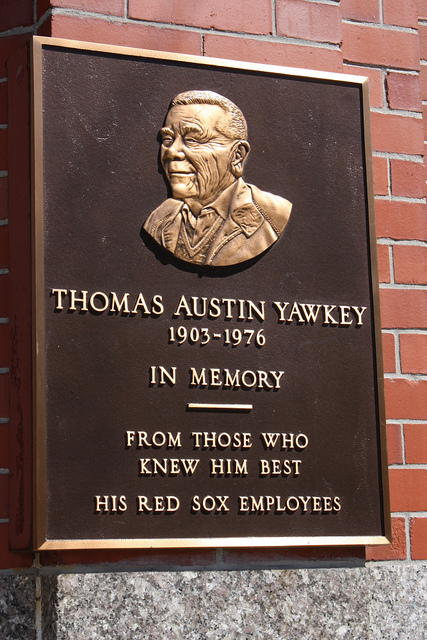
Yawkey TributeIt’s not often that I am called upon to rebut a web post that relies on one of my articles for its unethical conclusions, but that is the position that Ron Chimelis has placed me in with his recent essay, Why the Boston Red Sox should rename Yawkey Way.

To catch you up quickly: Tom Yawkey was a lumber tycoon and baseball enthusiast who owned the Boston Red Sox from 1933 to 1976, making him the longest-tenured team owner in the sport’s history. Yawkey was almost certainly a racist; if he was not a racist, his team’s policies certainly were for many years. The Red Sox were the last major league team to integrate, and blacks did not have a significant place on the team’s roster until the late 1960s, two decades after Jackie Robinson broke the color line. From the beginning, Yawkey ran the Red Sox as a public utility, paying little attention to the bottom line as he tried to build a winner out of the franchise that had been a perennial loser since selling Babe Ruth to the Yankees in 1919. After his death, Yawkey’s wife Jean continued the family tradition, running the Red Sox, except for a few years, until her own death in 1992.

When Tom Yawkey died, the City of Boston re-named Jersey Street, which runs past the entry to Fenway Park where the Red Sox play, Yawkey Way in his honor.

In the unerring clarity of hindsight bias, Chimelis argues that Tom Yawkey is undeserving of any recognition by the city that he devoted much of his life to representing, enhancing, serving, inspiring and entertaining because racism is the ultimate crime, and anyone possessing that vile state of mind should be consigned to shame forever. It is a common point of view, and an unfair one. Continue reading

Ethics Heroes: The New York Yankees

Yankees Wallpaper

You know how hard it is for the co-creator of “Pennant Pursuit, the Boston Red Sox Trivia Game” to write this.

It can’t be avoided though. The New York Yankees have, and not for the first time, upon reflection, demolished the oft-stated accusation that Major League Baseball is no longer a sport, but a business. This was always a false dichotomy, for from the days of rag-tag 19th Century baseball to the present, The Great American Pastime That Does Not Require You To Cheer Young Athletes Guaranteeing That They Will Spend Their Retirement In A Brain-Damage Haze has always been both, with each side constantly yielding to the other.

Coming off a disappointing season (the all-time most successful team in pro sports history missed the playoffs for only the second time in 19 years) and faced with an aging, injured, question mark-filled roster despite the highest payroll in the game ($228,995,945; the Houston Astros, in contrast, spend about 24 million, or less that the Yankees paid their steroid cheating third-baseman), and faced with baseball’s team salary luxury tax, which charges teams with a payroll exceeding 189 million for every dollar over it, the Yankees discarded their announced business plan of cutting back on salaries to avoid the tax threshold, and instead went on a spending binge. They snapped up most of the top free agent stars peddling their wares this winter, committing themselves to a staggering boost in contract obligations that will approach a half-billion dollars by the time the dust clears. Continue reading