An Ethics Lesson From the All-Star Game

It really is one of the most enduring sports deja vus—every year, sportswriters and fans engage in thousands upon thousands of words of complaint regarding baseball’s annual All-Star Game, the 2011 edition of which will occur tomorrow night in Phoenix. This year was no exception, and as is always the case, no consensus or conclusions were reached, except that everyone agrees that the game is mishandled, mismanaged, unfair and illogical in every possible way.

I have been thinking of the game’s plight as an ethics case study that proves a core truth: you can’t do the right thing if you don’t know your objectives, stakeholders, and how to prioritize them. In the All-Star Game as it has evolved, there are competing interests and stakeholders with no clear agreement regarding which takes priority over the other. It is literally impossible to do be fair: somebody always will be disadvantaged, and because there is no single objective either, utilitarian balancing doesn’t work.

It was not always this way. When the All-Star game was first conceived in 1935, it was intended to raise money for the players’ pension fund, the players then being generally paid little more than grocery clerks.  Since the game had to draw as much of a paying crowd as possible to make money, the rosters and starting line-ups were constructed to include the biggest stars and most popular players. It didn’t matter whether Babe Ruth was off to a great start or not: it wouldn’t be an All-Star Game without him in the starting line-up, so he was the right-fielder. Managers picked the team that they thought would both be the “starriest” and that would give them the best chance to win the game. Continue reading
Ethics Hero: Derek Jeter

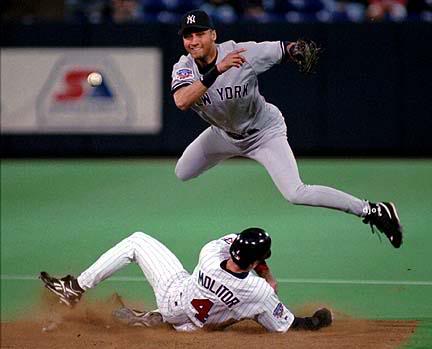
Roger Clemens is now on trial facing perjury charges. Barry Bonds has been convicted of obstruction of justice. Pacman Jones has just been arrested again; Tiger Woods hasn’t won a golf tournament since he was exposed as a serial adulterer. Through the travails and embarrassments of all of these and many more tarnished athletes who were once looked upon as cultural heroes, Yankee shortstop Derek Jeter has remained a constant— a team player, a clutch player, and an undeniably great player who has maintained his integrity and high values of competition and sportsmanship, never betraying the trust of his fans, his city, his team, or his game.

Yesterday Jeter reached 3000 hits, the watermark of the greatest of the greats, becoming the only lifetime New York Yankee to do so. He achieved the magic number with the flair only special players can muster, rising to a grand occasion like Ted Williams, hitting a home run in his final at bat, or Cal Ripken, marking  his passing of Lou Gehrig’s “iron man” record for consecutive games with a homer. Yesterday, Jeter passed 3000 in a rush, going 5 for 5 with the hit # 3000 being, yes, a round-tripper. Continue reading

Thanking Dick Williams…Finally

The late Dick Williams, doing what great leaders do

If you are not a baseball fan, or under the age of thirty, you probably never heard of Hall of Fame manager Dick Williams, who died yesterday at the age of 84. I never met Williams myself, but I have been indebted to him for four decades. I never told him the immense difference he made in my life, just by doing his job.

In the winter of 1967, I was a devoted fan of my home town team, the Boston Red Sox, and had been since 1962.  Over that period I had listened to every single baseball game on my transistor radio when a game wasn’t on TV, which was most of the time, or when I wasn’t at the game, which was almost always the case. I was the only person I knew who followed the team, and for good reason: it was torture. The Red Sox were hopelessly mediocre on the way to awful, and hadn’t had a winning season in more than ten years.

It is a great character builder to follow the fortunes of a terrible baseball team. Almost every day, for six months, you are let down, and yet return to the scene of your despair the next, attempting to muster hope while steeling yourself against likely disappointment. You find yourself finding things to appreciate other than winning: the gallant veteran player who “plays the right way” (Eddie Bressoud, shortstop, 1962-1965); the exciting rookie who gives promise of a better future (Tony Conigliaro, right fielder—rest in peace, Tony); the unique talent who is worth watching for his own sake (Dick Radatz, relief pitcher, 1962-1966). These things help, but following a perennial losing team and caring about them is like being punched in the gut four or five days a week without knowing which day you’re getting it.

Since 1965, I had always reserved seats for the first day of the season and one of the last two home games, just in case those last games would be crucial to a (hahahaha!) Red Sox pennant drive. This was especially pathetic, since the team was getting worse. They had finished in a tie for 9th place in 1966, and as the 1967 season loomed, Vegas had them installed as 100-1 underdogs to win the American League pennant. In truth, the odds should have been longer. Nonetheless, I wrote the Red Sox and got my tickets, this time for the next to last day of the season.

The team was full of rookies and near rookies, and appropriately had hired a minor league manager, Dick Williams, to be the new skipper. Williams was something else, however: he was a gifted leader. One day, in the middle of Spring Training, a Boston scribe asked the new manager what the prospects were for the upcoming season. Would the team escape the cellar? Would there be forward progress? Williams’ answer was instant front page news:

“We’ll win more than we lose.” Continue reading

Deadly Incompetence in Seattle….Luckily, It Was Just a Game

I know about the ADA, but still...hiring blind umpires who can't count just isn't working out...

It is rare that an ethics outrage repeats itself so closely that I could recycle a previous essay and just change the names. This occurred, however, in Seattle this past Saturday, in the baseball game between the Mariners and the San Diego Padres. San Diego’s Cameron Maybin walked on a 3-2 count (four balls are required by the rules) and eventually scored the only run of the game on Antonio Gonzalez’s fifth-inning single, allowing the Padres to defeat the Mariners 1-0 on Saturday night.

With one out in the fifth, Maybin walked when a pitch was called high by home plate umpire Phil Cuzzi. A video review of the at-bat by official scorer Dan Peterson confirmed the count should have been 3-2 when Maybin trotted to first base, meaning that his turn at the plate wasn’t completed. But Cuzzi, who like all umpires carries a pitch counter, saw that the stadium scoreboard showed a three-ball count before the pitch, and since 1) technology is always right 2) he wasn’t paying attention 3) he can’t count to “4” and 4) (or is it 3?) it isn’t like calling balls and strikes is his job or anything, he decided that the player had earned a base on balls. Continue reading

Ethics Dunce: Ex-Washington Nationals Manager Jim Riggleman

Jim Riggleman is a major league baseball manager of modest accomplishments, one of the forty or so men in the rotating pool that teams will use to fill manager vacancies with low-risk options rather than try someone promising but with little experience. He had a one-year contract with the hapless Washington Nationals that included a team option for a second, which the manager felt the team should pick up now, rather than at the end of the season.

Riggleman believed that he had some leverage. The Nationals have been surging since star third baseman Ryan Zimmerman has returned from an injury, and are, for the first time in the team’s  short time in Washington (they were once the Montreal Expos), flirting with a winning record more than half-way through the schedule. But as is often the case with players when a club option is involved, the Nationals saw no reason to make a decision on Riggleman’s contract until the season was over. A lot can happen in three months. General manager Mike Rizzo told Riggleman he would just have to wait. That’s what a team option is, after all. The team’s option. Continue reading

Andy Murray, Tennis Corrupter

That's nice, Andy: rub his nose in it.

Once upon a time, like, oh, a few years ago, tennis was a sport in which the ancient values of mutual respect between adversaries, honesty, fairness, and sportsmanship were paramount.  The periodic talented boors  like Connors, Nastase and McEnroe were aberrations, and their conduct was derided, colorful though it might be.

I am pretty sure that Scottish tennis star Andy Murray has put an end to this, unless the international tennis body or a public uproar puts an end instead to his bringing the tennis equivilent of NFL taunting and NBA showboating onto the court. Murray is a trick shot specialist, and at the London Queens Club tournament leading up to Wimbledon, he created a viral YouTube moment  when he hit a winner against opponent Wilfried Tsonga by swinging his racket under his leg. It was spectacular, flashy and fun. It was also rude, disrespectful and obnoxious.

Guess which the public cares about. Continue reading

Pointless, Obvious, Unbelievable Lies: How I Hate Them!

No, I'm not talking about Newt's statement that he is still a viable presidential candidate despite his whole staff quitting. But that too.

From the Washington Post:

A Northern California youth baseball league has barred Barry Bonds’ former personal trainer from coaching his son’s team. The president of the Burlingame Youth Baseball Association says Greg Anderson is not a registered coach and is prohibited from being on the field during games.Anderson, who has coached for years, was told of the prohibition after a parent complained about the convicted steroids dealer’s participation….Anderson spent three weeks in prison this year for refusing to testify at Bonds’ trial on charges that he lied about steroids use. Anderson earlier pleaded guilty to steroids distribution. Continue reading

Comment of the Day: “Schadenfreude, Ethics, and Those Fanatics Inside Us All”

Maybe "The Broadcaster" was all Harry had inside...

Rick elaborates nicely on the theme of my post on handling those fanatic personas that reside in each of us, and in the process takes the ethical measure of an iconic baseball broadcaster whose charms always escaped me…the late Harry Carey.

“It strikes me that there’s another part of the equation, which you only hint at here, but which you have mentioned in other posts. That’s the “ethics alarm” (to coin a phrase) that goes off, or should, when the director or the Red Sox fan or whoever That Guy is says or does something unethical. Part of it is “heat of the moment” stuff: the egoism that slips out in a moment of excitement. No, of course you didn’t want Thurman Munson to die, but yes, he did play for the hated Yankees, and their team just got worse. You’re forgiven the fist-pump. Once. And provided you (Jack, as opposed to Red Sox fan) didn’t mean it.

“I was watching a Cubs game on WGN sometime in the mid-1980s when news came over the wire that Montreal Expos infielder Hubie Brooks had suffered a season-ending injury. Brooks had been a favorite of mine when he’d played for the Mets (“my team”), and I continued to follow his career with some interest, so the news was doubly sad for me: a player had been seriously injured, and that player was Hubie Brooks.

“In contrast, Cubs announcer Harry Carey proclaimed “well, if it helps the Cubs win, it’s OK by me.” I remember the exact words 25 years later. What struck me was not that they were uttered, but that no one—not Carey himself, not his broadcast partner, no one—made the slightest attempt to walk them back. That was the official verdict: a season-ending injury (Brooks was never the same again, by the way) was a good thing if it happened to somebody in a different uniform. I mentioned the incident to a couple of friends—Cubs fans—and they laughed and said “oh, that’s Harry.”

“Everyone understood that Carey was a Cubs fan first and an announcer second. That was, I am told, part of his charm—I never saw it, but others did. Still, I was sort of hoping that there would be a human being in there somewhere. On that particular day, at least, I was disappointed. We lived in WGN country for another seven years. I never watched another Cubs game without turning off the sound.”

Schadenfreude, Ethics, and Those Fanatics Inside Us All

NBC baseball blogger Craig Calcaterra recently raised the sensitive issue of sports fan Schadenfreude*, something that I have been afflicted with from time to time. The occasion was the recent injury to San Francisco Giants catcher Buster Posey in a particularly gruesome collision at home plate. His comments made me think about the obsessed and narrow personas in all of us, and how we should regard their occasional callousness.

Posey was the 2010 National League Rookie of the Year; he is also a cornerstone of the Giants’ recent success: the team is the reigning Major League Baseball World Champion. The collision with Florida Marlins’ Scott Cousins simultaneously broke Posey’s leg, ended his season, jeopardized the career of an exciting young player (players often return from such injuries permanently diminished) and dealt a serious blow to the Giants’ chances of returning to the World Series in 2011.  Reacting to a blogger who suggested that the injury caused most non-Giants fans to  give “a little fist-pump”… because “their team’s chances of dethroning the Giants as World Series champions just got a little bit better,” Calcaterra wrote… Continue reading

Ethics Dunce: Buzz Bissinger

It took about an hour after the  Barry Bonds verdict for the first ethics-challenged national sports writer to write something outrageous about it. Not surprisingly, it was Buzz Bissinger, a the member in good standing of the Daily Beast’s stable of annoyingly hypocritical, biased or appallingly cynical writers, Bissinger belonging to the last category.

His post, which pronounced the Barry Bonds conviction “a travesty” in the title, contained one ethics howler after another, any of one of which would have justified an Ethics Dunce prize.

Here they are:

“It is true that the case of Barry Bonds does hit a new low, a new low in the waste of millions of dollars of taxpayers’ money, a new low in the witch hunt of a player who, because he was considered surly and arrogant and unlikable, is now having intimate details of his life revealed (such as testicle shrinkage), a new low in outrageous abuse of government power.” Continue reading