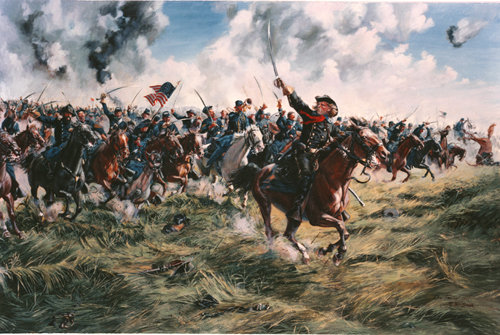
Today, July 3, in 1863 was the date of Pickett’s Charge, when Confederate General Robert E. Lee ordered a desperate Napoleonic advance against the Union line at Gettysburg in what has come to be a cautionary tale in human bravery and military hubris. The same day marked the zenith of the career of George Armstrong Custer, the head-strong, dashing cavalry officer who would later achieve both martyrdom and infamy as the unwitting architect of the massacre known as Custer’s Last Stand.
I have vowed to do all I can, which admittedly isn’t much, to get the story of what I like to call Custer’s First Stand into our nation’s cultural memory. I wrote much of what you are reading now way back in 2011, and have not adequately fulfilled my pledge since, although I have mentioned “Yellow Hair” (as his Native American conquerors called him) periodically over the years. Many historians have opined that Custer may have saved the Union army from defeat at Gettysburg with his bold actions this day, and therefore may have saved the Union itself. That accomplishment is far more important than the blunder at Little Big Horn that defines Custer’s image and reputation.
Custer’s heroics on the decisive final day of the Battle of Gettysburg teach their own lessons, historical and ethical. Since the East Calvary Field battle has been thoroughly overshadowed by the tragedy of Pickett’s Charge, it is little known and seldom mentioned. That is wrong.
Tell your friends and families the story, which has never been portrayed on screen. It is a really good story.
If you know anyone from Minnesota or is unfortunate enough to have to live in that ethically-addled state today, pause in your appropriate contempt for the blight on the Republic the Land of Lakes has become in recent years. Express your gratitude for their state, whose brave soldiers in this day in 1863 may have quite literally saved the United States of America and made this 250th celebration possible.
I know, I know. Minnesota has gone completely nuts. It has an incompetent, silly, uber-woke governor; its Attorney General is an anti-white racist and probably a criminal, the Mayor of Minneapolis is an Ethics Villain, it has an anti-Semitic Congresswoman who has openly admitted that her first loyalty is to Somalia, its opposition to ICE operations represents more of a genuine insurrection than anything that occurred during the 2021 Capitol riot, and the state is in a tight race with California, Washington, Oregon, New York and Maryland for the booby-prize of “Most Embarrassing State .” But ’twas not always thus.
July 2 was the second day of the decisive Civil War battle at Gettysburg, Pennsylvania, and the most complicated and wide-ranging day in the conflict. So much of desperate significance was going on at Seminary Ridge and Cemetery Ridge, on Little Round Top, the Peach Orchard, Devil’s Den and a half dozen other key features on the battle field that whether an instance of heroism was recorded or forgotten is as much a matter of chance as anything else. Even determining what was the turning point in the day’s conflict, which ultimately was won by the forces of the North, is an exercise in searching for order in chaos.
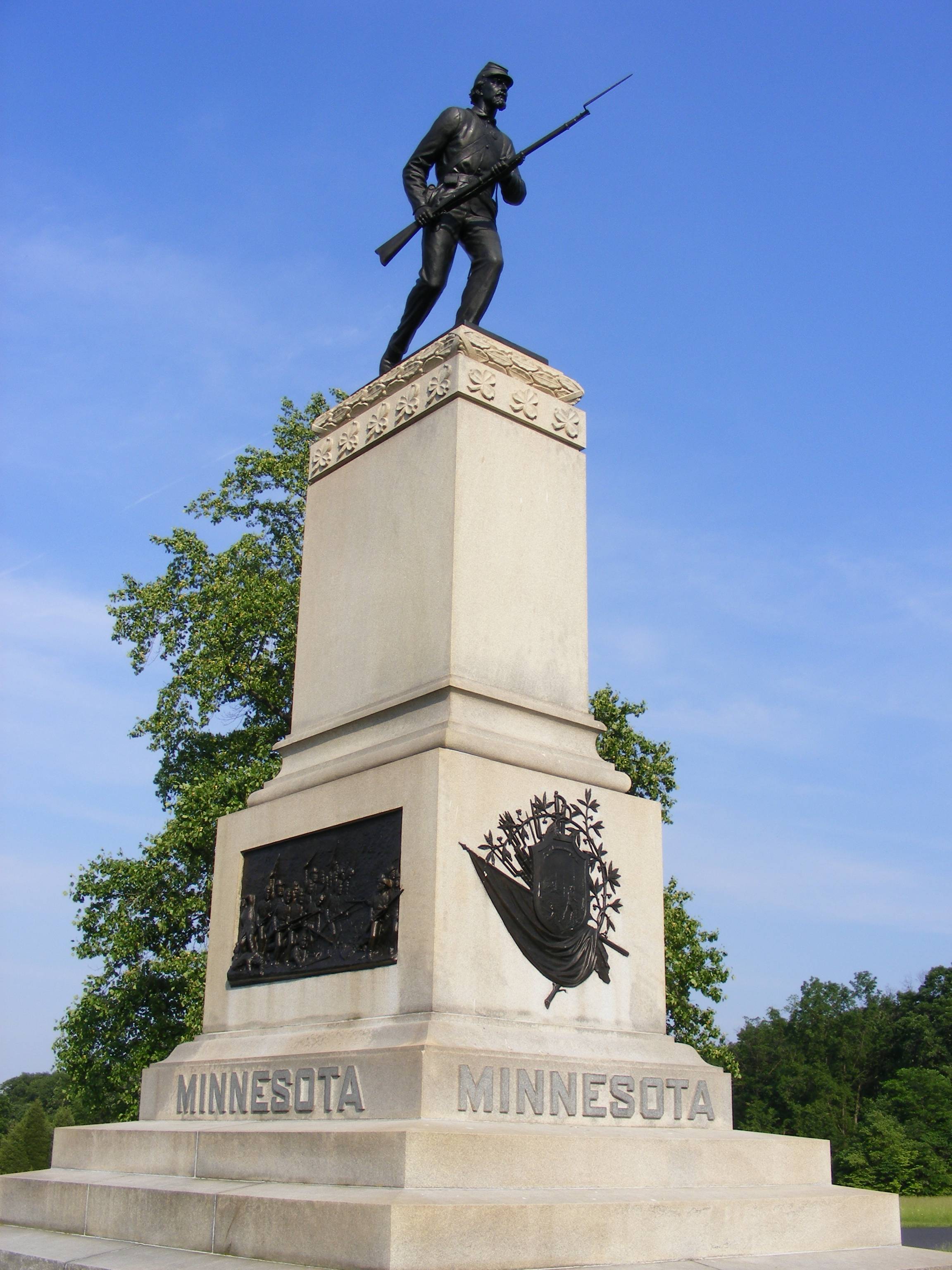
There is no question, however, that the First Minnesota Volunteer Regiment’s astonishing heroics stand out even among the many other examples of gallantry on that day. The battlefield monument to the First Minnesota is the largest erected to any Union regiment, and yet it has not guaranteed our cultural memory of the epic sacrifice those soldiers made. Other second day exploits, due to sometimes arbitrary choices made by historians and film makers, have taken up the limited space available in the public’s attention to the details of the Civil War.
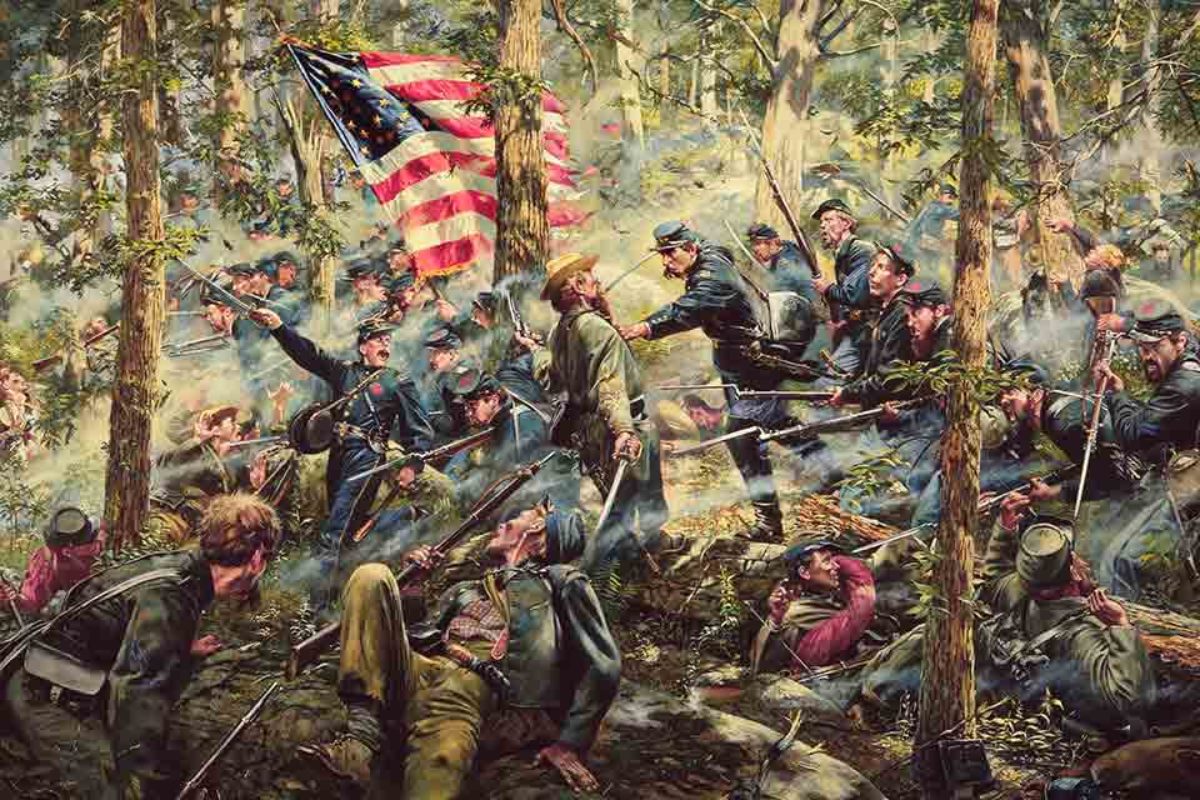
This is a massive injustice. As the battle raged for Cemetery Ridge, crucial high ground occupied by Union forces but under siege by the Grays, General Winfield Hancock saw a serious breach in the Union line. He realize, in horror, that Wilcox’s Alabama Brigade was on the verge of breaking through, possible dooming Meade’s army to defeat. The attack had to be blunted and and its advance stalled until he could round up sufficient reinforcements to repel the rebels.
Hancock ordered the First Minnesota to charge the brigade and hold the position, even though its 262 men was outnumbered by a force of more than 1200. It wasn’t quite the hopeless odds face by the defenders of the Alamo, but the regiment’s prospects were grim enough.
Today is July 1, which is always treated across the United States as the gateway to a long weekend and the Fourth of July, and little more. This year, it is the run up to the 250th Anniversary of out nation’s founding. July 1 is also, however, the anniversary of the first day of the Battle of Gettysburg, the most important and most deadly battle of the many important and deadly conflicts in the American Civil War. The two American armies that clashed in the Pennsylvania town sustained more than 50,000 casualties on the Gettysburg battlefield, which may be the saddest and noblest place in America. It is also reputed to be the most haunted, which considering the number of souls lost between July 1 and 3 in 1863, shouldn’t surprise anyone.
[Digression: The Gettysburg Hotel is allegedly haunted, and the proprietors designate specific rooms as haunted. The rent for those rooms is less than the other rooms because, I was told when I called to inquire regarding reservations, “guests tend not to stay the whole night in those rooms.]
Our 250th celebration is an appropriate time to remember Gettysburg, because it is one of those landmark events in American history that could have so easily turned out differently, and if it had, we would never have made to the Centennial, never mind the 250th. The fact that the North prevailed was due to a confluence of random events, the essence of moral luck.
If you have not made at least one pilgrimage to the battlefield, you owe it to yourself, to your family, and to the memory of the combatants, to go. You need not swelter in July. Gettysburg is just as inspiring in the Spring or Fall.
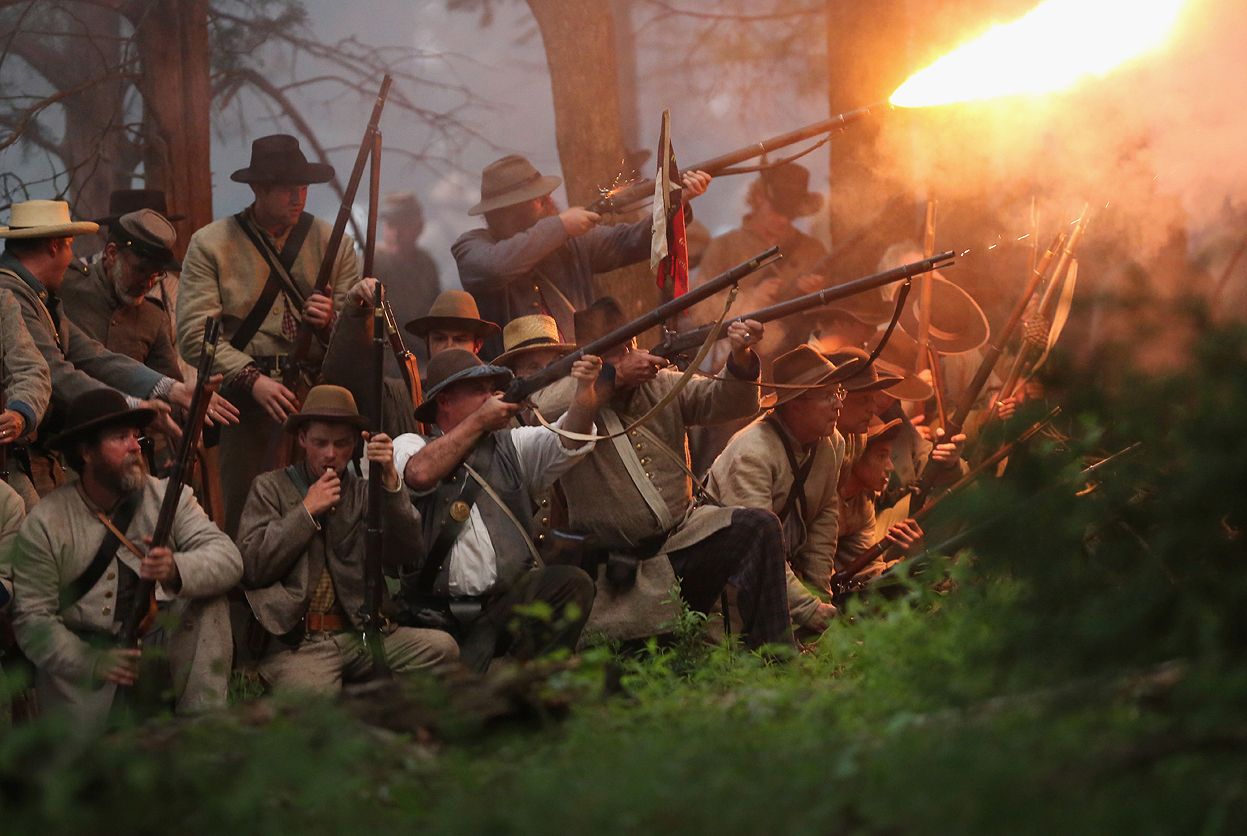
On July 2, 1863, during the second day of the Battle of Gettysburg with the fate of the Union and the United States hanging in the balance, Confederate General Robert E. Lee’s Army of Northern Virginia tried to break through the line of General George G. Meade’s Army of the Potomac at Cemetery Ridge, Culp’s Hill and Little Round Top. More than once that day, only luck and chaos prevented July 2 from marking the end of the nation as we know it, and from preserving slavery at least a little longer.
All accounts of the battle on July 2 are full of the word “confusion.” Robert E. Lee ordered Lieutenant General James Longstreet to attack by moving his troops up the Federal left flank while General A.P. Hill’s corps threatened the center of the Union line. If coordinated properly, General George Gordon Meade wouldn’t be able to move his troops to reinforce the Union left, where Lee instructed Lieutenant General Richard S. Ewell to make diversionary attacks and launch an all-out assault if possible. Lee’s plan, if successful, would force the Union army to surrender the positions it held on the high ground south of Gettysburg after the first day of the battle, and the entire Civil War might have been won by the South in a day.
My wife and I will finally be welcoming a new dog into the family tomorrow. It’s been more than a year since we lost Rugby, and it was time–for me, way past time. We met “Spuds” yesterday, who was being cared for by a wonderful woman who rescues and fosters abused and neglected dogs. Poor Spuds was given up to one rescue organization by his owner as a puppy, then adopted by a horrible woman who kept him in a tiny room and seldom fed him. A month ago, when he was removed from this monster’s home, he was about 20 pound underweight and suffering from malnutrition. You wouldn’t know it to meet him. Spuds is all white with a brown spot over one eye and flip-over ears, obviously some kind of pitbull-terrier mix. He’s 2 and a half year’s old, and, incredibly, trusting and eager to make friends with all dogs and people. He still has some rehabilitation to go through, but he’s a lively, athletic, loving dog with a sweet temperament, almost Rugby-like, but twice the size. Perfect.
“So, this fall, virtual class discussion will have many potential spectators — parents, siblings, etc. — in the same room. We’ll never be quite sure who is overhearing the discourse. What does this do for our equity/inclusion work? How much have students depended on the (somewhat) secure barriers of our physical classrooms to encourage vulnerability? How many of us have installed some version of ‘what happens here stays here’ to help this? While conversations about race are in my wheelhouse, and remain a concern in this no-walls environment — I am most intrigued by the damage that ‘helicopter/snowplow’ parents can do in the host conversations about gender/sexuality.” And while ‘conservative’ parents are my chief concern — I know that the damage can come from the left too. If we are engaged in the messy work of destabilizing a kid’s racism or homophobia or transphobia — how much do we want their classmates’ parents piling on?”
I have long advocated parents auditing their child’s classes just to prevent the kind of “teaching” Kay apparently engages in. It’s a basic tenet of practical ethics that if someone is a afraid of conduct becoming known, they know what the are doing is wrong, or may be viewed as wrong. Teachers have no justification for hiding the content of their classes from parents.
When Kay’s sinister comments prompted what should have been predictable criticism, he made his Twitter account private. Of course he did.
2. I saw this, thought it was too silly for words, then reader Michael sent me a link, and now I have to flag it. I’ve seen “Kindergarten Cop” several times; it’s one of my wife’s favorites, and one of “Ahnold’s” best. The unlikely story of a huge police detective with an Austrian accent going undercover as a kindergarten teacher to catch a criminal before he can kidnap and harm his estranged wife and their child, it’s funny and sweet, and intermittently exciting. However police-o-phobia is rampant during The Great Stupid, especially among hysterics and anarchists. So now that benign film has been declared dangerous.
Willamette Week reported that the movie was pulled from its slot at the Northwest Film Center’s drive-in summer cinema series in Portland after it was called offensive by deranged local author Lois Leveen. “There’s nothing entertaining about the presence of police in schools, which feeds the school-to-prison pipeline” she tweeted. Yes, that’s all it takes now for spineless administrators to cancel people, art, entertainment, anything.
Leveen even provided a perfect opening to shut her down with a curt, “You need help, Lois. Really. Trust us on this. This is pathetic” when, in an email, she compared “Kindergarten Cop” to “The Birth of a Nation.”
Right, Lois. And “Toy Story” is like “Triumph of the Will.” Continue reading →
I began the Fourth of July this year by watching the last 90 minutes of “Gettysburg,” Ted Turner’s epic 1993 film. My wife and I had begun watching on July 3, the date of Pickett’s Charge and the final day of the 1863 Civil War battle, but the more than four-and-a-half hour running time took me to Independence Day.
This was the extended version, the Director’s Cut, which adds 17 minutes of deleted scenes to the version shown in movie theaters, itself one of the longest movies ever offered to the American public. We had last watched the un-extended film from beginning to end on a VHS tape almost 30 years ago.
Observations:
“Gettysburg” is an ethics movie, and a great one. I don’t know why this didn’t come through to me the first time I watched it. Primarily it celebrates the Seven Enabling Virtues discussed in yesterday’s post, but the film teaches us a lot about leadership, integrity, compassion, duty, loyalty, and conflicts of interest.
If the film isn’t routinely shown in schools, and I’m sure it isn’t, that is a lost opportunity. A whole course of study could be based on the film alone, and it would be more educational than most history courses.
Some of the added minutes extend the Pickett’s Charge re-enactment, and the length of the sequence adds to its horror and wonder. How could anyone enthusiastically follow orders to attempt such a deadly march into enemy artillery and rifle fire, while lined up like tin rabbits at a shooting gallery, in an open field, even having to climb over fences?
The film makes it clear, and this is accurate, that it was the men’s trust and admiration, almost worship, of Robert E. Lee that made such insane valor possible. At Gettysburg, Lee abused that trust. He was warned that the plan was madness, and he was so certain of his own invulnerability that he persisted.
The film made me realize that it is likely that Lee’s famous “It was all my fault!’ refrain to his returning shattered troops signified his realization that his vanity and pride had been the direct cause for the Pickett’s Charge fiasco, and indeed the entire engagement. After the fiasco, the film shows Lee as a shattered man. General Longstreet, who repeatedly advises Lee to go around the Union entrenchment and take up a position on high ground between Pennsylvania and Washington, reminds Lee that even after the failed Confederate assault on Little Round Top on July 2, it is not too late for his plan to work. Lee replies that such a maneuver would be tantamount to a retreat, saying that he had never left the field of battle with the enemy in control, and is not about to start.
If General Lee was capable of listening to what he was really saying, he would have realized that he was using a personal motive to justify a decision that could not be justified rationally.Continue reading →
The anthemic music is the finale tothe 1993 film Gettysburg,which has one of my all-time favorite scores, by Randy Edelman. I have worn out three CDs, and this particular selection, “Reunion and Finale,” almost lost me my drivers license once when I was playing it loudly in my car and blew past the speed limit by 25 mph or so.
I will be interested to see if any channel shows Ted Turner’s epic this weekend. I’m sure it is now regarded as politically incorrect because the film does not portray the Southern generals and soldiers as vicious racists, and the balance that the film was praised for when it was released is now regarded as “pro-Confederacy propaganda.” That is a fatuous take on the film, which is about human beings, not politics, and arguably the most historically accurate historical drama ever made, based on what may be the best historical novel ever written, “The Killer Angels,” by Michael Shaara, just a wonderful book. Read it. You can thank me later.
Unlike July 2, one of the most significant dates in U.S. history with multiple major events, July 3 stands out for one momentous event. Even in the sequence of events leading to American independence, July 3 was relatively boring: it was devoted to the debate over Jefferson’s Declaration, resulting in more than eighty additions and redactions.
July 3 was the final day of the pivotal Battle of Gettysburg in 1863, reaching its bloody climax in General Robert E. Lee’s desperate gamble on a massed assault on the Union center. In history it has come to be known as Pickett’s Charge, after the leader of the Division that was slaughtered during it.
At about 2:00 pm this day in 1863, near the Pennsylvania town of Gettysburg, Lee launched his audacious stratagem to pull victory from the jaws of defeat in the pivotal battle of the American Civil War. The Napoleonic assault on the entrenched Union position on Cemetery Ridge, with a “copse of trees” at its center, was the only such attack in the entire war, a march into artillery and rifle fire across an open field and over fence. When my father, the old soldier, saw the battlefield for the first time in his eighties, he became visibly upset because, he said, he could visualize the killing field.
The battle lasted less than an hour. Union forces suffered 1,500 casualties,, while at least 1,123 Confederates were killed on the battlefield, 4,019 were wounded, and nearly 4000 Rebel soldiers were captured. Pickett’s Charge would go down in history as one of the worst military blunders of all time. Continue reading →
The Ethics Alarms countdown to the Fourth—you know, that racist holiday celebrating white supremacy?—begins today, one of the truly epic dates in our history. Of course, those who find history upsetting because it makes them feel”unsafe” don’t know any of this stuff, making them pretty much useless citizens with their ability to understand current events stuck at an infantile level.
On July 2, 1776, The Second Continental Congress, assembled in Philadelphia, formally adopted Virginia delegate Richard Henry Lee’s resolution for independence from Great Britain. The vote was unanimous, with only New York abstaining. Of course, Richard Henry Lee was Robert E. Lee’uncle and a slave-holder, so we really shouldn’t remember him or his significance to our nation’s independence.
Never mind.
On July 2, 1839, enslaved Africans on the Cuban schooner Amistad mutinied, killing two crew members and seizing control of the ship, which had been transporting them to be slaves on a sugar plantation. This set in motion a series of events that ended with the U.S. Supreme Court ruling, with only one dissent, that the Africans had been illegally enslaved and had exercised a natural right to fight for their freedom. Massachusetts Congressman John Quincy Adams, the sixth president of the United States from 1825 to 1829 who, like his father, was a passionate foe of slavery, served on the Africans’ defense team. With financial assistance of abolitionists , the Amistad Africans were returned to their homes in West Africa.
They never teach this story in schools, but your kids can read about ithere.Continue reading →
1. “General, I have no division!” At about 2:00 pm, , July 3, 1863, by the little Pennsylvania town of Gettysburg, Robert E. Lee launched his last, desperate and audacious stratagem to win the pivotal battle of the American Civil War, a massed Napoleonic assault on the entrenched Union position on Cemetary Ridge, with a “copse of trees” at its center. The doomed march into artillery and rifle fire, across an open field and over fences, lasted less than an hour. The Union forces suffered 1,500 casualties,, while at least 1,123 Confederates were killed on the battlefield, 4,019 were wounded, and nearly 4000 Rebel soldiers were captured. Lee’s bold stroke had failed spectacularly, and would go down in history as one of the worst military blunders of all time.
That verdict is debatable, but this is not: Pickett’s Charge, as the attack came to be called, holds as many fascinating ethics lessons as any event in American history, and this blog has returned to it for enlightenment time and time again.
Pickett’s Charge also teaches that leadership requires pro-active decision-making, and the willingness to fail, to be excoriated, to be blamed, as an essential element of succeeding. Most of all, perhaps, it illustrates the peril’s of hindsight bias, for without a few random turns of fate, Robert E. Lee’s gamble might have worked.
2. Funny how if you continually denigrate someone based on his color and gender, he will eventually stop respecting you. Stanford University has established a Men and Masculinities Project that aims to help men develop “healthy and inclusive male identities”—because they obviously don’t have those now. “We acknowledge that male identity is a social privilege, and the aim for this project is to provide the education and support needed to better the actions of the male community rather than marginalize others,” anti-man-splains Stanford’s gurus. Stanford, of course, is not alone in pushing the ubiquitous progressive narrative that men are toxic, along with whites, making white men the worst of all. Perhaps this might explain why support for Democrats among young white men is falling fast.
Nah, it must be because they are sexist and racist…
3. But..but…settled science!The Economist estimates that as many as 400,000 papers published in supposedly peer-reviewed journals were not peer-reviewed at all. Scientists, scholars and academics are no more trustworthy or alien to unethical conduct than anyone else, but because most of the public (and journalists) don’t understand what they write about and have to accept what they claim on faith, they are presumed to be trustworthy.
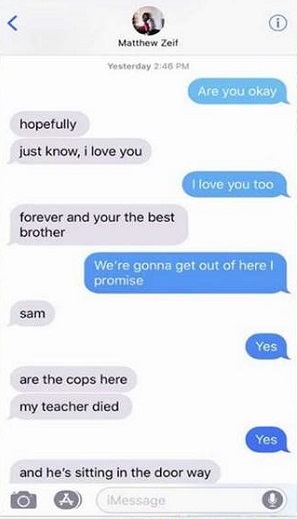
Cross the Parkland shooting with the ethical problems created by technology, and you get this..
One of our engaged readers sent me this story, about how real-time texting and tweeting have become standard fare during mass shootings and other crisis situations. The story is full of positive words for the phenomenon….
The texts hit a nerve with people because they’re so gut-wrenching and real, Pamela Rutledge, director of the Media Psychology Research Center, tells Yahoo Lifestyle. “They are highly emotional, and enable people to feel empathy and a connection to what the students were feeling at the time,” she says. Social media in particular is good for sharing these texts, Rutledge adds. “Removing the sense of mediation in connection is what social media does best,” she says. “It transports people into events and allows them to share the feelings more intensely.”
The messages are also stimulating to people and create a horror-story-type feeling — except they’re not made up, clinical psychologist John Mayer, author of Family Fit: Find Your Balance in Life, tells Yahoo Lifestyle. That can also make the experience more real. “They bring the reality of the dangers in the world into one’s life and right into your personal space,” Mayer says. “Therefore, it becomes even more frightening.”
The texts also allow people to experience the events vicariously, albeit from a safe distance, and can prompt feelings of gratitude and appreciation for the safety they do have, Rutledge says.
But these kinds of texts really resonate because they’re authentic and straight from the source. “They are real-time reporting of feelings and events,” Rutledge points out.
Well, it’s certainly nice that vivid reporting comes out of massacres! What would we do without social media and cell phones!
My reaction is completely different: Why are these people texting and tweeting in the middle of a crisis?Continue reading →