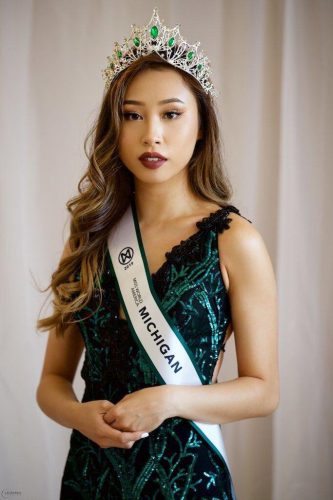
20-year-old Miss Michigan Kathy Zhu was stripped of her title because she tweeted against the mandatory wearing of hajibs, and the about the problem of black-on-black violence.
MWA Michigan State Director Laurie DeJack announced the measure, writing Zhu,
“It has been brought to the attention of Miss World America that your social media accounts contain offensive, insensitive and inappropriate content, and in violation of MWA’s Rules and Conditions, specifically the contestant requirement of ‘being of good character and whose background is not likely to bring into disrepute Miss World America or any person associated with the organisation. Therefore, and effective immediately, MWA does not recognize you as a participant of any sort or in any capacity as it relates to any and all events of MWA. Furthermore, let this communication serve as official notice to remove any mention of yourself as a participant in MWA from all social media platforms (including photographs of you wearing the MWA Michigan sash and/or crown, and any text claiming to be a participant of MWA events).”
What were the messages that led the organization to conclude that Zhu exhibited bad character that brought “disrepute” on the pageant group? Last year, Zhu tweeted critically about a “Try a hijab” booth on campus, writing “So you’re telling me that it’s now just a fashion accessory and not a religious thing? Or are you just trying to get women used to being oppressed under Islam?” Later, Zhu tweeted, “Did you know the majority of black deaths are caused by other blacks? Fix problems within your own community first before blaming others.”
Zhu is refusing to apologize, and has gone on offense, writing back in part, Continue reading

 Ethics Alarms