“Villain” is the best I can muster right now. I really can’t find the right word for someone who would do what Sofia Nelson did, or who would be able to look at themselves in the mirror after she did it.
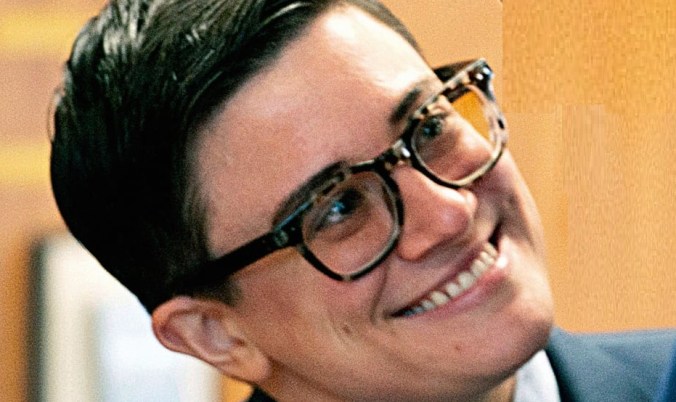
Nelson, a close friend of J.D. Vance’s in law school and for many years thereafter, sent about 90 of the emails and text messages they exchanged from 2014 through 2017 to The New York Times. Nelson is gay or a trans-male or a trans-female, or something, I couldn’t possibly care less. Nor will I read the Times’ article about what its partisan “Slime Trump and Vance!” posse found in the emails thus far. All that matters from an ethics perspective is the throbbing betrayal of trust represented by anyone the sharing past private communications with a media outlet without obtaining consent and permission from the other party to the exchanges. It’s revolting that the Times would accept such stuff: this is a National Enquirer level story. Trump’s running mate once wrote “Love you” to a guy who is now a chick! Ew! Does that mean Vance is gay, not that there’s anything wrong with that?
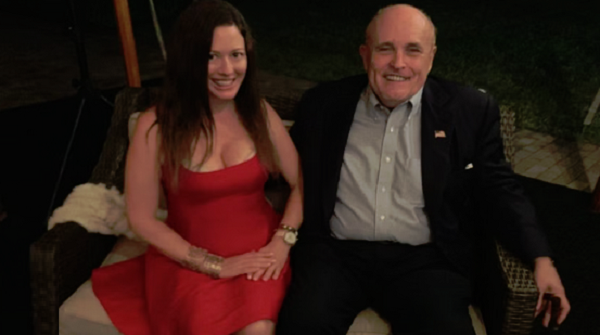
I don’t mean Rudy Giuliani. Maybe the former mayor of New York City really did harass and “sexually assault” Noelle Dunphy, seen above with Rudy, after he hired her (she says) in January 2019 when the old prosecutor was 75 years old. Even if that is true—and, frankly, no man over 60 these days is likely to be able to avoid committing legal harassment, as in creating a “hostile work environment,” working closely with a young woman who is looking for offenses to protest (See:Joe Biden, the late George H.W. Bush, and too many others to count.)—Giuliani is at least partially the victim here. Use the wrong word and it’s pervasive sexism; touch a shoulder without consent and it is “assault.” Yes, there is no excuse for men of any age not to keep up with the evolution of ethics in this area and others, but kindness, compassion and the Golden Rule dictate a reaction other than lying in wait for an opportunity to exact revenge or worse, exploit a past relationship for current personal gain.
Rudy is currently under attack from all sides, primarily as part of an organized effort to punish the allies of Donald Trump, particularly the lawyers. Already named as a co-conspirator in the latest indictment of Trump, Giuliani is in the process of being disbarred in the District of Columbia on the theory that he “helped destabilize our democracy” and “done lasting damage” to the oath to support the U.S. Constitution that he had sworn when he was admitted to the bar. [No further comment from me: I have a conflict in this matter] Dunphy or her lawyer decided that this was the perfect time to pounce, with Giuliani already being savaged in the news media like anyone who doesn’t publicly reject Trump. So she not only chose now to sue him, she also included embarrassing quotes the old man made when he thought the two were alone and his comments were private.
“Jews! They want to go through that freaking Passover all the time. Man, oh, man. Get over the Passover. It was like 3,000 years ago. OK, the Red Sea parted. Big deal. Not the first time that happened.” Says the Times, “In another portion, he engaged in a derisive discussion of the size of Jewish men’s genitals.”
Sexism? “In another transcript, Mr. Giuliani says that he is physically aroused by Ms. Dunphy’s intelligence, adding, ‘I’d never think about a girl being smart. If you told me a girl was smart, I would often think she’s not attractive.'”
Prop comic Gallagher, once a college campus comedy superstar, died last week, reviving memories of a classic ethics family drama with many life lessons attached.
Gallagher (first name, never used professionally: Leo) was an acquired taste that I never acquired, but he had many TV specials, a famous bit (smashing things, especially watermelons, with a sledgehammer), and even ran for Governor of California. In 1987, researchers at Loma Linda University in Southern California took blood samples from medical students while they watched Gallagher’s antics. Their white blood cell levels increased the more they laughed at him. His comedy, the study concluded, strengthened their immune systems.
Why hospital staffs don’t smash watermelons in cancer wards, I don’t know. But I digress.
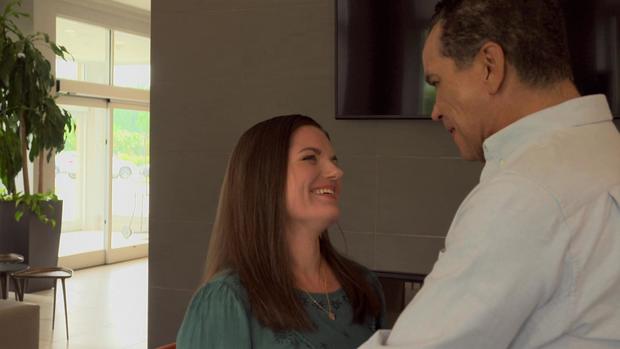
The story of the rejected and abandoned Russian orphan haunted “48 Hours” reporter Troy Roberts after he bid the girl farewell in the Russian hospital. He wanted to know what had become of her, and tried to track her down over the years, with no success. Then, after more than two decades had passed, Caralee reached out to him and they arranged to meet once again.
That supposedly homicidal little girl who was diagnosed as incapable of love now lives in North Carolina as Sabrina Caldwell. She is 33, happily married and has four young children. Roberts met with her near Sabrina’s home, and he spoke with her husband as well. Sabrina explained that she was depressed and even suicidal when she was with Crystal and Jesse, who she felt were more interested in her younger brother than her. When she was falsely accused of trying to kill Joshua, whom she says she loved, she told Roberts she “wanted out.” She agreed that she tried to kill him. She made up the claims that she was hallucinating. When she was abandoned by her adoptive parents in Moscow, she said she felt like she was in jail, but now believes she was partially responsible, since she had agreed to her parents’ version of events and lied about hallucinating.
Then again, she was just a child at the time.
After two months in the mental hospital, Nina Kostina, who had helped arrange her adoption, rescued Sabrina and brought her back to the United States. Three years later she adopted by another family in North Carolina. n 2008, Sabrina volunteered for the non profit Mercy Ships, spending two years providing medical care to the poor in Africa. That led to a job at a hospital when she returned to North Carolina. Two years later, she fell in love with fifth grade teacher Phil Caldwell, whom she met through her church. Before she would agree to marry him, she made him watch the “48 Hours” episode about her first adoptive parents. He told Roberts that he was stunned at what she had gone through. They were married in 2014, and now have three daughters and an infant son. Sabrina Caldwell has never been diagnosed with any mental or emotional illness, and takes no medication for such disorders. Continue reading →
At the end of last year, CBS’s “48 Hours” broadcast an update of a horrifying episode from two decades ago. I missed both programs, but I stumbled upon a rerun of the December 2021 follow-up last night. The tale is a true ethics train wreck that, incredibly, had a happy ending, making it also an abject lesson in moral luck.
The story had special resonance for me because it involved the aftermath of an American couple adopting of a Russian orphan, a process my wife and I went through as well. In 1997, Crystal and Jesse were a young married couple who had tried and failed to conceive. They fund Russian adoption agency’s website and were smitten by a photo of a beautiful 9-year-old girl. The couple began the adoption process. The child’s medical records from the adoption agency, were concerning, though: they described developmental problems.
CBS made a big deal about this, but essentially all older Russian orphans have developmental issues. Crystal told CBS that the “were assured that this child was healthy and that in a good home … with the best doctors in America helping her with the developmental issues, that she should be fine.” That was accurate advice (and she and her husband should have known that by doing responsible research before deciding to adopt a Russian orphan). I should also mention here that Russian medical records regarding orphans are notoriously unreliable. Our son, who has been freakishly healthy, came with ten pages of supposedly serious medical problems. Our pediatrician literally laughed at the document. Continue reading →
Judge Michelle Odinet of the City Court of Lafayette, Louisiana, resigned last week after being heard on a video using the term “nigger” while watching security footage of a foiled car burglary outside her home. In her letter of resignation to the chief justice of the Louisiana Supreme Court, Odinet said she was stepping down “after much reflection and prayer, and in order to facilitate healing within the community.”
“My words did not foster the public’s confidence and integrity for the judiciary,” she wrote. Yeah, I would say that that’s accurate. Still, it’s a strange story. In the video, voices off camera inside the judge’s home are heard saying “nigger” repeatedly and laughing as they watch security-camera footage of someone trying to break into a car until the criminal was foiled. Also used: “mom,” which is the judge, who was clearly joining in the hilarity.
The video was originally sent by an unknown source to a local newspaper, and when she was first questioned, Odinet tried to huminhumina out of the mess. She initially said she had no recollection of the conversation shown, and claimed that her “mental state was fragile” because of the attempted burglary. She also used the excuse that she had been “given a sedative at the time of the video.” Then she played the Pazuzu card (“That’s not me talking!”) protesting that “Anyone who knows me and my husband, knows this is contrary to the way we live our lives.” Continue reading →
My late friend Bob McElwaine was of another era for sure. Once an active Hollywood publicist with many A-list clients, Bob once peddled his memoirs to publishers. He was an excellent writer with a great sense of humor, but was told repeatedly that unless he included “dirt” on his famous friends, girl friends and clients (like Danny Kaye, Robert Mitchum, Janet Leigh and Dean Martin) the book was a non-starter. Bob refused. “My clients hired me to be discrete and to keep their secrets,” he said. “It doesn’t matter if they are dead now: I’m not betraying them for a check.” (Bob did tell me some his experiences, knowing that I would not publish them. Yikes!)
Well, Bob is dead, and so is his brand of professionalism, trustworthiness and honor, as two forthcoming books demonstrate.
Baseball had a rare PR triumph earlier this month when it held a regular season game between the New York Yankees and the Chicago White Sox in the Iowa cornfield diamond that was the setting for the cult movie favorite “Field of Dreams.” The TV ratings were the best for any regular season broadcast in 16 years. That’s amazing, but maybe it shouldn’t be. Despite rumors of its demise, baseball still has a cultural bedrock of tradition, nostalgia and history unmatched by any other sport, professional or amateur. So many Americans would not tune in to a baseball game if they didn’t still have a flicker of affection for the sport, and if your argument is, “Yeah, but that’s just because of the movie,” the movie wouldn’t have become iconic if a lot of people didn’t care about baseball. As Terrence Mann said,
Now my confession: I’m not a wild fan of the film, nor that scene. The scene in particular is unforgivably stagey and artificial: it’s right out of the (much better) book, “Shoeless Joe,” and not even the great James Earl Jones could make it sound like anything but a recitation. I got annoyed, during the hype for the game broadcast, with “Field of Dreams” being repeatedly called “The greatest baseball movie.” I don’t regard it as that; I think it just barely makes the top five, and I could be talked out of ranking it that high.
For good reasons, many baseball writers, fans and bloggers have criticized the film over the years, and not just because it is shamelessly manipulative. But it is that. Baseball writer Craig Calcaterra, a vocal debunker of the film, writes,
“I will fully admit that a story about a father and son repairing a longstanding rift over a game of catch — with or without the magical realism elements — could form the basis of a MAJOR chills moment in an absolutely fantastic movie. The problem, as I’ve said in the past, is that “Field of Dreams” does not earn its chills moment. It is lazy in that it does not sketch out the dispute between Ray and his dad in anything approaching realistic terms — it’s dashed off in the rushed intro with almost no details — and it does nothing to explain why Ray’s moving the Earth and the Heavens to bring his dad back to that ball field is so important or why it serves as the “penance” Ray must pay for whatever reason. With no buildup or backstory, there’s no payoff.”
But worse, for me and others, is the slipshod handling of baseball history. “Shoeless Joe” Jackson was not innocent of taking a bribe to throw the 1919 World Series, he was guilty. He was not a thoughtful, wise-cracking Ray Liotta, he was just north of being a moron. He batted left-handed, and famously so, not right-handed like Liotta. When Frank Walley’s character, a magically reincarnated and youthened old ballplayer named Archie “Moonlight” Graham, whose single appearance in the major leagues was in 1905, is nearly beaned by a close pitch, he says “Hey ump, how about a warning?” Umpires didn’t warn pitchers for throwing at batters in 1905, and not for more than a half-century after that. Sloppy.
I have some very dear friends who are still angry with me for writing this admittedly harsh analysis of their favorite Christmas movie. Maybe that’s why I didn’t post it last Christmas season; I don’t know. It really is an ethics mess, however, and as I’ve stated elsewhere this week on Ethics Alarms, if you are going to make an ethics movie, someone involved ought to have functioning ethics alarms. The heartwarming ending—I still get misty when the old general played by Dean Jagger, gets saluted and serenaded by his reunited army unit—doesn’t make up for all the gratuitous lying and betraying going on in the rest of the film.
I have never mentioned this here before, but the movie was the result of an ethical act by one of the most unlikely people imaginable, Danny Kaye. If you search for Danny here, you will find that I have more connections to him than to any other entertainer, primarily through my co-writing and direction of an original musical about him, written by his long-time publicist and my friend. I credited Kaye with my interest in performing, musicals, and comedy, but my research into the real man was disheartening: in stark contrast to his persona and his public image, Danny was a miserable, paranoid, selfish, mean and insecure sociopath when he wasn’t playing “Danny Kaye,” which could be on stage or off it. “White Christmas” had been conceived as a re-make of “Holiday Inn” with the same cast, Bing Crosby and Fred Astaire. Fred couldn’t do the project, so his part was re-written for Donald O’Connor, who became ill so close shooting that there was no time to retool the script and have the film ready for its target holiday release. In desperation, the producers asked Kaye if he would play Bing’s side-kick even though it meant 1) playing a support, which he had never done in a movie since becoming a star 2) playing a role that couldn’t highlight his special talents 3) subordinate himself to Bing Crosby, who was indeed the bigger star and box office draw, and most daring of all, expose his own limitations by doing dance numbers created for Donald O’Connor. Kaye was not a trained dancer, just a gifted mimic and athlete who could do almost anything well. Danny (actually Sylvia, his wife, agent and and career Svengali) had his price for the rescue: he demanded $200,000 and 10% of the gross.
Everyone around Danny Kaye was shocked that he agreed to all of this. Not only did he agree, he also amazed everyone by not playing the under-appreciated star on set, by doing O’Connor’s choreography as well as he did, and by knowing how not to steal focus from the star, something he infamously refused to do when he was in “Lady in the Dark” with Gertrude Lawrence. The movie was the top grossing film of 1954, and the most successful movie musical up to that time.
Danny’s good deed was punished, because today it is by far the most seen of his films, and is likely to be the source of his public image as time goes on. Yet it is not his best movie, or a fair representation of what made him a unique and popular supporter. Like Darren McGavin, a fine and versatile dramatic actor cursed to be remembered only as the father in “A Christmas Story,” Danny’s slice of immortality also minimizes his legacy and talent. Watch “The Court Jester.” With your kids or grandchildren.
William B. Crews, an official at the National Institutes of Health, announced his retirement this week after he was outed as surreptitiously attacking the NIH and particularly Dr. Anthony Fauci in posts on Twitter and on the right-wing website RedState using the screen name “Streiff.”
Crews worked for and promoted the National Institute of Allergy and Infectious Diseases while simultaneously undermining the agency’s work with his posts since March. His deception and betrayal was exposed by The Daily Beast.
A representative comment Crews wrote on RedState in June read, “We’re at the point where it is safe to say that the entire Wuhan virus scare was nothing more or less than a massive fraud perpetrated upon the American people by ‘experts’ who were determined to fundamentally change the way the country lives and is organized and governed.”
This is a perfect Ethics Dunce performance, because what Crews did was both unethical and dumb. Screen names tend to get discovered, and something like this is a career-breaker. It’s also a cowardly and ineffective way to make an impact, if the objective is to actually accomplish something. Secret whistle blowing only works these days if your objective is to take down the President.
The ethical way to have an effect on policy and public opinion is to make objections like “Streiff’s” public and under one’s real name. It also helps if you can prove your claims. Continue reading →




 Ethics Alarms