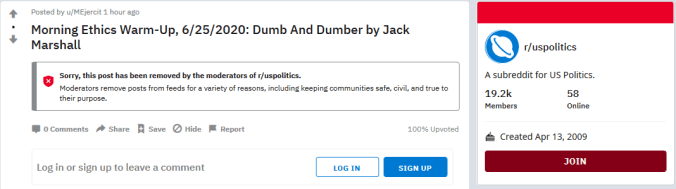
Ethics Alarms reader and frequent commenter Michael J. Ejercito reports that he tried to post this morning’s warm-up on the U.S. politics Reddit and got the above response.
Your Ethics Alarms Ethics Quiz of the Day is…
Ethics Alarms reader and frequent commenter Michael J. Ejercito reports that he tried to post this morning’s warm-up on the U.S. politics Reddit and got the above response.
Your Ethics Alarms Ethics Quiz of the Day is…
It is clear, if it wasn’t already, that everything hinges on whether the American public is as stupid and inattentive as those seeking to manipulate it think it is.
1. Mobs? What mobs? I just listed to CNN’s health expert, Dr. Gupta, list the reasons there has been a surge in Wuhan virus cases. Notably absent from his list were the mass, no social distancing demonstrations/protests/riots that began two weeks ago as a prominent part of the George Floyd Ethics Train Wreck. These, as you may recall, were largely supported by the health experts (though I don’t have a record of Gupta being among them) as they apparently decided that Black Lives Matter matters more than all the black lives that would be put in danger by ignoring the safety measures we shut down the country to install.
I also have yet to read a single news story about the new cases of the virus that highlights the completely predictable effect of the mobs, which are still roaming, as a factor in the so-called “surge,” though I can’t check everything.
Is the news media really certain that if they don’t report this connection, it will never occur to most of the public? I’m already reading accusations that opening up the states is “racist” because of the evidence that African-Americans have contracted the virus and died from it at a higher rate than the rest of the public. By that logic, encouraging the mobs of George Floyd protesters was also racist.
To re-phrase Wilford Brimley from his great scene in “Absence of Malice”: “American Public, are you that dumb?” So far, it seems so. Continue reading

I know these stories are stupid, but I love them, and besides, I can’t pass up the chance to correct Jonathan Turley.
Justin Arthur Allen Couch, 25, pictured above, is charged with using a machete to attack the victim in the arm and leg during an argument in Tarrytown, Florida. The victim is alive but may have permanent injuries. Couch, as you can see above, has a drawing of a machete tattooed on his face. I’m sure it’s just a coincidence.
Of course, the tattoo doesn’t prove that he’s guilty of a machete attack. It’s circumstantial evidence at best. In fact, if I were defending Couch, I’d be tempted to argue to the jury that the machete should make them question whether Couch was the attacker. Who would be so stupid as to use a machete as a weapon when one is right there on his face? I sure wouldn’t. I’d use a hammer, a golf club, a seafood fork, indeed anything but a machete.
Then again, I would never have a machete tattooed on my face. That act alone raises a rebuttable presumption that Couch is an idiot.
Professor Turley, writing about the case, opines,
Face tattoos are unlikely to be receive assistance from the court in allowing a shroud or covering. The machete tattoo is one of the choices in life that comes back to haunt you in your machete attack case.
The Professor could doubtless make me look like a baboon in a law school class, but he is wrong on this topic, which is a specialty of mine. Turley cites some amusing cases, like the man accused of sexual assault with a forehead where a tattoo reads “I’m a pornstar. I fuck Teen Sluts”…
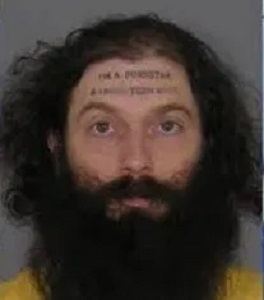
…and this doofus, who faced charges for multiple crimes….

I was musing early yesterday about whether calling the current reaction/over-reaction/ exploitation/ “Hey great now we can do all kinds of stuff because nobody will dare say no to us!” to the George Floyd video a “freakout” was excessively denigrating it, trivializing or misrepresenting it. I decided it was all three. By the end of yesterday, I realized I was wrong.
I’ll still use the “George Floyd Ethics Train Wreck” tag on posts emanating from this madness, but ethics train wrecks, situations where virtually anyone who gets involved instantly engages in unethical conduct, are more rational than ethics freakouts, which are almost entirely fueled by emotion, hysteria, hate, present time perspective, and mob mentality.
I haven’t used the description often here, but looking back through the lens of history, I’d list among past freakouts the Salem witch trials, the French Revolution and “The Terror,” World War I, the Holocaust, and the U.S.’s ” Red Scare.” There are others; I’m not looking to compile the definitive list. The definition of a freakout, as opposed to a an ethics train wreck, is partially that once the fever has passed, virtually everyone looks back on the event and thinks, “What the hell? How did that happen? What was wrong with those people?” The other distinguishing factor is that while wise members of a society will contend with each other during an ethics train wreck and try to stop the runaway train, the tendency of the un-freaked during a freakout is to try to keep their heads down, avoid making eye contact, and if confronted with one of the raving, just nod and mutter, “Sure. Whatever you say.”
THAT, as the partial list above demonstrates, is a dire mistake. Ethics freakouts get people killed, and do damage to lives and society that can take decades to repair. Continue reading
Things could be worse!
For example, I bet you thought a week ago that being in the middle of a pandemic was bad. What I have noticed, and if you’ve been reading regularly, so have you, is that we are increasingly being told by journalists, pundits and politicians that up is down, day is night and black is white, and we are expected to believe them. (They think we are really, really gullible.) This is Rationalization #64, Yoo’s Rationalization, “It isn’t what it is,” the rationalization version of “The Jumbo.” (“Elephant? What elephant?”) The society that allows such brazen misinformation to permeate its culture is on a fast track to totalitarianism.
Here are two recent examples….
1. Multiply the hypocrisy of Prof. Charles Bergstrom’s tweet by 1200, and you get…this, an open letter from health and medical officials making the head-exploding argument that protests/riots around the United States should not be discouraged the way they discouraged every other public gathering. Everything I could say about this final proof that too many medical and health experts lack basic professional integrity, making the degree of trust placed in their advice by policy-makers, the media and the public not merely unwarranted but irresponsible, I have written here already. However, the text of the letter also suggests that too many medical and health experts just aren’t very bright. How else could one explain statements in the letter like,
“We created the letter in response to emerging narratives that seemed to malign demonstrations as risky for the public health because of Covid-19,” according to the letter writers, many of whom are part of the University of Washington’s Division of Allergy and Infectious Diseases. Instead, we wanted to present a narrative that prioritizes opposition to racism as vital to the public health, including the epidemic response. We believe that the way forward is not to suppress protests in the name of public health but to respond to protesters demands in the name of public health, thereby addressing multiple public health crises.”
In other words, ‘We oppose maligning demonstrators as risky to the public health although we have maligned demonstrators in other contexts as risky to the public health but because of the purpose of these demonstrations, they aren’t really risky to the public health compared to the risks of not addressing what they are protesting about, although nothing about the actual demonstrations will address those risks.’ Not only is this Rationalization #64, Yoo’s Rationalization, “It isn’t what it is,” it’s Authentic Frontier Gibberish! To state the obvious, or what should be, one may oppose racism without spreading the Wuhan virus: oppose it by staying home, Zooming, writing blog posts, anything but getting in the middle of mobs. Also “Respond to protesters’ demands” is an imaginary action: “Fix everything!” is not a demand capable of responding to.
Then there is this head-spinner:
“Staying at home, social distancing, and public masking are effective at minimizing the spread of COVID-19. To the extent possible, we support the application of these public health best practices during demonstrations that call attention to the pervasive lethal force of white supremacy. However, as public health advocates, we do not condemn these gatherings as risky for COVID-19 transmission. We support them as vital to the national public health and to the threatened health specifically of Black people in the United States. We can show that support by facilitating safest protesting practices without detracting from demonstrators’ ability to gather and demand change. This should not be confused with a permissive stance on all gatherings, particularly protests against stay-home orders.”
Never mind losing all respect for supposed medical professionals who could put their names on such illogical, dishonest, self-contradictory crap without using pseudonyms; I will ask my family to ship me to the Home for the Bewildered if I ever say anything this stupid.
2. Okay, I’ve turned both my college and grad school diplomas to the wall and turn my face away from them in abject shame when ever I pass by…now what? Christy E. Lopez, who is a a Distinguished Visitor from Practice at Georgetown Law School, authored a truly incompetent op-ed in the Washington Post titled “Defund the police? Here’s what that really means.” It makes the Tom Cotton’s op-ed that broke the New York Times look like “The Origin of the Species.”
“We turn to the police in situations where years of experience and common sense tell us that their involvement is unnecessary, and can make things worse. We ask police to take accident reports, respond to people who have overdosed and arrest, rather than cite, people who might have intentionally or not passed a counterfeit $20 bill. We call police to roust homeless people from corners and doorsteps, resolve verbal squabbles between family members and strangers alike, and arrest children for behavior that once would have been handled as a school disciplinary issue.”
Outside of the current fad of calling the cops on grade-schoolers who make gun shapes with their fingers, a legitimate example of misusing the police, what planet is this woman from? We ask police to take accident reports because it’s the only way to ensure that witnesses are questioned and scofflaws don’t flee the scenes of accidents they caused. Police respond to people who have overdosed because a) they might die and b) they may be victims or perpetrators of crimes. Passing counterfeit $20 bills is a crime, and a form of robbery. Is someone who would do that expected to pay a $20 fine? Does the professor think we should decriminalize counterfeiting?
Damn right we call police to roust homeless people from corners and doorsteps: I once had a demented homeless woman banging on my door and screaming at 5 am. She also weighed about 300 pounds’ it took four officers to restrain her. Or would it be better if I had just brained her with a baseball bat? “Squabbles between family members” are often what we call “domestic abuse” and end in violence. She’s lying about what the police are asked to address.
The op-ed is all like that: one more example of Rationalization #64, Yoo’s Rationalization, “It isn’t what it is.” #64 is now in the DNA of progressive culture, and we shall see just how susceptible to Orwellian distortion–“War is Peace”— that the American public is. “Police abolition means reducing.with the vision of eventually eliminating, our reliance on policing to secure our public safety, ” she writes. Oh! That’s funny; I would think police abolition would mean abolishing the police. Aren’t lawyers supposed to be sticklers about language? Guess not. “It means recognizing that criminalizing addiction and poverty, making 10 million arrests per year and mass incarceration have not provided the public safety we want and never will.,” she explains.
Maybe not, but we’re a lot safer than we would be without those arrests…

But who in their right mind trusts someone who writes that by “police abolition” activists don’t mean police abolition? Hasn’t everyone heard enough double-talk like this? The Democrats don’t want open borders, they just don’t want anyone prosecuted for sneaking into the country. They don’t approve of infanticide, they just don’t think it should be a crime to kill a baby that survives an abortion. They don’t want to repeal the Second Amendment, they just want “comprehensive gun policy reform” that will make it impossible for a citizen to own a gun. They don’t oppose freedom of speech, they just want to make “hate speech” illegal, with them defining “hate.” They don’t want socialism, they just support a “Green New Deal” which advocates a guaranteed income for those “who choose not to” work.
Why would we ever think that the objective is to abolish police departments just because they call what they want to do “police abolition”? Boy, its conspiracies, conspiracies, conspiracies with you conservatives! You’re paranoid, that’s all.
Ann Althouse, a lawyer obsessed with words, similarly found Lopez’s “we don’t mean what we say” ruse annoying. She wrote,
Why not use words that people can understand and that convey the meaning you want to put in our head? If your idea is so reasonable, why not use words that are effective in making people who care about peace and harmony agree with you?
“Police abolition means reducing, with the vision of eventually eliminating, our reliance on policing to secure our public safety….”
Now, that’s just confusing! You said “reducing” but then you said “eliminating.”
No, it’s not confusing, Ann. It’s honest; she slipped up and said what she meant.

One could also call this an ethical tweet, as it neatly unmasks the hypocrisy of the scientific community as well as the self-serving myth that scientists are squeaky-clean objective and do not bend their pronouncements to partisan and political motives.
Bergstrom is a science star. Atheoretical and evolutionary biologist and a professor at the University of Washington in Seattle, he has been a vocal critic of low-quality or misleading scientific research. Now he is proving how we get it.
In another tweet, he writes, “We are having difficult but vital conversations about whether public health professionals can support the #BlackLivesMatter.protests during a pandemic. I’m unhappy to see these defaulting to utilitarian calculus rather than considering deontological or virtue ethics perspectives.”
That one’s pretty funny. The reason policy-makers are told that they must follow in lockstep the pronouncements of “experts” is that scientists et al. are not calibrating facts, recommendation and conclusions based on biases, personal preferences and non-factual considerations. In fact, that is the very reason policy makers must make the trade-offs scientists cannot, or should not. Now, struggling to find a way out of the obvious verdict of hypocrisy, Bergstrom is extolling “virtue ethics.” The problem is that virtue ethics also requires balancing and prioritizing among the virtues. Now we know that Bergstrom, among others, calibrates his recommendations according to his own political and ideological preferences. Go to work to continue earning income and care for one’s family? Not important enough to justify the risk. Gather in church to serve one’s spiritual needs? Nope. Attend a funeral of a loved one to express grief and respect? Not worth the risk. Protest being forced to accept an economic Armageddon and the suspension of civil rights to prevent virus-triggered fatalities that have been tolerated in the past without installing such draconian measures? Selfish and irresponsible.
Mass demonstrations in the streets out of anger and opportunistic political motivations, leading to millions of dollars of property destruction, human misery, deaths of bystanders and police, looting and riots in furtherance of vague objectives and generalities?
Sure! Now that’s worth it! Continue reading
Judge websites, social media platforms and your friends who rely on this flagrantly unethical site as authority accordingly.
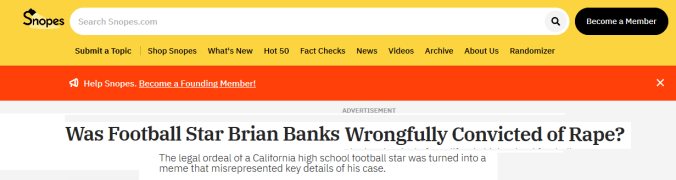
For some reason there has been an outbreak of tips to Ethics Alarms involving the usual Snopes stunts, including its factchecking the conservative satire site, the Babylon Bee. Reader Pennagain reminded me of this classic though, which nicely sums up Snopes in a concise, stinky package.
The Snopes question it supposedly examined (but didn’t) in a 2018 “FactCheck” has resurfaced because there is a new podcast about the Banks tragedy. (I can tell when Banks’ story is attracting attention again when the EA post about Wanetta Gibson starts picking up traffic.)
Here’s the rest of that “factcheck”:
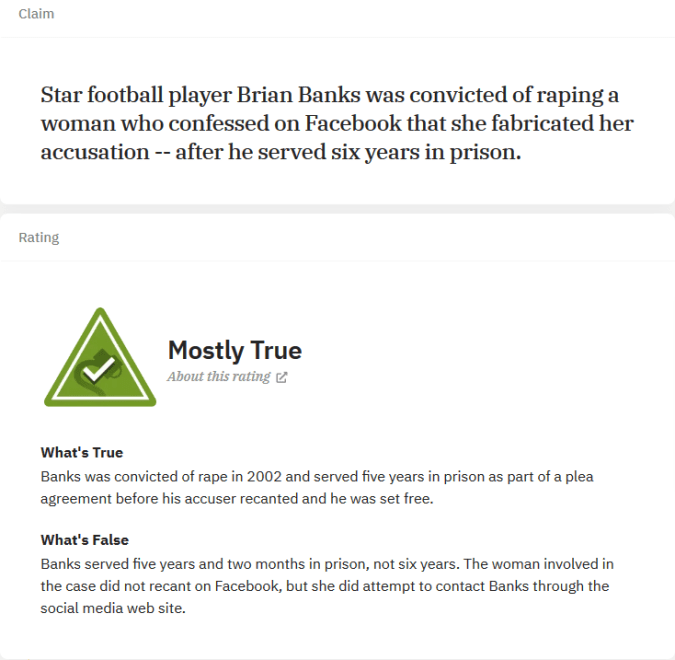 Snopes pulls this bait and switch trick a lot. The answer to linkbait question ‘Was Banks wrongly convicted of rape?” is “Yes”, and any assertion to that effect isn’t “mostly true,” it’s absolutely, 100% true. Beneath the question that heads the “inquiry,” Snopes significantly rephrases the “claim” which it then “debunks” by giving us the breathless revelations that Gibson didn’t recant ON Facebook, she contacted Banks through Facebook and then confessed in person, and that Banks “only” served 5 years and two months, not “six.” Continue reading

Now and then an old post suddenly get a lot of clicks. Often this will draw my attention to an essay I had forgotten: such was the case with this post from 2010. Someone on Reddit put it up for discussion, and last week the old post had hundreds of views. I was intrigued and re-read it. Good post!
I would change a few observations—in the intervening years we have learned that Woodrow Wilson was even worse than I thought—and add some, but the post was long, and a thorough evisceration of this embarrassing survey’s results would require a book.
The Siena College Research Institute persuaded over 200 presidential scholars to participate in a survey designed to rank America’s forty-three Chief Executives. There is great deal to be leaned from the resulting list that the Institute proudly released on July 1; unfortunately, very few of the lessons have anything to do with the men on it.
The list shows us that:
Lists are mostly for fun and to start arguments. When one purports to make historical judgments, however, and the individuals doing the judging are supposed to be experts, there is still a responsibility to try to do the task fairly, competently, and responsibly. Continue reading

Yes, it’s the New York Times again. I use that paper for the majority of the Ethics Alarm unethical journalism posts for a few reasons. One is that the paper comes to my door every day, so I read a lot of articles that I might miss on the web. Another is that the Times is the most successful and influential newspaper in the country, and its work is more closely followed and more criticized than any other paper, and most news sources generally. The Times also advertises itself as the nation’s “paper of record,” placing itself on a pedestal with standards of integrity and reliability that it is obligated to meet….and does not. Finally, the paper is unacceptably biased in its political coverage and editorial product.
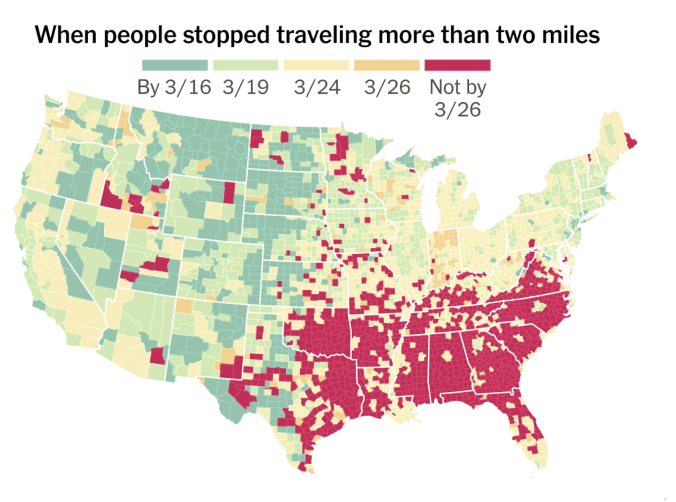
Today’s “Where America Didn’t Stay Home Even as the Virus Spread” is far from then times at its worst. It is, however, unacceptable and unethical. I’m not even in disagreement with the piece’s main thesis, which is that the regions that have not imposed shelter at home restrictions on the public are at more risk of exploding Wuhan virus cases. That makes sense; that’s even obvious. However, the Times’s main tool in making a case was the map below, which it explained this way:
“Stay-at-home orders have nearly halted travel for most Americans, but people in Florida, the Southeast and other places that waited to enact such orders have continued to travel widely, potentially exposing more people as the coronavirus outbreak accelerates, according to an analysis of cellphone location data by The New York Times. The divide in travel patterns, based on anonymous cellphone data from 15 million people, suggests that Americans in wide swaths of the West, Northeast and Midwest have complied with orders from state and local officials to stay home.”

Woody Allen in “Manhattan” with a 16-year-old Mariel Hemingway (playing a 17-year-old)
To be clear, I haven’t read Woody Allen’s autobiography, “Apropos of Nothing,” and I won’t. I found myself unable to endure anything related to Allen after he married his own quasi-daughter following a sexual affair with her while they were both living with Mia Farrow, Allen as her supposed lover and domestic partner, Sun-Yi Previn as her adopted child. While I maintain that the works of artists should be kept separate from the character flaws and misdeeds of their creators, that’s an intellectual and ethical position, not an emotional and gastrointestinal one. The latter are non-ethical considerations, but that doesn’t mean I can ignore them.
If I were a professional book reviewer, however, I would be forced to put my revulsion aside, or refuse the assignment of rendering a verdict on “Apropos of Nothing.” It is undeniable that the New York Times book reviewer, Dwight Garner, couldn’t or wouldn’t do that. To be fair, the Times no longer enforces the core journalism ethics principle that journalists shouldn’t allow personal biases to infect their reporting, but that is an explanation, not a defense. Some observations: Continue reading
 Ethics Alarms