No Boating Accident: The NBC 911 Scandal, and the News Media’s Dilemma

Yup...boating accident! George Zimmerman looks cute in this photo, don't you think?

NBC completed its internal investigation into why the middle of the audio of George Zimmerman’s 911 call was edited out, making him sound like a racist. To recap, here is what was on the recording:

Zimmerman: This guy looks like he’s up to no good. Or he’s on drugs or something. It’s raining and he’s just walking around, looking about.

Dispatcher: OK, and this guy — is he black, white or Hispanic?

Zimmerman: He looks black.

And here’s the version played on NBC, MSNBC, and posted on the MSNBC website:

Zimmerman: This guy looks like he’s up to no good.  He looks black.

This was no boating accident: this was the Great White shark of intentional news media misrepresentation and tape doctoring, in the middle of a racially charged incident, with one man dead and his killer being subjected to credible death threats, and irresponsible demagogues accusing him of a hate crime. Continue reading

George Zimmerman and the “Racial Profiling” Canard

Racists, all of 'em.

On the frequently disgusting but reliably gripping CBS drama “Criminal Minds,” viewers quickly get accustomed to hearing the FBI profiler heroes alert police and public to be on the look-out for a “white, middle-aged man.” Why man? Easy: virtually all serial killers are male. Why white? Same thing: although a rare black serial killer comes along (the D.C. snipers were African-American), the vast majority of serial killers from Jack the Ripper onward have been Caucasian.

You know, I just don’t feel denigrated by the fictional FBI’s alert (the real FBI would do the same.) Telling the public that the individual butchering prostitutes or massacring families is the same race as I am isn’t bias, bigotry or racism, it’s logic. It is also, beyond question, racial profiling, which, under the right circumstances, makes sense, prevents crime, catches criminals, and isn’t unethical or racist in the least.

So effectively have civil rights advocates and the media managed to bias the public against rational racial profiling, however, that the phrase itself has become a synonym for racism. When you mangle and distort a descriptive term in this way, blurring the distinctions between phrases and concepts, the culture gets a lobotomy and forced aphasia. What is the term for a fair and legitimate conclusion that a particular crime in a particular area is more likely to be performed by one race than another? Right now, the term is racism. Continue reading

Ethics Train Wreck Update: Martin-Zimmerman Reflections

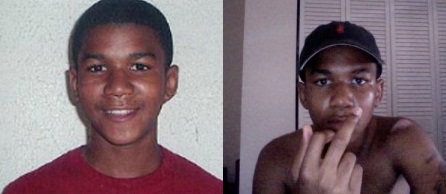
Is it only fair to show one version of the victim?

As the NAACP joined with Al Sharpton today to lead a protest of thousands in Sanford Florida, some notes on recent ethics carnage and confusion in the wake of Trayvon Martin’s shooting death:

  • Roslyn Brock, who chairs the national board of directors for the NAACP, perfectly illustrated  ignorance of the justice system and short-sightedness that has characterized this whole, sorry incident. “We come to make sense of this great tragedy and the entire world grieves with us,” she said . “When the Sanford police did not arrest George Zimmerman, they essentially placed the burden of proof on a dead young man who cannot speak for himself.” But of course, as every American should know, that is where the burden of proof lies. The alleged victim in a death is represented by the state, and it is the state that has the burden of proof of guilt as well as having the burden to justify an arrest. It is not Zimmerman’s responsibility to prove his innocence, though that is what the un-American process engineered by race-activists and the media has come to. Does the NAACP really want to take the position that there should be a presumption of guilt in criminal matters? Or just in circumstances where the victim is an African-American and the suspect is not?
  • While CNN has taken the lead in trying to present a balanced picture of the controversy, NBC, mostly through MSNBC, has thoroughly disgraced itself by essentially taking an advocacy position on Zimmerman’s guilt, even to the point of doctoring his 911 call to make it seem clear that this was a case of racial profiling. “This guy looks like he’s up to no good…He looks black.” is how Zimmerman’s 911 call was played on the  “Today Show” and relayed on MSNBC’s website. The actual conversation was this: Continue reading

It’s You, Keith.

The news that The Angry Man of the Self-Righteous Left, Keith Olbermann, was fired by Al Gore’s Current TV was hardly news at all, since most of us had entered a pool on when Olbermann would get jettisoned from his latest gig. The predictable episode does have an ethics lesson for all of us, however, that involves the virtues of accountability, humility, honesty and contrition.

Olbermann, true to form, attacked his former employers and blamed them for his exit, writing  via Twitter…

“…I’d like to apologize to my viewers and my staff for the failure of Current TV. Editorially, Countdown had never been better. But for more than a year I have been imploring Al Gore and Joel Hyatt to resolve our issues internally, while I’ve been not publicizing my complaints, and keeping the show alive for the sake of its loyal viewers and even more loyal staff. Nevertheless, Mr. Gore and Mr. Hyatt, instead of abiding by their promises and obligations and investing in a quality news program, finally thought it was more economical to try to get out of my contract. It goes almost without saying that the claims against me in Current’s statement are untrue and will be proved so in the legal actions I will be filing against them presently. To understand Mr. Hyatt’s “values of respect, openness, collegiality and loyalty,” I encourage you to read of a previous occasion Mr. Hyatt found himself in court for having unjustly fired an employee. That employee’s name was Clarence B. Cain. In due course, the truth of the ethics of Mr. Gore and Mr. Hyatt will come out. For now, it is important only to again acknowledge that joining them was a sincere and well-intentioned gesture on my part, but in retrospect a foolish one. That lack of judgment is mine and mine alone, and I apologize again for it.”

This, of course, is not really an apology. It’s not an apology when your message is, “I’m sorry my employers are unethical slobs who didn’t appreciate the excellent job I was doing.

Keith Olbermann has either been fired or quit under acrimonious circumstances in engagements with, count them, five broadcast organizations: ESPN, CNN, Fox, MSNBC, and now Current TV. This, despite being obviously talented and often getting excellent ratings. Olbermann is a smart guy, and yet even now, his reaction seems to be, “Why, oh, why, do people keep treating me so badly?”

It’s you, Keith! Continue reading

More Public School Political Indoctrination

Here is what’s scary to me: a teacher considers giving his middle school students the assignment of doing opposition research on the Republican presidential candidates, and no ethics alarms go off for him at all. Fairness? Objectivity? Abuse of power? Prudence? Bias?

Not a ding.

Michael Denman assigned his 8th grade students at Liberty Middle School in Fairfax County the task of researching the weaknesses and vulnerabilities of the four presidential hopefuls looking to challenge President Obama and forward them to the Obama campaign. The students were told to research the backgrounds and positions of each of the candidates ,find their “weaknesses,” and  to prepare strategy papers to exploit them in the campaign. Then they were told to find a contact in the Obama campaign to send them to. Continue reading

Revisiting the Tragedy of the Dead Child in the Locked Car

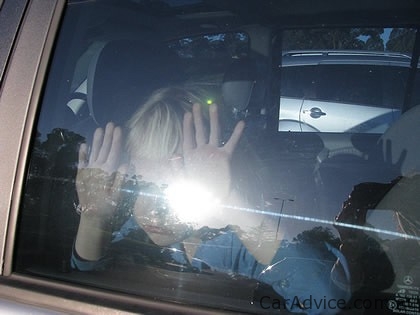
Almost two years ago, I wrote about Washington Post feature writer Gene Weingarten’s provocative and sensitive 2009 exploration of the tragic cases in which a distracted parent leaves a small child in an over-heated car. The issue, now as then, is how society should treat such parents, who are without exception crushed with remorse and guilt, their lives and psyches permanently scarred. Weingarten’s original piece, which won him a 2010 Pulitzer, did not take a position on how such parents should be treated by the criminal justice system. In today’s Washington Post, he does.

Weingarten writes:

“The parents are a continuing danger to no one, nor could anybody sanely argue that fear of prison is even a minuscule factor in preventing this. So we are left with the nebulous notion of punishing, for punishment’s sake alone, an act of accidental negligence that by its nature subjects the doer to a lifetime of agony so profound that it is unfathomable to anyone who has not lived it. Prosecution is not, in my view, warranted.”

Weingarten is thoughtful, analytical, reasonable, compassionate and fair. He is also, in this case, dead wrong. Continue reading

Comment of the Day: Time To Retire Editorial Cartoons—With Gratitude

Cartoonist and frequent combatant on Ethics Alarms Barry Deutsch did not disappoint—I was counting on a strong reply from him—in commenting on my post about political cartoonists. And I think he has me convinced. I think what I should have suggested, rather than advocating sending newspaper political cartoonists to the trash bin of history (soon to be followed by newspapers themselves), is that editors exercise some discretion over when an editorial cartoon, even by a respected cartoonist, just doesn’t meet editorial standards.

Here is Barry’s persuasive and educational Comment of the Day on the post Time To Retire Editorial Cartoons—With Gratitude:

“Oh, how could I possibly resist this thread?

“1) At his best, Tom Toles is a wonderful cartoonist, elegant and with an incredibly distinctive style. But he hasn’t been at his best for years. The particular cartoon you’re talking about — which can be seen here, if anyone’s curious — is an embarrassment.

“The problem with that Toles cartoon isn’t that it takes a side, or that it paints with a broad brush; many good cartoons do both those things. The problem is, it’s painfully stupid.

“2) There are good political cartoonists doing interesting work, but they’re mostly not found in mainstream newspapers.

“3) Even the best political cartoonists tend to produce more mediocre than great cartoons.

“4) It’s a very, very rare reader who can recognize the artistic merit of a political cartoon that they strongly disagree with politically.

“5) The economic base has fallen out from under political cartooning; every year, fewer and fewer newspapers support a staff cartoonist, and those that remain are seeing their incomes and outlets shrinking. And no one’s yet found a business model for political cartooning to thrive on the web.

“As a result, the most talented new cartoonists usually aren’t going into political cartooning, because they want to be able to eat and pay rent.

“6) Some of the most interesting political cartoonists have gone so far away from traditional political cartooning that no one even recognizes what they’re doing as political cartooning. See, for instance, Joe Sacco, who does journalism in comics form; his second book on Palestine, “Footnotes In Gaza,” is one of the best books about life in Gaza anyone’s done, in prose or comics.

Time To Retire Editorial Cartoons, With Gratitude

The nuanced subtlety of Pulitzer Prize winning Herb Block. Translation: "Nixon's a crook." Brilliant!!!

All right, hear me out. I love cartoons. I used to aspire to being a cartoonist. I have good friends who are cartoonists, and I know there are cartoonists who are strong contributors to Ethics Alarms. But for many years it has appeared to me that editorial cartoons have become an increasingly archaic form of commentary, one that misinforms the public and contributes to the venom and lack of nuance in public discourse.

Cartoons, by their very nature, deal in caricature, exaggeration and extremes for metaphorical and humorous effect. The practical effect of this, however, is that the opinions expressed through cartoons are also “supported” in a manner that would be outrageous in a written opinion piece. I know: you can’t hold a cartoon to the same standard as an op-ed. Fine—then don’t put it on the editorial pages. Continue reading

Social Science, Group Research and Bigotry: The Most Slippery Slope

Typical...

Decades ago, Arthur Jensen became a target of critics and a pariah in his field by publishing a controversial study that indicated that differences in racial performance on intelligence tests probably had a genetic component. He was, and is, called a racist, though Jensen has continued to produce respected research. Since the publication of the 1969 Harvard Educational Review article that made him infamous, Jensen has won the prestigious Kistler Prize in 2003 for original contributions to the understanding of the connection between the human genome and human society.

The problem with Jensen’s research results, whatever the legitimacy of the data and his methods, was this: What do you do with it? Like other studies that show women, as a group, with less aptitude for the sciences, or those that show superior traits in other races and ethnic groups, this information just serves as a catalyst for bigotry. Whatever the trends within a large group may be, they tells us nothing about any individual in that group. Yet the existence of a study creates a natural tendency to apply the claimed group characteristics to every group member. Most people think like that, always have and always will. This is similar to the problem with stereotypes. Many, perhaps most, stereotypes have some truth in them. I was raised in a Greek family, and Greeks are reputed to be clannish, cheap, bigoted, and gifted in the kitchen. Well, that would describe a large proportion of my relatives, too, but not all of them. My Aunt Bea is fanatically liberal. My Mom couldn’t cook a lick.  All right, they all were cheap, but the point is that it would be foolish and unfair to assume what any of them would be like without knowing them.

Knowledge is an absolute good, but perversely, some knowledge also guarantees abuse, and thus results in more bad than good. Jensen’s study, as far as I can see, has no good use in a democracy where every individual has the right to be assessed according to his or her conduct and character. Nor do any studies that “prove” character or ability differences in broadly defined groups.

This is all a prelude to my conclusion that the now widely publicized National Academy of Science study that has this conclusion-“Higher social class predicts increased unethical behavior”—is just throwing gasoline on a fire, and has no useful or benign purpose at all. Continue reading

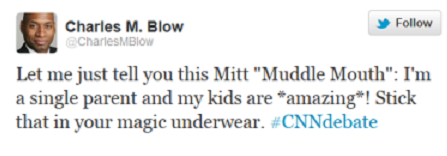
Ethics Dunce: NY Times Columnist Charles M. Blow, and the Times, If It Doesn’t Do Something About Him

Behold the above tweet from last night, appearing on the Twitter feed of Charles M. Blow, a regular New York Times op-ed columnist. And note:

  • This is supposed to be a respected and respectable journalist of the preeminent U.S. newspaper, and he is sending gutter-level messages via social media, plus
  • …his tweet immediately descends to crude name-calling (“Muddle-Mouth”) aimed at a Republican presidential candidate, and
  • …goes lower still, making first a crude reference to underwear, and
  • …making the reference a religious slur as well. Continue reading