The Ethics of Interviewing Kids on Camera


Art Linkletter was right: "Kids say the darndest things!"

When I initially learned about  Chicago TV station WBBM editing  an interview with a 4-year-old boy last month to make him sound like an aspiring gang-member when he actually said that he wanted to be a policeman, I decided to pass. I try to avoid making obvious observations, and nobody could defend the conduct of the station’s editors, who intentionally truncated the child’s remarks to the interviewer to make them sound chilling. The larger question of whether the child should have been interviewed at all, however, is more challenging. We see kids being interviewed on TV all the time, and it is far from certain that reporters are doing so ethically.

In the wake of  the WBBM incident, journalistic ethics expert Al Thompkins reprinted his guidelines for interviewing juveniles on the Poynter site. I’m an admirer of Thompkins, but I found his guidelines almost as chilling as the distorted interview itself. Here is his guidance on the issue of interviewing kids, with my reactions: Continue reading
My Grudge

Sen. Mitch McConnell (R-Ky) has been in the epicenter of the last-ditch debt ceiling negotiations, and will probably deserve significant credit if the nation’s looming, self-created crisis is averted, if only temporarily. I’m going to have a hard time applauding, however, and not just because I think the entire incident has proven that America’s leadership void in all branches of government is terrifying. I can’t stand Mitch McConnell. I can’t stand to look at him, listen to him or read about him, and for the most unfair of reasons. I have a deep personal grudge against his wife, and its aura is wide and strong enough to engulf the Senator as well.

Back in 1987, McConnell’s wife, Elaine Chao, was a Reagan appointee in the Transportation Department, and I was out of work. Recalling that I had done a lot of work in transportation policy analysis, my former boss of two jobs back, (who is the current President of the U.S. Chamber of Commerce), graciously offered to make some calls on my behalf, and set me up to meet with Chao, a friend of his. The meeting that resulted remains the most humiliating and infuriating business-related experience of my life. Continue reading

Scent Branding, Mind-Control, and Ethics

Agreed: this is scary. We're not there yet. We don't even know if "there" exists.

A recent article on the web that purported to explore the ethics of “scent branding” was fascinating for two reasons.

First, “scent branding” is a term I had never encountered before, for a practice that I had not focused on. About five seconds of thought, however, made me realize that indeed I was aware of the phenomenon, and had been for quite a while. “Scent branding”—using fragrances in a commercial environment to create a desired atmosphere and to prompt positive feelings, recollections and emotions from patrons—has been around a long, long time, though not under that label. When funeral parlors made sure that their premises smelled of flowers rather than formaldehyde, that was a form of scent branding. Progress in the science of scent allowed other businesses to get into the act: I was first conscious of the intentional use of smell when I spent a vacation at the Walt Disney World Polynesian Villages Resort. The lobby and the rooms had a powerful “tropical paradise” scent, a mixture of beach smells, torches and exotic fauna. It was obviously fake, like much in Disney World; also like much in Disney World, I found it effective, pleasant, and fun. I certainly didn’t think of it as unethical. I was normal in those days, however.

Well, more normal.

The second aspect of the article, entitled “Is it Ethical to Scent Brand Public Places?”, that caught my attention was that it had an obvious agenda. The piece was opposed to scent branding, and set out to find the practice unethical in order to justify condemning it. Continue reading

We Know Enough about Ethics Already

If Shakespeare understood ethics so well, why are we still pretending to be ignorant about it?

I awoke to read about a breathlessly announced new work on ethics, a book called “Blind Spots: Why We Fail to do What’s Right and What to do About it.” Business Professor  Ann Tenbrunsel and co-author Max Bazerman write that we are unaware of the “ethical blind spots” that keep us from recognizing how we engage in unethical actions. The book cites tests and new research showing behavior that the authors call “ethical fading” and “motivated blindness.” They examine such case studies as Enron and the Madoff scam to show how people “believe they will behave ethically in a given situation, but they don’t. Then they believe they behaved ethically when they didn’t. It’s no surprise, then, that most individuals erroneously believe they are more ethical than the majority of their peers.”

Stop the presses! Conflicts of interest make us ignore core values and act in our own best interests, and we rationalize our actions to avoid confronting the true nature of our conduct!

Oops! I just stated the entire thesis of the book. I’m sorry, Ann! Apologies, Max! Continue reading

Fact Checker Ethics, Part II: Validating Deceit, and Practicing It Too

Et tu, Fact Checker?

In its review of Washington Post “Fact Checker” Glenn Kessler’s shameful refusal to call the Democratic dissembling on Social Security, Ethics Alarms saved the best—which is to say, worst—for last.

Beginning with a statement typical of Obama Administration and Democratic leadership positioning on the subject, Rep. Xavier Becerra’s (D-Calif.) “Social Security has never contributed a dime to the nation’s $14.3 trillion debt…not one penny to our federal budget deficit this year or any year in our nation’s history,” Kessler gives a brief history of Social Security, why it has no more money, and concludes with this nonsense:

“Becerra is sincere in his convictions and his statement is true, so far as it goes. Yes, Social Security in the past has not contributed to the nation’s debt. But it’s basically a meaningless fact and actually distracts from the long-term fiscal problem posed by the retirement of the baby boom generation and the shrinking of the nation’s labor pool.” Continue reading

Fact Checker Ethics: Alibis For Obama, Part I

The Washington Post “Fact Checker,” Glenn Kessler, is among the most biased of the breed. On the issue of the Obama Administration’s outright dishonesty on Social Security, however, he is embarrassing his paper and the entire Fact-Check community.

Lately, his strategy has been to bury obvious dishonesty by the Obama Administration and Democrats regarding Social Security in technical details, excusing straightforward misrepresentation (how’s that for an oxymoron?) and encouraging readers to shrug, give up, and move on

How nice for the President to have political allies posing as objective truth-tellers. Continue reading

The Shannon Stone Tragedy Ethics Quiz, Part II

Don't try this if you're not a firefighter

 Many commenters were upset with me for characterizing the tragic death of Shannon Stone, who fell to his death while trying to catch a ball during a Texas Rangers game, as the result of his own bad judgment, suggesting that I was impugning the character of a dead man. (I wasn’t.) That reaction sparks the second Ethics Alarms quiz question relating to the incident.

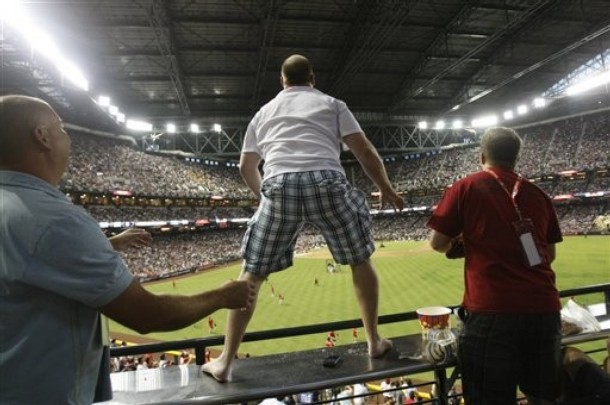
NBC baseball blogger (and lawyer) Craig Calcaterra put up a post this morning headlined “Idiot nearly falls from the stands chasing a ball at the Home Run Derby”:

“Just days after Shannon Stone died from a fall while reaching for a baseball at a Texas Rangers game, a fan at last night’s Home Run Derby nearly fell out of the outfield stands while lunging for a home run ball hit by Prince Fielder.  He was spared serious injury or death only because his friends grabbed him by his feet, held him and then pulled him back as he dangled over the railing above a concrete deck 20 feet below…His name is Keith Carmickle, and common sense is not his forte. His fall came after he stepped up onto the narrow metal table which abutted the railing — the kind you stand in front of and set your drink on while watching the game — and then, while still standing on it, reached down low to catch the ball as it came in…He missed the ball, but his momentum carried him forward and he fell headfirst over the rail. If it wasn’t for his brother’s and his friends’ quick action, down he would have gone. Despite his idiocy, he (a) escaped this dangerous situation of his own making unscathed; and (b) was allowed to stay at the Derby by security. Both of these factors have been added to the “evidence that there is no God and/or that He is not just and fair” side of the big ledger I keep on my desk and in which I tally the wonder and folly of Humanity as I encounter it…”

Your questions to answer, if you dare: 1) Is it fair for Calcaterra to call Carmickle an idiot, and Stone just a random victim of circumstance? 2) Why or why not? Continue reading

An Ethics Lesson From the All-Star Game

It really is one of the most enduring sports deja vus—every year, sportswriters and fans engage in thousands upon thousands of words of complaint regarding baseball’s annual All-Star Game, the 2011 edition of which will occur tomorrow night in Phoenix. This year was no exception, and as is always the case, no consensus or conclusions were reached, except that everyone agrees that the game is mishandled, mismanaged, unfair and illogical in every possible way.

I have been thinking of the game’s plight as an ethics case study that proves a core truth: you can’t do the right thing if you don’t know your objectives, stakeholders, and how to prioritize them. In the All-Star Game as it has evolved, there are competing interests and stakeholders with no clear agreement regarding which takes priority over the other. It is literally impossible to do be fair: somebody always will be disadvantaged, and because there is no single objective either, utilitarian balancing doesn’t work.

It was not always this way. When the All-Star game was first conceived in 1935, it was intended to raise money for the players’ pension fund, the players then being generally paid little more than grocery clerks.  Since the game had to draw as much of a paying crowd as possible to make money, the rosters and starting line-ups were constructed to include the biggest stars and most popular players. It didn’t matter whether Babe Ruth was off to a great start or not: it wouldn’t be an All-Star Game without him in the starting line-up, so he was the right-fielder. Managers picked the team that they thought would both be the “starriest” and that would give them the best chance to win the game. Continue reading

Attention FCC: What the News of the World Scandal Reveals About Rupert Murdoch

Rupert Murdoch

Concluding that the News of the World scandal in Great Britain shows that Rupert Murdoch has less than a sufficient reverence for ethics, journalistic or otherwise, is an intellectual achievement well within the powers of Forrest Gump.  Concerns about the integrity of the Australian media magnate have been voiced since he first stuck his kangaroo’s nose in the American media tent. As is too often the case here, legitimate points were minimized by their linkage to political bias: was Murdoch bad for American journalism because he was unethical, or because he was conservative? His most vocal critics, being from the Left, regard the two as the same, which allowed Murdoch to accumulate defenders on the political right who should have been just as wary of his methods and ethical deficit.

Now his flagship tabloid, The News of the World, has folded in the midst of a still-unfolding scandal. You can read details here; the important thing to know is that the tabloid was essentially lawless. Continue reading

“Professionalism?” What’s THAT? Julie Chen, CBS and the Descent of Broadcast Journalism

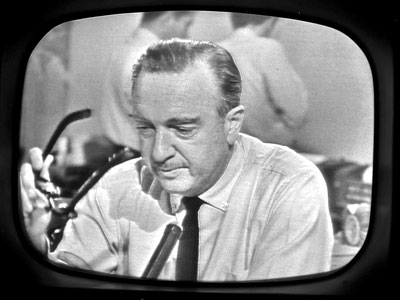
Walter could keep it together. Not Julie Chen.

The Casey Anthony verdict is doing some good: it is exposing the awful deficit in objectivity and professionalism in the broadcast media.

The latest example: while CBS’ “The View” rip-off, “The Talk,” was underway,  viewers saw co-host Julie Chen break down as she tried to read the news that Casey  Anthony had been found not guilty of killing her daughter Caylee. Chen attempted to read the verdict, but was overcome with emotion  and was unable to continue, asking her co-hosts,  “Help me out here.”

In 1937, radio broadcaster Herbert Morrison was correctly criticized for being unable to keep his composure and report the flaming destruction of the zeppelin The Hindenburg without weeping and becoming unintelligible. In 2011, a woman described in her official bio as a “news anchor; reporter; and journalist” couldn’t compose herself to read the news of a not guilty verdict. Continue reading