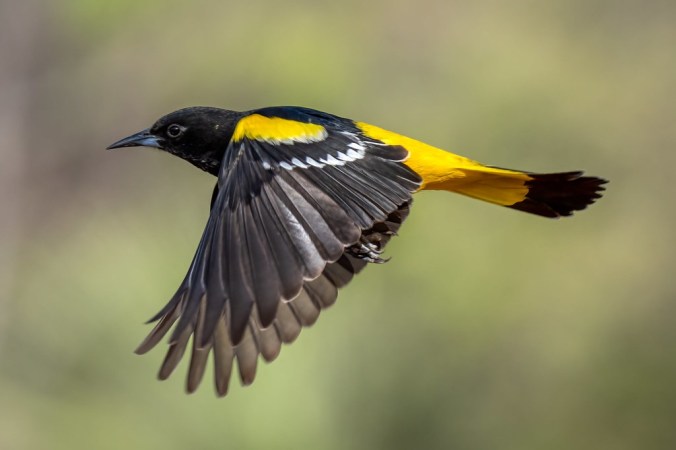
A “Great Stupid”-George Floyd Freakout Mash-up Classic! The Fentanyl Overdose Death Of A Black Perp In Minnesota Will Result In A Name Change For Scott’s Oriole

I’m not kidding.

This story has convinced me that the obsessions of the woke-infected have no limits. Hold on to your skulls…

The American Ornithological Society announced yesterday that it will remove human names from the common names for birds to create “a more inclusive environment for people of diverse backgrounds interested in bird-watching.” It is expected that around 80 birds in the U.S. and Canada will be renamed, the announcement says.

Wait, what?

It seems that this political correctness movement among bird brains began in 2018, when a college student named Robert Driver proposed renaming the McKown’s longspur, a small bird in the Central United States was named for John P. McKown, who collected the first specimen of the species in 1851. Ah, but Driver’s research revealed that McKown was insufficiently psychic about what causes would be deemed acceptable in a hundred years or so, and thus he fought Native American in the Seminole Indian in 1856, then participated in an expedition against Mormons in Utah in 1858, and worst of all, became general in the Confederate Army. Driver’s crusade was rejected at the time, because…well, it was stupid, to be blunt. The bird was named for McKown because McKown first spotted and identified it. His politics, positions on Indian relations and military exploits have exactly nothing to do with that distinction. 99.99% of people who hear the name “McKown’s longspur” don’t know or care who McKown was, or what he did in the Seminole War, nor should they. Driver—I’ll have to check to see what wokeness indoctrination factory he got his degree from—was just a bit ahead of his time. His ilk hadn’t started toppling Thomas Jefferson statues yet.
Continue reading

Birding Ethics vs. Education Ethics: One Applies Common Sense, The Other Doesn’t Apply It, Or Sunscreen Either

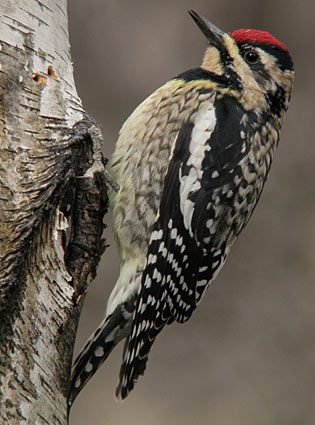
"Don't worry, Mr. Sapsucker---the birders are looking out for you. Just be grateful you don't go to public school in San Antonio."

“Don’t worry, Mr. Sapsucker—the birders are looking out for you. Just be grateful you don’t go to public school in San Antonio.”

In the intense avocation of bird-watching, a code of ethics reminds practitioners of common sense. In public school education, there is no accepted code of ethics. And there is precious little common sense.

Cornell University’s Macaulay Library contains more than 200,000 bird call recordings, and 150,000 of them can be downloaded onto smartphones and other electronic devices. This allows canny bird-watchers to play the calls in the wild, attracting rarely-seen species.

Unfortunately, these realistic calls, experts say, can stress birds, including endangered species. Thus there is a code of ethics for the recreation of birding, The American Birding Association’s Principles of Birding Ethics, and it states,

 “Limit the use of recordings and other methods of attracting birds, and never use such methods in heavily birded areas, or for attracting any species that is threatened, endangered or of Special Concern, or is rare in your local area.”

It’s a well-conceived code that gives behavioral guidance where guidance is needed.

Now let’s look at a profession where most of us would say common sense is essential, and where the lack of it leads to  unethical and unacceptable conduct born of institutionalized incompetence. No, this time I’m not talking about our government. I’m talking about the educational profession, and the public schools. Continue reading