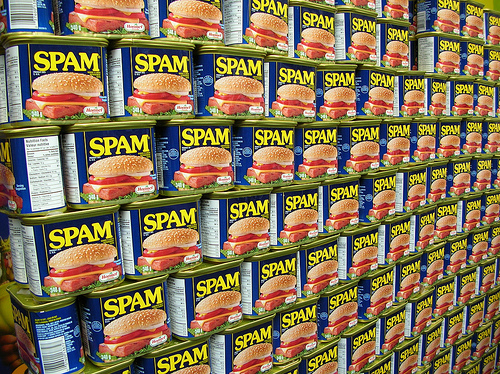
A Pause To Spew My Hatred of Spam

A typical day at Ethics Alarms!

One reason, not the only one, but one of them, that I was foiled trying to respond to a series of critical posts on an online forum was that fear of spam had caused the administrators to make it insanely difficult for me to post there—just another way for online spam to plague me. According to Akismet, WordPress’s excellent spam detection service, I now have reviewed and deleted over 45,000 pieces of spam since Ethics Alarms began. (I have to check the spam because occasionally it traps a genuine comment, kind of like dolphins getting caught in tuna nets.)

Let me be clear: I hate these people. I hate the people who send spam, the people who employ spam services, the people who write the deceitful, stupid spam messages, and the spamming outfits that make their grimy living off of it. There is no such thing as an ethical spammer or an ethical company that assists in spamming. By definition, spam is dishonest, as it pretends to offer content when there is none, and purports to represent genuine interest in the site, when it is only interesting in planting a link that will maximize a commercial site’s SEO.

Spam is not only dishonest, but it is insultingly dishonest, because it is so obvious. Continue reading

Loop-Hole Ethics and The New York Times

The NYT’s website paywall plan floats in a sea of holes.

Ariel Kaminer, author of “The Ethicist” column in The New York Times Magazine, made an interesting assertion in her answer to a reader who asked about whether he could exploit several loop-holes in the Times’ new paywall plan for its website.

Noting that he was a struggling freelance journalist who visits the Times website often, he asked if it was unethical for him to use his parents’ free access to the content, since they are subscribers.  Then he Mused about other scenarios. “If I buy online access, can I share the password with my live-in girlfriend, even if I move to New York for the summer? What about our other housemates?” Continue reading

Blogger’s Ethical Dilemma: The New York Times’ New Plan

I'm gonna hate to lose you guys!

The New York Times announced yesterday that it will begin charging for content on its website. After 20 articles have been read by any user within a month, that user will be required to purchase a $15 a month access fee, or forgo the “Grey Lady,” online at least. (Subscribers to the paper will have still have unlimited free access to the digital version.)

For bloggers like me, who rely on hundreds of on-line sources for my ethics commentary, the new Times plan poses an ethical dilemma. Continue reading

BugMeNot is Not Welcome Here

I just refused to post another comment from a reader who entered a BugMeNot e-mail address. What is BugMeNot? I wrote about it years ago on the Ethics Scoreboard, as an Unethical Website of the Month. :

“BugMeNot allows web users to access sites that require on-line registration, so they don’t have to divulge their real names, e-mail addresses or other personal information. Through BugMeNot, they share active user names and passwords for more than 130 forced-registration sites, such as the New York Times, and Washington Post sites. In other words, the site facilitates dishonesty in multiple ways. It permits users to access information from a provider without meeting the conditions required by that provider for access, and it facilitates deception, as consumers acquire entry to restricted sites by using false identities.”

I prefer that all posters here use their full names (thank you, Tim, Tom, Bob and Steven!) but I will allow single handles as long as I am given a real e-mail address. (See the conditions of commenting in the body of the page here). Getting a fake screen name from a commenter who lists a BugMeNot address is not only a violation of posted rules, but also an insult: someone who does this is bugging me. If you don’t want to post under the restrictions of Ethics Alarms, fine, but you have a lot of nerve sending in a comment with a fake e-mail address on the theory that I’m infringing on your privacy. I require some modicum of accountability from commenters, who are my cherished guests: don’t tell me I’m “bugging you” by requiring some honesty on an ethics site.


To Edit, or Not to Edit: A Blogging Ethical Dilemma

I was just simultaneously reading an excellent, if not particularly revolutionary, article about blogging ethics and checking out the latest comments on the Immortal Tide (with Acti-lift!) Debate. Suddenly I found myself wishing that the author, whose essay concentrated on editing blog posts, had also addressed the issue of editing blog comments.

Unlike some blog platforms, WordPress does not have a feature that allows commenters to review or spell-check their own posts. Despite this, many of the regular commenters here have a better record of avoiding typos than I do, and I have preview and spellcheck features. When they make a spelling or grammatical error (and I notice it), I will fix it for them: WordPress allows me to edit comments. Sometimes a commenter will e-mail me personally and request an edit, and I am happy to oblige.

A while ago, one new commenter whose post was riddled with spelling and grammatical errors accused me of letting her errors stand to make her look unintelligent because she had disagreed with my original post, while I continued to edit comments that were more friendly. In her case, I actually hadn’t read the previous typo-infested comment that she was referring to, and treated her complaint as a request to edit it, which I did. But it was a mess, and I wondered then if it made sense, or was even fair, to turn an inarticulate, careless comment into a clear and persuasive one.

Today I have read several posts on the endless Tide commercial thread from a 15-year-old girl. The post is in text-speak, essentially, without capitals, punctuation or any attention to style. It is a clear comment, however,even if it is obviously the expression of a 21st Century teen. Should I edit her comment to give it more credibility, by punctuating it, for example?

What is an ethical editing policy regarding comments on an ethics blog? The options, as I see them, with their ethical pros and cons: Continue reading

Julian Assange: Not a Hero, Not a Terrorist, Not a Criminal, Just an Asshole

I know. Well, sometimes a vulgar word is the most accurate we have.

Our definition of journalism has yet to catch up with the cyber age, and freedom of speech does not distinguish among blogs, newspapers and dissidents. What ensures responsible use of First Amendment rights is ethics, not law. America allows journalists to act as information laundries, taking material that a private citizen was bound not to reveal by law, contract, or professional duty, and to re-define it to the world as what “the public has a right to know,” defined any way the particular journalist finds appealing.

Despite all the fulminating and condemnations by the likes of Mitch McConnell and Newt Gingrich on the Sunday talk shows, the U.S. can’t make Wikileaks founder Julian Assange a terrorist just by calling him one, nor can it fairly declare him a criminal for accepting the product of the unethical and often illegal acts of leakers, and making it public, just like the New York Times has done on many occasions…not under current laws.  Bradley Manning, the U.S. soldier who leaked many of the secret documents, is certainly a criminal. So was Daniel Ellsberg, who, to nobody’s surprise, is cheering Assange on and attacking his critics. . Assange, however, is not a criminal. He has not revealed any information that he accepted in trust while  promising not to reveal it. He is no more a criminal than the New York Times, if the New York Times was published in Hell. Continue reading

Note to Ethics Alarms Readers: No More Ads! (And I’m Sorry It Took So Long For Me To Kill Them)

Dear Ethics Alarms Readers,

As discussed here last week, I only recently learned that WordPress has been planting ads in Ethics Alarms according to some mysterious formula. Whatever it is, the formula managed to keep me in the dark and deface my blog, giving some readers the impression that I had approved of, or profited from the ads. I never saw them, nor did WordPress ever give me notice what the ads were, how they were being placed, or that they were being run at all. Some of the ads, I learned, were for products that I find objectionable: for example, Barack Obama-mocking T-shirts in questionable taste.

Without checking to make sure, because it is pointless, I will stipulate that somewhere in the vast number of Conditions of Use provisions I must have agreed to at some point in time now lost to posterity, there must have been a statement in fine print giving WordPress permission to do all this. Had I read it, I would have probably agreed to it anyway, and would still be in the same position today, coming late to the realization that because I never saw ads on Ethics Alarms doesn’t mean some readers aren’t. I take full responsibility for this, and I apologize. I have a duty to you, just like WordPress has a duty to me. It should have kept me informed, particularly when their conduct affected the content of my website. It didn’t.

Anyway, I have paid the 30 bucks that buys me, and you, a year of ad-free content. If you see another ad on Ethics Alarms, please let me know. And There Will Be Blood.

Thank you for your patience, passion, loyalty and understanding. In the year since Ethics Alarms began, we have begun to build a diverse community of readers who constantly surprise, challenge, amuse and enlighten me with its insight and opinion on ethics and related matters. I know I don’t express my appreciation to all of you frequently enough; I will try to do better.

Sincerely,

Jack Marshall

WordPress Ethics, Or How Offensive Obama T-Shirt Ads Ended Up On My Blog

WordPress supplies a versatile and useful product that is user-friendly (if I can manage it, believe me, it is user-friendly), inexpensive, and well-serviced. It also seems to be diligent about supplying regular information, which is especially important to me. So many companies, and especially the government, regularly surprise me with unpleasant, disrupting, or costly changes in what they provide that I only learn about by accident, or when they start causing me trouble.

A few months back, for example, Direct TV gave me no-charge charge access to HBO, just a couple of months after I had canceled it. There was no notice about this, and as a result, we didn’t watch the network at all for some time, since we didn’t know we were receiving the signal. It was puzzling that the access to HBO just appeared, and when it had hung around a few months, I decided to look at the bill, which we paid automatically. Now, I discovered, we were being charged for HBO, which I had just canceled.

When I called Direct TV, the representative apologized, took off the charge, credited me with a past months charge before I had realized what had happened, and removed HBO. He also gave me a long explanation about why this had happened, which boils down to this: when your service is interrupted (as it was several months ago; I was late with a bill payment), it is my responsibility to tell Direct TV what channels I was getting before the interruption, or it might just slip in premium channels without telling me when it reconnects my service. Is this written anywhere? No, it isn’t.

I no longer trust Direct TV.

I don’t trust the Transportation Security Administration, either. Last week, in the middle of a trip that involved several flights, I set off the gate alarm, as is my custom (I have a metal hip), and prepared for the ceremonial wanding. But this time, it wasn’t a wanding; oh no no no! It was a bona fide, full-body, rough massage feel-up that included a sprightly hello to my throat, rear-end, and naughty bits. In many cities, such stimulation would have cost me a pretty penny, though only if it were not performed by a large, heavy, middle-aged guy named Carl, as mine was. Yes, in rapid response to the underwear bomber, whose attempted act of terrorism was more than a year ago, TSA has now instituted new pat-down procedures designed to determine, among other things, what’s in your BVDs. There was no advance notice of this to flyers, of course, until I was actually at the feel-up point of no return, having made my meeting schedule and bought my non-refundable ticket. In fact, the new procedures had been instituted mid-day, after I had taken a flight including the usual game of Wand Me.

Now, back on the ground, I learn that some readers of my WordPress blog see a string of Google Ads in the text, ads triggered by key words and automatically generated. Continue reading

Krystal Ball, the Dildo Nose, Human Nature, and Trust

Krystal Ball is a Democrat running for an open Virginia Congressional seat in the 1st District. Today, however, most Americans who know her at all only do so because some spectacularly embarrassing photos of her have gone viral on the Internet. In the shots, a Santa-clad Ball is shown in a series of suggestive poses involving a bright red dildo, which is fastened to the nose of young man wearing reindeer antlers. In some shots, she has Rudolph the Dildo-nosed Reindeer on a leash, just to add that dominatrix flair we all associate with the holidays. Continue reading

More Spam Ethics

Increasingly, specialty blogs are sporting posts asking whether particular practices are ethical. That is a good thing. The unfortunate part is that too many of the posters lack the tools to answer the question.

You would think the proprietor of a website called “Pro Blog Service,” for example, would be capable of at least spotting the ethical issues in his query about blogging, but no. In a post entitled “Is It Unethical To Edit Spam Comments?“, he describes the common spamming practice of sending in a comment to a blog post that expresses bland and non-specific praise for the original post in order to get a URL publicized. He asks, Continue reading