Is It Fair For A Business To Discriminate Against the Homely?


Take your pick!

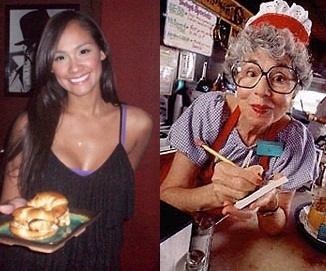
The EEOC is investigating a popular Boston area coffee shop chain, alleging that it discriminates in favor of attractive young waitresses to the detriment of older or more homely waitresses. The management of Marylou’s disputes the accusation, arguing that its hiring pool is disproportionately young and attractive.

I don’t want to get into the actual guilt or innocence here, but rather muse about the ethical issue. Should there be laws preventing employers from using attractiveness as a criteria in hiring, if it is relevant to the success of the business, or even if it is not? If a coffee shop owner’s patrons are overwhelmingly male, and the owner believes that having waitresses who look good in a starched uniform makes the customers happy and more likely to spend their money, why should the law prevent that? Is there anything really wrong with the conduct? Continue reading

Tim Wakefield, the Knuckleball, and Character

My favorite baseball player retired a few days ago. Tim Wakefield, a knuckleball specialist who had pitched the last 17 years with my home town Boston Red Sox, finally decided to hang up his spikes at the age of 45. There were several remarkable aspects to his long and successful career (he won 200 games, something the vast majority of major league pitchers never do), not the least of which was throwing the knuckleball almost exclusively, an infamous and rare pitch that is almost as difficult to throw as it is to hit or catch. (Former catcher Bob Uecker famously quipped that the best way to catch a knuckleball was to wait until it stopped rolling, and pick it up.) The most remarkable, however, was the way Wakefield always exhibited exemplary character, on the field and off of it. Continue reading

Another Confession

Heh, heh, heh...

I am Boston born and bred, and was a fan of the Patriots since their AFL beginnings, when Babe Parilli called the signals. If there is any NFL team I want to see win, it’s the Pats, though my fervor is significantly dimmed by the fact that the team’s coach is a cheat.

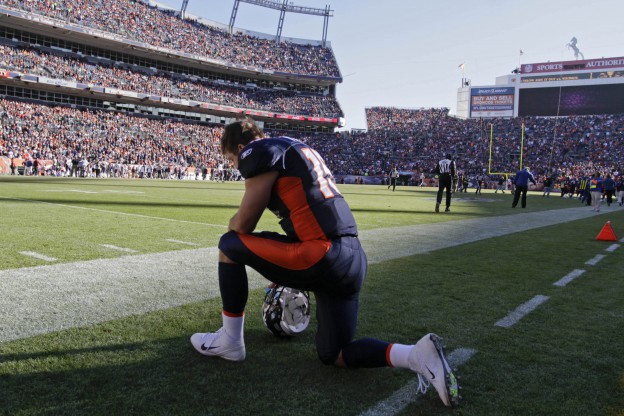
Nevertheless, I realize today that seeing Tim Tebow upset the New England Patriots would make me happy. Not because it would reinforce the nutty belief of the (polls say) almost half of the public who apparently think God is a Denver fan, which is only a reminder that half the nation is below average intelligence, but because it would undoubtedly make all the fanatic Tebow-haters miserable. And since their misery will be entirely the result of these mean-spirited individuals’ own lack of graciousness, tolerance, respect and fairness, they will richly deserve their fate.

Maybe they’ll learn something. I doubt it, but you never know. Yes, that silly half of the country will be insufferable, but I’ll deal with them later.

GO DENVER!

__________________

Update: Never mind!

Ethical Quote of the Week: Boston Judge Frances A. McIntyre

Not speech.

“… while Occupy Boston protesters may be exercising their expressive rights during their protest, they have no privilege under the First Amendment to seize and hold the land on which they sit… ‘Occupation’ speaks of boldness, outrage, and a willingness to take personal risk but it does not carry the plaintiffs’ professed message. Essentially, it is viewed as a hostile act, an assertion of possession against the rights of another. The act of occupation, this court has determined as a matter of law, is not speech. Nor is it immune from criminal prosecution for trespass or other crimes.”

Suffolk Superior Court Judge Frances A. McIntyre, in a 25 page decision lifting the temporary restraining order that has blocked Boston officials from forcibly dismantling Occupy Boston’s  encampment by declaring that mere occupation does not constitute “speech” within the First Amendment.

Well, of course.

Occupying property, public or private, and preventing rightful owners or those who should also have access to do likewise is hostile, and has been from the beginning. “Boldness, outrage, and a willingness to take personal risk” pretty much defines all the Occupy movement has been able to communicate clearly, its more substantive positions being a matter of some dispute, or changing according to tactical needs.

Too many municipal leaders, their political biases and yellow streaks showing, have been reluctant to make this obvious and necessary point in order to toady to hard-left voting blocks and cynical Democratic operatives who think the Occupiers bolster the class warfare theme that seems to be the agreed-upon 2012 electoral strategy. But as public annoyance with the endless occupations wore on (and the novelty wore off), the yellow streaks worked against the demonstrators. They are going to have to find some other way of “speaking” besides sitting around.

A well-reasoned, articulate and rational position would be nice.
Getting Scrod* in Boston: The Ravages of Seafood Fraud

“Why, certainly that’s a red snapper, sir! Just came off the boat today!!”

If there is an opportunity for profitable dishonesty that nobody is paying attention to, the overwhelming likelihood is that it will flourish to the point of becoming standard practice.

Isn’t that discouraging? I hate to write that sentence, as I hate to think or accept the conclusion behind it. Yet when I come upon a topic like seafood fraud (or fish fraud), it is hard to deny.

The Boston Globe just published the results of a wide-ranging, five-month investigation into the mislabeling of fish in the Greater Boston area and other parts of Massachusetts. The shocking results showed that Bay State consumers:

“…routinely and unwittingly overpay for less desirable, sometimes undesirable, species – or buy seafood that is simply not what it is advertised to be. In many cases, the fish was caught thousands of miles away and frozen, not hauled in by local fishermen, as the menu claimed. It may be perfectly palatable – just not what the customer ordered. But sometimes mislabeled seafood can cause allergic reactions, violate dietary restrictions, or contain chemicals banned in the United States.

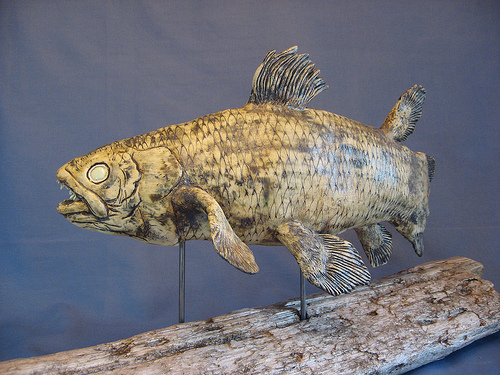
“The Globe collected fish from 134 restaurants, grocery stores, and seafood markets from Leominster to Provincetown, and hired a laboratory in Canada to conduct DNA testing on the samples. Analyses by the DNA lab and other scientists showed that 87 of 183 were sold with the wrong species name – 48 percent.” Continue reading

Ethics Dunce: CBS

"That's Entertainment!"

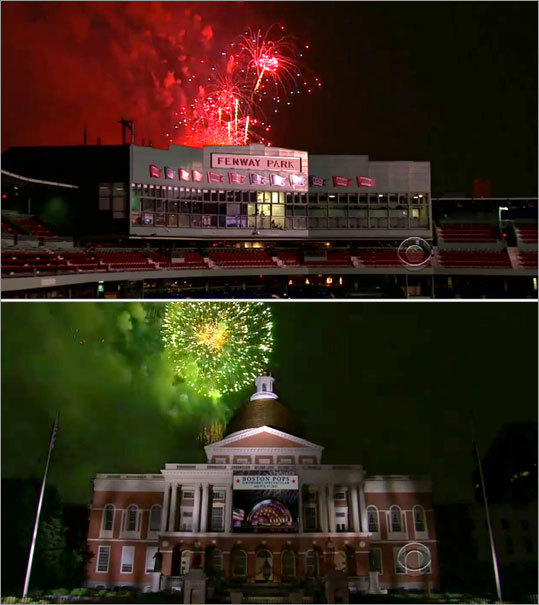
It took a few days, but Boston viewers finally figured out that CBS’s broadcast of the city’s famous Fourth of July fireworks display was digitally altered to present a spectacular view of the display that is geographically impossible. Yes, CBS, network of Murrow and Cronkite, presented a phony, enhanced version of the fireworks without bothering to disclose to viewers what they were really seeing.

Yesterday Boston bloggers and observers began pointing out that it was  impossible to see the fireworks above and behind such famous locales as the State House, Quincy Market, and home plate at Fenway Park, because the display, as always,  was launched from a barge in the Charles River, located where it could not be seen from those places.

“According to CBS, you can see the fireworks from the right side of Quincy Market, even though Beacon Hill is in the way,’’ wrote Karl Clodfelter, a research scientist and a commenter on the Boston blog UniversalHub.com. “Also, they come up behind the State House when you’re standing across the road . . . which means the barge must have been parked on the Zakim* this year.’’ Continue reading

“He’s Suffered Enough”: Ethical Lawyering, Dubious Ethics

Attorney Barry Wilson is undoubtedly doing his job, and it is a tough one: arguing for the justice system to do less than throw the book at Boston’s disgraced former Boston City Councilor Chuck Turner, who richly deserves it. This is the lawyer’s sacred duty to a client that makes the profession the butt of jokes and the object of contempt, but it is an ethical and systemic necessity.  It also can be stomach-turning in cases like Turner’s. All Wilson has in his defense arsenal is the hoary “he’s suffered enough” argument. It is always ethically dubious, and this time it boarders on ridiculous.  Continue reading

The Ethics of Booing Manny Ramirez

As it so often does, the world of sport is presenting us with a clear ethical conflict tomorrow night—one of those times when we have to prioritize ethical values, and decide which is more important in our culture, because if we meet one, we violate another.

Manny Ramirez will be returning to Boston’s Fenway Park in a Dodger uniform, as Boston hosts Los Angeles in an inter-league contest. Continue reading

The Arizona Boycotts: Unethical and Unjustified

Seattle, San Francisco, Los Angeles, Washington D.C., Boulder, Boston, St. Paul, Austin, El Paso, Oakland and San Diego have all announced a boycott of Arizona, which stands condemned, in their view, of “violating basic American principles,” “Draconian law enforcement,” “promoting racism,” and “un-American measures.” All this, for announcing that the state is going to enforce a law long on the books that the Federal government stubbornly fails to enforce itself.

Almost all boycotts are unethical, and this one doesn’t come close to being fair or reasonable. Boycotts use economic power to bend others to the will of large groups that disagree with conduct or policy, bypassing such niceties as debate, argument, and rational persuasion. They can be effective, but they always depend on causing harm to third-parties, bystanders and others not directly involved in the decision that prompted the boycott, thus creating pressure on decision-makers to change direction based on considerations that have nothing whatsoever to do with the underlying controversy. It is a bullying tactic, and the only way it can pass ethical muster is if the reasons for it are clear, strong, virtuous, undeniable, and based on irrefutable logic that the boycott target is so wrong, and doing such harm, that this extreme measure is a utilitarian necessity. Continue reading

Public Privacy and the Ubiquitous Camera

Everybody has a camera…well, almost everybody. Thanks to cell phones, we can be recorded in still or video formats almost every second of the day. We are our own Big Brother.  So much so, in fact, that it is hard to muster too much fright and indignation over increasing use of public cameras by the government. Boston police, for example, now have immediate access to street video of shootings, robberies, and homicides on many city streets, and use real time images to send information about the suspects and crimes to responding officers. Continue reading