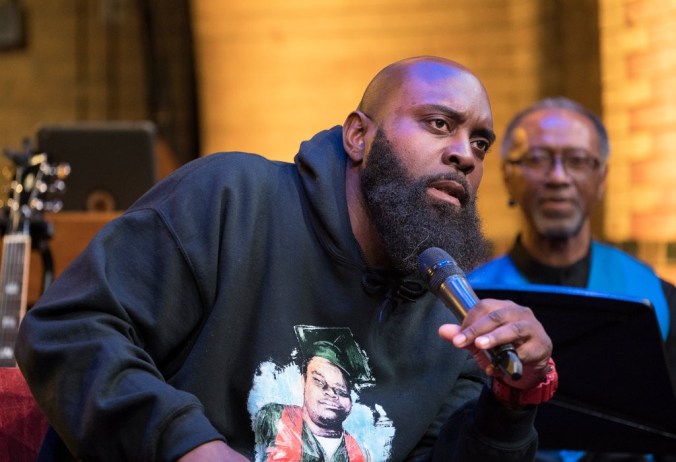
Mike Brown’s father during a discussion after the performance.
“Antigone in Ferguson” premiered at Normandy High School, Michael Brown’s alma mater, in September of 2016. Now the Harlem Stage is presenting it in New York City, Off-Broadway. A play is a play and art is art; artists are going to enable juvenile, half-baked and even destructive political ideas and themes, and playwrights will turn their perceptions of reality into stagecraft that they often are far more qualified to execute than the task of making sense out of the world. This drama was conceived and directed by the activist playwright Bryan Doerries in response to the shooting of Michael Brown in Ferguson, Missouri four years ago, overlays the structure of the ancient Sophocles Greek tragedy with a distorted version of Brown’s death and its aftermath. The goal, says the sympathetic—complicit may be a better word—New York Times, is “to open the door on the thoughts and feelings aroused by the shooting of the 18-year-old Mr. Brown by a white police officer, and by the protests that followed. ”
The play is championed by the Brown family, which means that in part it exists to perpetuate a politically useful lie and the apparently invulnerable narrative that Brown was the innocent, sweet-natured victim of a racist cop who murdered the teen in the streets of Ferguson, and then got away with his deed because the white justice system is bent on killing young black men.
This quite simply is not what happened. The racialist Obama Justice Department was eager to be able to show that the officer was a killer, but in the end, despite the sympathetic spinning of the news media for months, the evidence did not support that conclusion, and no charges could be brought. Mike Brown, stoned and freshly off roughing up a storekeeper, resisted a lawful arrest, tried to grab a police officer’s gun, and then, when he focused his imposing 300 pound mass on charging the smaller cop who arrested him, got himself shot—stupidly, needlessly. His friend on the scene, however, quickly concocted the “Hands up! Don’t shoot!” exchange that never happened, and as that false version slowly twisted its way from slogan to protest to debunked myth, the facts of Brown’s case were neatly discarded for a narrative that advances the cause of division, anti-police bias, racial hatred, and more. Continue reading
 Ethics Alarms