Once Again, Unethical Tears For A Well-Earned Execution: Boyd v. Hamm

Supreme Justices Sonia Sotomayor and Ketanji Brown Jackson are in a tight competition for most flagrantly incompetent liberal member of the Supreme Court. Jackson appears to be well ahead, but Sonia let her inner sensitive Latina run wild in her recent emotional dissent in Boyd v. Hamm, in which the Supreme Court turned down the plea of a condemned prisoner to force Alabama to execute him by firing squad rather than by the relatively new method of nitrogen gas asphyxiation. (Sotomayor’s lame dissent was joined by her two Democratic, reflex-Left wing colleagues because they are nice.)

Some salient facts: Anthony Boyd was convicted of murder in the first degree because he and two drug-dealing comrades killed another drug dealer by binding him and setting him on fire. I’d say Boyd was ethically estopped from complaining that his own execution method was “cruel and unusual,” but he did, even though he had earlier been given a choice between death by firing squad and death by nitrogen, and picked the latter. This is more consideration than his victim was given; at least nothing in the trial transcript indicates that the victim was offered a choice between being roasted alive or having his head bashed in with a rock.

Sonia, however, want us all to feel horror that Boyd, who was executed after his last-ditch appeal to SCOTUS failed, suffered pain in the process of dying. “Take out your phone, go to the clock app, and find the stopwatch,” Sotomayor opens her October 23 dissent. “Click start. Now watch the seconds as they climb. Three seconds come and go in a blink. At the thirty second mark, your mind starts to wander. One minute passes, and you begin to think that this is taking a long time. Two . . . three . . . . The clock ticks on. Then, finally, you make it to four minutes. Hit stop.”

Wow. That’s some impressive legal argument.

My dissent from the dissent: I don’t care, and nobody should. The endless obstacles bleeding heart judges and ethically-confused death penalty activists have thrown in the way of our society’s obligation to set and enforce standards of conduct are destructive and costly. Boyd had a choice, and may have chosen the nitrogen method specifically so his lawyers could use it to stall the arrival of his day of reckoning. The murder he was convicted of committing was particularly heinous and cruel: I might be persuaded to endorse a system in which convicted murderers are executed in the same manner as their victims. But for such an individual to beg for a less “cruel” form of punishment is Death Row chutzpah. Yet Sotomayor fell for it.

Continue reading

Regarding Biden’s Mass Mercy For Convicted Murderers

As was anticipated after reports that were issued over the weekend, “President Joe Biden announced” today that he has commuted the sentences of 37 convicted murderers, thus taking them off federal death row. They will now serve out life sentences in prison, being housed, fed, given medical attention and more at taxpayer expense. This was done deliberately to foil the announced intention of President-elect Donald Trump to carry out the verdicts of juries and the courts.

“Biden’s statement”—this is in quotation marks because he didn’t write it, probably doesn’t understand it and quite possibly never read it or approved it—reads,

“Today, I am commuting the sentences of 37 of the 40 individuals on federal death row to life sentences without the possibility of parole. These commutations are consistent with the moratorium my Administration has imposed on federal executions, in cases other than terrorism and hate-motivated mass murder.Make no mistake: I condemn these murderers, grieve for the victims of their despicable acts, and ache for all the families who have suffered unimaginable and irreparable loss. But guided by my conscience and my experience as a public defender, chairman of the Senate Judiciary Committee, Vice President, and now President, I am more convinced than ever that we must stop the use of the death penalty at the federal level. In good conscience, I cannot stand back and let a new administration resume executions that I halted.”

Ethics observations:

Continue reading

“Clayton Lockett Is Dead, Right? Then 1) Good! and 2) His Execution Wasn’t ‘Botched'”: The Sequel

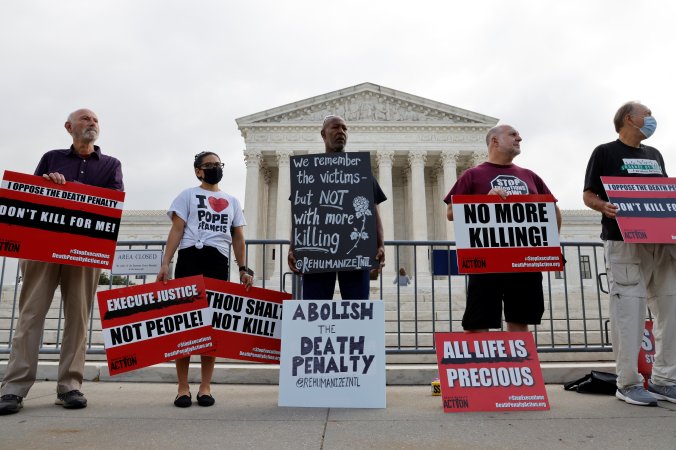
Demonstrators in Washington rally against the death penalty outside the Supreme Court building Oct. 13, 2021. (CNS photo/Jonathan Ernst, Reuters)

Following this introduction is an EA post from ten years ago about a “botched” execution. The issue has come around again: The always woke online tabloid The Guardian is caterwauling over another messy execution, this time in Alabama. “The only lesson from this grim sequence of events is that when states use human beings as guinea pigs for lethal experiments, they are bound to suffer, whether at the point of a needle or behind a mask,” Matt Wells, deputy director of the human rights group Reprieve US, is quoted as saying. OK, they suffer. I have no sympathy for them. Killing human beings is hard, and murderers like Clayton Lockett and Carey Dale Grayson are at fault for making society kill them. There are ways of killing the condemned that involve no suffering at all, and I don’t know what we don’t make use of them except that they are a bit spectacular. In India, they used to execute people by training an elephant to step on their heads and smash them like a grape. I don’t understand why states have to be fooling around with methods as baroque as nitrogen poisoning.

The Guardian also includes the obligatory anti-capital punishment statement from the daughter of the victim. “Murdering inmates under the guise of justice needs to stop,” Jodi Haley, who was 12 when her mother was killed, told reporters. “No one should have the right to take a person’s possibilities, days, and life.” Well, Jodi, you have been indoctrinated to your disadvantage and society’s best interests. Nobody has the right to make me pay to keep them alive when they have violated the conditions of the social compact, and when allowing them to live devalues the lives of others while requiring lesser punishments for other terrible crimes.

I was going to reprint the post below substituting Grayson for Lockett, but that isn’t necessary. Everything below applies to the Alabama execution as well.

____________________

Capital punishment foes have no shame, and (I know I am a broken record on this, and it cheers me no more than it pleases you), the knee-jerk journalists who have been squarely in their camp for decades refuse to illuminate their constant hypocrisy. In Connecticut, for example, holding that putting to death the monstrous perpetrators of the Petit home invasion was “immoral,” anti-death penalty advocates argued that the extended time it took to handle appeals made the death penalty more expensive than life imprisonment—an added expense for which the advocates themselves are accountable.

A similar dynamic is at work in the aftermath of the execution of convicted murderer and rapist Clayton Lockett in Oklahoma.Witnesses to his execution by lethal injection said Lockett convulsed and writhed on the gurney, sat up and started to speak before officials blocked the witnesses’ view by pulling a curtain. Apparently his vein “blew,” and instead of killing him efficiently,  the new, three-drug “cocktail” arrived at as the means of execution in Oklahoma after extensive study and litigation failed to work as advertised.  Why was there an excessively complex system involving multiple drugs used in this execution? It was the result of cumulative efforts by anti-death penalty zealots to make sure the process was above all, “humane.” Of course, the more complicated a process is, the more moving parts it has, the more likely it is to fail.

Continue reading

Small Ethical Silver Lining To An Ugly Cloud: At Least This Awful Woman’s Lawyer Talked Her Into Pleading Guilty

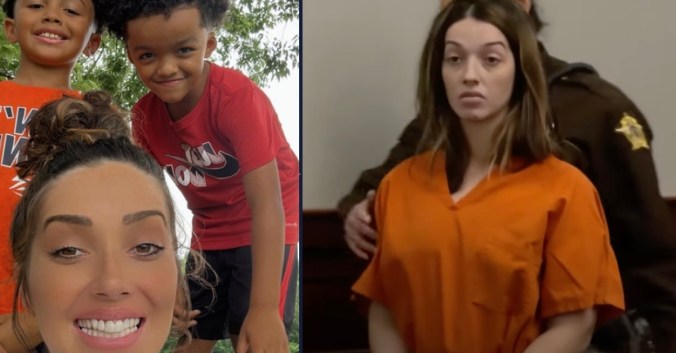
Tiffanie Lucas, 33, had been preparing to try an insanity defense in her upcoming December murder trial stemming from her Novenber 8, 2023, shooting of her sons Maurice “Peanut” Baker Jr. and Jayden Howard, 6 and 9. Now she says she will plead guilty and rely on the judge to decide her fate.

Continue reading

The Explanation For Everything That Afflicts Americans of Color Is Systemic Racism, Part II: Botched Executions

A report released last week by Reprieve, a human rights group that opposes the death penalty apparently shows that the lethal injections of convicted murderers are botched more than twice as often as the executions of white convicts. Spinning, the New York Times says, “That finding builds on a wealth of research into racial disparities in how the U.S. judicial system administers the death penalty. The proportion of Black people on death rows is far higher than their share of the population as a whole.”

“We know that there’s racism in the criminal justice system,” said Maya Foa, an executive director of Reprieve. “We know it’s there in the capital punishment system, from who gets arrested, who gets sentenced, all of it. This is, though, the first time that it’s been looked at in the context of the execution itself.”

To start with, they don’t “know” that at all. It is a self-perpetuating theory built on other debatable assumptions, such as believing that the disproportionate number of blacks on Death Row, and in the U.S. prison system generally, is because a disproportionate number of blacks commit crimes that legitimately put them there. Second, how exactly does doing a bad job killing a condemned prisoner show racial bias?

More from the Times:

Continue reading

Another Example of Why the Death Penalty Is Necessary

My go-to case for defending the death penalty is the Cheshire home invasion, though the surviving Boston Marathon bomber Dzhokhar Tsarnaev is an equally strong, indeed I would say irrefutable case. I now have another one.

Read with care.

Kristel Candelario left on a summer vacation in Puerto Rico with a male friend, leaving her 16 month daughter Jailyn alone in a playpen with a few bottles of milk. The neighbor’s doorbell camera recorded the baby’s anguished screams as she suffered from abandonment and separation, hunger and dehydration. After a few days at the beach and another stopover in Detroit, Jailyn’s mother returned tp her Cleveland home to find her daughter dead, though she had the gall to call 911 in a panic. She’d been gone for about 10 days. I wonder what she expected to find.

Continue reading

Oregon’s Governor Spares 17 Murderers Who Deserve To Die

It is clear the the 2022 Ethics Alarms Award for the Most Incompetent Elected Official of the Year is going to come down to the wire. Oregon Governor Kate Brown, already a strong contender (as she was in 2021 and 2020), just delivered a pure grandstanding exhibition that insulted multiple juries, undermined the rule of law, and in effect lowered the penalty for vicious murder to that of far less heinous crimes.

Her decision to commute the death sentences of 17 convicted killers who have forfeited the right to live in civilized society is legal, and the power she has to make it is necessary. There has to be some safety valve for the justice system, which is bound to fail as all systems do, and making the executive the final arbiter of extreme and unusual cases is the best of several flawed options. However, many governors abuse this power, and, like Brown, use it to pander to a political base. Here, from Oregon Live, is the list of the seventeen men on Death Row that Brown feels deserve to continue to live at taxpayers’ expense: Continue reading

In This Law Vs. Ethics Clash, Choosing Law Over Ethics Is The Ethical Course [Link Added]

Clear?

Probably not. Let me explain.

On July 5, 2005 in Kirkwood, Missouri, police were executing a search warrant. While they were in his home, twelve-year old Joseph Long suffered a seizure and collapsed. Police, maybe thinking he was faking, maybe worrying about being distracted from their jobs, maybe because they were just cold-hearted bastards, did nothing to help him, and wouldn’t let his mother intervene either. The child died. Two hours later, the same officers responded to the same neighborhood after getting reports of illegal fireworks being set off. Kevin Johnson, the dead child’s older brother, spotted officer William McEntee, one of the police who had been at his home earlier that evening. “You killed my brother,” he said, and fired a gun at the officer multiple times, killing him.

Johnson was tried, sentenced to death, and now, 17 years later, has run out of appeals. He’s going to be executed. His daughter, Korry, just two when he murdered the police officer, is now 19 and wants to be among the limited number of attendees at her father’s death. Missouri has a statute, Revised Code Section 546.740 that determines who is eligible to watch an execution: Continue reading

Observations On Another Capital Punishment Fiasco

That’s Alan Eugene Miller, who was convicted of murdering three men in 1999. Nobody disputes that he is guilty. The only question is how and when he will be executed, as he received the death penalty and deserved to. The fact that he is still breathing 23 years after his crimes speaks for itself, and is self-evidently absurd, a direct consequence of the moral and ethical confusion over capitol punishment. People like Miller—that is, people who have forfeited their right to continue living in a civilized society—cost law abiding citizens millions by the time they finally get their just desserts.

This story is especially infuriating as well as ridiculous. Alabama passed a law in 2018 that gave death row prisoners a choice between being killed by a lethal injection and dying by a nitrogen hypoxia, which is death by being deprived of oxygen.

[Observation: Why a condemned prisoner should be given any choice at all is beyond me. As Alabama Governor Kay Ivey, said, Miller’s three victims didn’t get to choose whether they would be shot in the chest.]

Miller is, we are told, afraid of needles, so he chose suffocation.

[Observation:  This already sounds like a Monty Python skit. Again, who cares what he’s afraid of? Presumably he’s also a bit afraid to die. So what? Why should the state, or the society he betrayed, have any ethical obligation to yield to his delicate sensitivities?] Continue reading

Law vs Ethics: A SCOTUS Decision Rings Ethics Alarms

It’s not surprising that last week’s decision in the Arizona case of Shinn v. Ramirez and Jones didn’t get much coverage outside of the legal media. The decision is procedural rather than substantive, and the majority opinion by Justice Thomas in the 6-3 holding is hard sledding. Nonetheless, it is a classic example of law trumping ethics. The Justice Sotomayor dissent, joined by the other two liberal justices, argues that it trumps law as well.

I would not argue that law must never trump ethics, for law requires consistency and systemic application over the long term to have credibility and integrity. However, Shinn involves a man facing the death penalty, and the decision by the conservative justices chose the virtues of finality over the possibility that the government might be executing an innocent man.

Continue reading