Death Throes Of The Death Penalty: Dumb Expert, Dumb Advocates, Dumb Debate

“Next!”

As I recently concluded, the death penalty is beyond saving, not because it can’t be defended ethically and morally, but because the issues are tangled beyond repair.

The controversy over the legality of the so-called drug cocktails that somehow became our execution method of choice is a perfect example. The battles over capital punishment trapped policy-makers into this kinder, gentler, ridiculously complicated method of execution that has suffered snafus ranging from unavailable drugs to ugly extended deaths. The problem is the floating definition of “cruel and unusual punishment,” prohibited by the Constitution, but almost entirely subjective. Many judges think killing a killer is itself cruel by definition, and the more reluctant Western Europe becomes to execute the worst of the worst, the easier it is to make the argument that the death penalty is also unusual.

I don’t get it. I never have. India once executed condemned criminals by having the subject place his head on a stump under the raised foot of  trained elephant, which on a command would smash the head like a grape. Quick, painless–messy!—but virtually fool-proof. A pile-driver would be an acceptable equivalent.  Ah, but ick! In this stupid, stupid, intellectually dishonest debate, ick always equals “cruel and unusual,” because to opponents of the death penalty, killing people, even horrible, dangerous people, is inherently icky.

(Oddly, ripping unborn babies out of the womb is not, but I digress.)

I’ve admitted it, and I will again. (This lost Ethics Alarms Luke G., one of its best commenters the last time.*) It is obviously wrong to intentionally prolong an execution or deliberately cause pain, but if the occasional execution is botched and the condemned suffers, that should be cause for great rending of garments, nor should it be used to discredit capital punishment. As I wrote here about Clayton Lockett’s execution in Oklahoma

“There was no question of Lockett’s guilt, and his crime was inhuman. Such wanton cruelty and disregard for innocent life warrants society’s most emphatic rebuke, and the most emphatic rebuke is death. It is essential that any healthy society make it clear to all that some crimes forfeit the continued right to not just liberty, but also life. Anyone who weeps because this sadistic murderer experienced a few extra minutes of agony in the process of being sent to his just rewards has seriously misaligned values. No method of execution will work every time, and to make perfection the standard is a dishonest way to rig the debate. If the death penalty is justified, and it is, then we should expect and accept the rare “botch.” Meanwhile, if the concern really is efficiency, reliability, speed of death and minimal pain, there are literally dozens, maybe hundreds of methods of swift execution that would accomplish this. They just won’t pass the standards of death penalty opponents, because no method will.”

Today the Supreme Court heard oral arguments on the question of whether Oklahoma’s use of the common surgical sedative midazolam did not reliably make prisoners unconscious during lethal injections, thus violating the Eighth Amendment’s protection against “cruel and unusual punishment.” It’s a ridiculous case, which arises out of the botched April 2014 execution of Lockett that sparked the post I just quoted. It is a ridiculous case because the method of execution isn’t worth arguing over. Elephant. Head. Problem solved. Why is Oklahoma fighting about which cocktail to use? This is the anti-capital punishment team’s game, and sooner or later, the result is preordained.  Continue reading

Tsarnaev’s Irrelevant Finger And The End Of Capital Punishment

dzhokhar-tsarnaev finger

I’ve stated here several times that I am in favor of the death penalty when it can be shown beyond any doubt whatsoever that an individual committed a horrific, cruel, unequivocally inexcusable murder or murders, preferably murders. One of the two Boston Marathon bombers, Dzhokhar Tsarnaev, the surviving one, clearly qualifies. Unfortunately, the public, the law and the legal profession are too confused to bring integrity to capital punishment, and I think, because of that, it can never be sufficiently fair and coherent to be ethical. Continue reading

KABOOM! Head Exploded, Can’t Write, Don’t Need To: The FBI Forensic Scandal

Happy New Year!

This is res ipsa loquitur: “the thing speaks for itself.” If I have to explain what’s unethical about this and why, you are beyond my help.

From the Washington Post:

The Justice Department and FBI have formally acknowledged that nearly every examiner in an elite FBI forensic unit gave flawed testimony in almost all trials in which they offered evidence against criminal defendants over more than a two-decade period before 2000.

Of 28 examiners with the FBI Laboratory’s microscopic hair comparison unit, 26 overstated forensic matches in ways that favored prosecutors in more than 95 percent of the 268 trials reviewed so far, according to the National Association of Criminal Defense Lawyers (NACDL) and the Innocence Project, which are assisting the government with the country’s largest post-conviction review of questioned forensic evidence.

The cases include those of 32 defendants sentenced to death. Of those, 14 have been executed or died in prison, the groups said under an agreement with the government to release results after the review of the first 200 convictions…

Read the rest here.

President Lincoln’s Misunderstood Ethics Crisis: The Great Sioux Uprising

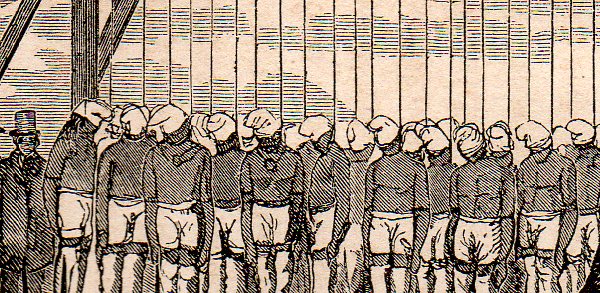
Dakota hanging

As part my so-far futile efforts to leave Ferguson in the rear view mirror, let’s revisit one of the Abraham Lincoln’s great ethical dilemmas during the Civil War, in which today’s date, December 1, was pivotal.

Minnesota’s Great Sioux Uprising, now usually called the Dakota-U.S. Conflict, was among the bloodiest Indian wars in the West, with hundreds of Native Americans, settlers and military casualties. The Sioux were defeated soundly, and the U.S. Army tried 303 Native Americans by military commission, finding them guilty of war crimes and sentencing them to death by hanging. Federal law required Presidential approval of the death sentences, and this was a problem Abraham Lincoln, the President at the time, did not need.

For it was 1862, and the Civil War was raging. This was a year full of Union defeats, indeed, disasters, like Fredericksburg, and both the war and Lincoln’s ability to lead it were in peril. Lincoln was also calculating all the political angles before issuing the Emancipation Proclamation. On top of the burdens of war and politics, he was coping with personal tragedy: his young son Willy had died nine months earlier, and Mary Todd Lincoln was teetering on emotional collapse from grief.
Now he had to decide whether to allow the execution of more than 300 Indians convicted in trials that were no better than kangaroo courts. Few Americans were concerned about the fate of the Native Americans, but Lincoln, with all of his other worries, took on the task of reviewing the trial records. What he found was manifest injustice.  Continue reading

Hall v. Florida: The Supreme Court Opts For Ethics Over Law

On a purely ethical basis, it is difficult to argue with the majority opinion in Hall v. Florida, where the U.S. Supreme Court ruled that executing a convicted killer whose IQ had been determined to be 71 was still cruel and unusual, and thus a violation of the 8th Amendment, despite Florida law’s cut-off for mental retardation being a score of 70. On the basis of law, however, the SCOTUS decision is hard to defend. Funny, I thought the job of the Supreme Court was to interpret laws.

“Intellectual disability is a condition, not a number…,” wrote Justice Kennedy for the 5-4 majority, in which he joined the so-called “liberal wing.”  “This is not to say that an IQ test score is unhelpful. It is of considerable significance, as the medical community recognizes. But in using these scores to assess a defendant’s eligibility for the death penalty, a State must afford these test scores the same studied skepticism that those who design and use the tests do, and understand that an IQ test score represents a range rather than a fixed number.”

The problem is that the whole concept of a “condition” like intellectual disability is a subjective one. The theater company for which I serve as artistic director is presenting the Abby Mann historical drama “Judgment at Nuremberg,” and one of the most troubling scenes involves a man, the son of a Communist, sterilized by the Nazis because he was “mentally defective,”  or perhaps because of his family’s political views. The Nazi test: make a sentence out of the words hare, hunter, and field. A witness for the prosecution, the man who was sterilized fails to answer the test on the stand, just as he failed when quizzed by the Nazis. Continue reading

No Ruth, Monica Is Still A Victim, Bill Is Still A Predator, And Why Do “Feminist” Pundits Still Make Excuses For The Clintons?

biil-and-monicaThe Washington Post’s brigade of shamelessly ideological or just plain incompetent columnists has been out in force of late, placing me in a dilemma: if I write full posts calling all of them on their deceitful and irresponsible essays, I make Ethics Alarms look like Newsbusters, and if I don’t, only the angry, equally ideological columnists on “conservative media sites” will, and what they say doesn’t matter, because they’re all mean, lying “wingnuts,” don’t you know. So I’m going to let it pass that Kathleen Parker wrote yet another of her wishy-washy, hand-wringing protests against the fact that ethical decision-making requires policy makers to make tough choices, her craven proclamation that while it is true that some criminals deserve to die, she isn’t willing to accept her part in society’s obligation to see that they get what they deserve. I will note that either she or the Post scrubbed the online version of a sentence in the print version that actually said that explicitly, but never mind. Parker is still clear in her high-minded cowardice.

And I will restrain myself from awarding the Baghdad Bob Award to Eugene Robinson, who increasingly makes me wonder how much of a role affirmative action played in his Pulitzer Prize. He submitted a certifiably batty column proclaiming that the Obama administration has been a wonder to behold, that the economy is “fixed”, that the latest jobs and economic numbers were glorious, that Obamacare is an unequivocal success, and that the Democrats should declare that all is well, because it is. Meanwhile, just about every fact-based story in his own, relentlessly liberal newspaper rebutted his words. Robinson’s an opinion columnist: a point of view is necessary. Misleading readers ( “Critics have stopped talking about a hypothetical “death spiral” in which the health insurance reforms collapse of their own weight, since it is now clear that nothing of the sort will happen,” he wrote. I was able to find several such predictions from credible analysts written within the last two weeks, and I didn’t spend much time looking. Here’s one of them…) and partisan cheerleading, however, is unethical and unprofessional. The Pulitzer just isn’t what it used to be, I guess. Sort of like the Nobel Peace Prize.

I am going to take on Dana Milbank’s description of the Benghazi scandal as a “nothingberger”Shouldn’t referring to a coordinated, news-media-assisted cover-up of  intentional public deception by a President in the midst of a Presidential campaign as “nothing” (never mind that the incident at the heart of the deception involved the deaths of four Americans, including an ambassador) disqualify a columnist from regular publication by a respectable news source?—-but not today.

No, today the winner is Ruth Marcus, a member of the Post’s editorial staff whose column this week spun the new Monica Lewinsky Vanity Fair piece as a boon to Hillary Clinton: Continue reading

Comment of the Day: “Clayton Lockett Is Dead, Right? Then 1) Good! and 2) His Execution Wasn’t “Botched””

capital-punishmentThere are well-established group of ethics topics that will always cause spirited debates here, because they are issues that have always divided public opinion and always will: morality vs ethics, drug legalization, abortion, war, social justice, socialism, plus various controversies involving race, sexuality and gender. I try to wade into these only when a current even beckons, as to some extent the arguments are futile and familiar, and too many people refuse to think or listen anymore, retreating to slogans and reflex positions articulated by others.

I decided to wade into one of the most polarized, of these, capital punishment, when the Clayton Lockett execution in Oklahoma sparked a national debate that seemed strange to me, and indeed driven by the unwarranted assumption, uncritically accepted by the news media, that the painlessness of executions were a crucial feature of making them ethical as well as societally palatable. It also opened the question of whether one execution that doesn’t follow the script necessarily calls capital punishment itself into question. I confess: both in my post’s title and in the tone of my responses to anti-death penalty commentators, I intentionally sought to roil the waters of debate, and was determined not to allow the nice people who usually express compassion for the pain and suffering of humanity’s worst and deadliest escape with the usual pieties.

Sure enough, this annoyed the heck out of some readers. Responding to the emphatic objections of one, Isaac delivered a personal and powerful rebuttal. Here is his Comment of the Day on the post Clayton Lockett Is Dead, Right? Then 1) Good! and 2) His Execution Wasn’t “Botched:” Continue reading

Clayton Lockett Is Dead, Right? Then 1) Good! and 2) His Execution Wasn’t “Botched”

Capital punishment foes have no shame, and (I know I am a broken record on this, and it cheers me no more than it pleases you), the knee-jerk journalists who have been squarely in their camp for decades refuse to illuminate their constant hypocrisy. In Connecticut, for example, holding that putting to death the monstrous perpetrators of the Petit home invasion was “immoral,” anti-death penalty advocates argued that the extended time it took to handle appeals made the death penalty more expensive than life imprisonment—an added expense for which the advocates themselves are accountable.

A similar dynamic is at work in the aftermath of the execution of convicted murderer and rapist Clayton Lockett in Oklahoma.Witnesses to his execution by lethal injection said Lockett convulsed and writhed on the gurney, sat up and started to speak before officials blocked the witnesses’ view by pulling a curtain. Apparently his vein “blew,” and instead of killing him efficiently,  the new, three-drug “cocktail” arrived at as the means of execution in Oklahoma after extensive study and litigation failed to work as advertised.  Why was there an excessively complex system involving multiple drugs used in this execution? It was the result of cumulative efforts by anti-death penalty zealots to make sure the process was above all, “humane.” Of course, the more complicated a process is, the more moving parts it has, the more likely it is to fail.

Continue reading

Update: “The Kidneys of Orlac”

He will die, not with his boots on, but with his kidneys in...

He will die, not with his boots on, but with his kidneys in…

One of the best threads Ethics Alarms has ever hosted occurred in response to the November 2013 post, “The Kidneys of Orlac,” which discussed the strange case of the Ohio death row resident who wanted to donate his organs to ill relatives. The issue generated an Ethics Quiz, a follow-up poll (“The Amityville Kidney”) involving the related issue of whether the recipient of a murderer’s organs had a right to know their creepy origin, and a terrific Comment of the Day, which was just one of the COTD-worthy submissions.

I had forgotten about the story until Mark Draughn raised it again at Windy Pundit in the context of criticizing bioethicists, one of whom had what Mark considered a particularly misbegotten argument against the transplants (I agree with Mark about that argument, but I also oppose giving condemned prisoners the privilege of donating organs to loved ones, or anyone at all.) This led me to review original post, which led me to re-read the comments.

I also discovered the resolution of the dilemma, which occurred at the end of last month. Ronald Phillips will not be allowed to donate his organs, because he wouldn’t have enough time to recover from the operation before his execution.  Ah, yes, the old “You have to be in tip-top shape before we can kill you, or it isn’t really punishment”  Catch 22! Ethics, you see, had nothing to do with the bureaucratic resolution here, just the letter of the law, rules, and bureacrats refusing to look for the best solution in an anomalous situation, rather than the one they could reach on auto-pilot. As a result, nobody made a reasoned determination about what is right, or what capital punishment really signifies, or apparently even tried. That is how so many government decisions are made, and that, my friends, is far scarier than having the kidneys of a killer.


KABOOM! Does Everyone Upset About The “Affluenza” Sentence Feel Better Now?

Top: Morris. Bottom: Me.

Top: Morris. Bottom: Me.

Today we travel cross the pond for a head explosion-prompting episode. A charming young woman and mother named Loren Morris, now 21, began having sexual intercourse  with an 8-year-old boy five years ago, and continued for two years until he was ten years old, involving about 50 forced sexual acts.

The boy, now 14, was overheard bragging about his premature sex life at school, and that led to his molester’s arrest and trial. This week a judge today gave Morris a two-year prison sentence at Worcester Crown Court. She will be eligible for release on parole after only a year.

This case is relevant to a couple of recent Ethics Alarms controversies. Presumably Morris is being sentenced leniently on the basis of her horrific crime being committed while she was a juvenile, even though she is an adult now. As I asserted in the stateside case of the juvenile assault ripening into a murder, I think a juvenile whose crime is only discovered and proven after he or she enters adulthood should be tried and punished as an adult. Continue reading