Last Meal Ethics

Sure, the dinner was great, but the after-dinner entertainment was terrible...

The dragging-death killer of James Byrd, Lawrence Russell Brewer, went to his Texas execution last week after ordering up a true pig-out for his last meal: two chicken fried steaks smothered in gravy with sliced onions; a triple meat bacon cheeseburger with fixings on the side; a cheese omelet with ground beef, tomatoes, onions, bell peppers and jalapenos; a large bowl of fried okra with ketchup; one pound of barbecue with half a loaf of white bread; three fajitas with fixings; a Meat Lovers pizza; three root beers; one pint of Blue Bell vanilla ice cream; and a slab of peanut butter fudge with crushed peanuts. When it arrived, he didn’t eat any of it. Texas authorities were annoyed, or insulted (“I make you a delicious meal, your favorite, and this is the gratitude I get?”), or something. Brewer’s wasteful order caused the state  to re-consider the appropriateness of the tradition of the last meal accommodation for the condemned, and legislators decided to eliminate it entirely. Other states have begun to debate doing the same thing.

It’s time for the question that needs to start most ethics discussions: “What’s going on here?” Continue reading →
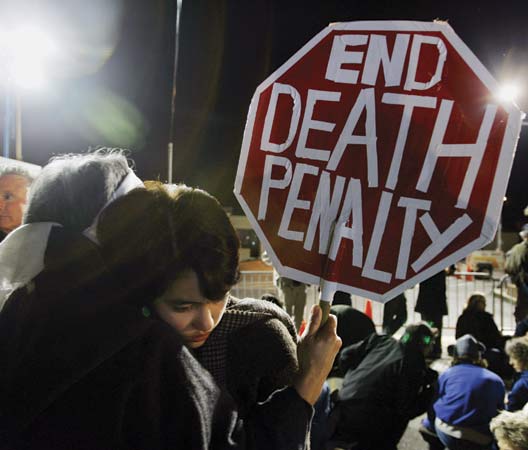
Troy Davis, Lawrence Brewer and the Capital Punishment Ethics Train Wreck

At this point, nothing about the death penalty  in the United States makes any sense, logically or ethically, and that is true for all sides of the capital punishment debate. September 20 should be designated Capital Punishment Day in memory of the contradictions, absolutist pronouncements, convenient rationalizations and everything else that occurred in the years, days and hours before Troy Davis’s execution in Georgia. Then perhaps America as a society will devote one day a year to considering rationally and unemotionally how the death penalty should fit into its criminal justice system without having the discussion warped by the peculiarities of  individual cases. As it stands now, not only is capital punishment an ethics train wreck, the policy debate about it is an ethics train wreck. Everyone who even dips his toe into either becomes irresponsible, conflicted or intellectually dishonest.

Did you know that another inmate was executed yesterday? I didn’t, until this morning. In Texas, white supremacist gang member Lawrence Russell Brewer was executed Wednesday night for the horrific 1998 dragging death slaying of James Byrd Jr., a man from East Texas who had his head pulled off by a chain attached to a truck for the offense of being black. If death penalty opponents are serious and have any integrity, they needed to show it by protesting the execution of Brewer exactly as intensely as they opposed the death of Davis, but of course they did not. Continue reading →

The Ethics of Killing Theresa Lewis

There were five arguments for not executing murderess Theresa Lewis, who just became the first woman put to death by Virginia in almost a century. Four of the arguments were flawed, but one was not. And one should have been enough to save her life. Continue reading →

Why “Cheating the Hangman” Is Unethical

Brandon Joseph Rhode, a convicted killer who attempted suicide hours before he was to be put to death yesterday by injection, had his execution postponed by the Georgia Supreme Court. He tried to slit his wrists and his throat, but was stopped in time to save his life.

This happens every now and then, and when it does someone always asks why the State doesn’t just let the condemned do its job for them and let the prisoner die. The reason is that it would be wrong, in a couple of ways: Continue reading →

Ethics and the Killer’s Liver

Johnny Concepcion, a 42-year-old man accused of stabbing his wife to death,  received a liver transplant at New York-Presbyterian/Columbia University Medical Center in New York, raising the natural question, “WHAT?!!”

Or to be more precise: Wouldn’t it be more ethical to withhold a life-saving liver transplant from such a man, and give the liver instead to someone who isn’t a blight on society and likely to spend the rest of his life in prison?

No.

Continue reading →

Ethics Heroes: The Texas Commission on Judicial Conduct

Thank you, Commissioners, for avoiding the impulse to support a fellow judge, and standing up for decency, compassion, and common sense in the judicial profession.

In a display of arrogance, rigidity and callousness that has justly haunted her for three years, Sharon Keller, the Presiding Judge of the State Court of Criminal Appeals, told a clerk to close down the courthouse on the dot of  5:00 PM on September 5, 2007, knowing well that attorneys were rushing there to file a last-minute appeal to save a prisoner from execution. Once the doors were closed, there was nothing they could do, and their client, Michael Richard, was put to death that night. Continue reading →

The Hood Fiasco: SCOTUS Ducks An Ethical Imperative

Charles Hood has been on Death Row in Texas since 1990, when he was convicted of murder in the shootings of Ronald Williamson and Tracie Lynn Wallace at Williamson’s home in Plano, Tx. Hood had worked for Williamson and was living in his home. There was plenty of convincing evidence that Hood committed the murders; his defense was essentially based on mitigating circumstances. Nonetheless, it was by any logical and ethical standards, an outrageously unfair trial. Why? In a scenario that would have been laughed out of a “Law and Order” writers’ conference, the trial judge, Verla Sue Holland was sleeping the prosecutor,  county district attorney Tom O’Connell. Continue reading →

Bizarro World Ethics: Saving the Prisoner to Kill Him

Lawrence Reynolds, an Ohio Death Row inmate, was supposed to to be executed by lethal injection this week. Instead, he is in a Youngstown hospital after an apparent suicide attempt late Sunday night. Having rescued him from death by his own hand, Ohio will now pay for Reynolds’ medical treatment until he is healthy enough to be sent to the Southern Ohio Correctional Facility near Lucasville, where executions take place.

Then they’ll kill him. Continue reading →

Ethics Trumps Morality: Ending “Don’t Ask, Don’t Tell”

Almost lost in the din of President Obama’s defiant State of the Union address was his promise to finally end “Don’t ask, don’t tell” as military policy. There is no ethical argument against this long overdue move. It has always been a policy based on the political expediency of politicians afraid to do the right thing.

“Don’t ask, don’t tell” is unethical. The law treats gay Americans in a biased and discriminatory manner, reinforcing negative stereotypes and the irrational fears. It also hurts the military and the nation by robbing it of able soldiers and military personnel. Continue reading →