 As you probably know by now, North Carolina voters went to the polls yesterday and passed a constitutional amendment that made same-sex marriages and even civil unions invalid under the law. Amendment 1, as it is called, is unusually brutal, as it will almost certainly take away the health insurance of many individuals in long-term committed relationships who were covered by their partner’s workplace insurance, and if they have pre-existing conditions, it will be difficult and expensive finding new coverage. Even that however, is less harmful and hurtful than having their home state declare that they are a second-class citizens, which is what this and similar provisions around the country do. Continue reading
caring
When Routine Deadens Ethics

"Good boy!!!"
A Niagara County, New York coroner just resigned as he faces possible imprisonment after taking a fresh body part from the carnage of a local plane wreck and using it to train his personal cadaver-sniffing dog.
How, you may ask, could anyone, particularly a public coroner, be so callous and ethically numb? “Hey! Here’s a leg! What luck! Now I can train Rex!” How can a professional—or a human being— treat some grieving family’s loved one like a piece of meat?
I think it’s natural, really. Coroners, morticians, medical examiners, rescue workers, military commanders and doctors all have to detach themselves from the human beings whose deaths are a routine part of their daily work, or they risk being unable to do their work at all. Objectivity and independent judgment are crucial elements of professional conduct, and emotion, including sorrow, sympathy, and revulsion, is the enemy of objectivity. The danger is that in order to deaden one’s emotions through repetition and routine, one risks unplugging an ethics alarm. For these emotions are also part of the ethical value of caring.
The coroner might have been excellent at his job, but he lost all human connection to his work. The mangled body part that had once been a living, breathing, loving person seemed like a piece of meat, because to the coroner, like his dog, it was just a piece of meat.
When feeling gets in the way of a professional’s duties, it is only normal for the professional to try to eliminate them, and even prudent, except that the absence of feelings can cause a deficit in ethics. Building those callouses over normal human emotions are matter of survival in some professions, but doing so creates what I call a “pre-unethical condition” requiring awareness and vigilance.
The Niagara coroner wasn’t sufficiently vigilant, and he fell into a career ending trap.
______________________________
Facts: WGRG New York
Graphic: Greenwich Roundup
Ethics Alarms attempts to give proper attribution and credit to all sources of facts, analysis and other assistance that go into its blog posts. If you are aware of one I missed, or believe your own work was used in any way without proper attribution, please contact me, Jack Marshall, at jamproethics@verizon.net.
A Facebook Suicide and the Duty To Rescue

One takeaway from Claire Lin's death: it's a good idea to have Facebook friends with character.
In Taiwan, a distraught young woman sent streaming photos* of her suicide attempt as she conversed with nine Facebook friends. Some urged her to stop, but none tried to contact police or rescue professionals as she asphyxiated herself with burning charcoal fumes. Yes, her attempt was successful. You can read the disturbing story of Claire Lin’s Facebook suicide here.
Would this happen in America? I wouldn’t be surprised. Sociologists are already weighing in with opinions about the isolation of social media and how the internet makes reality seem less real. I doubt that any of that was especially important in this incident. There have been so many other examples of people left to die with potential rescuers aplenty that were documented on Ethics Alarms and elsewhere, from the Mount Everest climbers who walked past their dying companion, to the more recent case of the Apple store employees who listened to a women get beaten to death in Maryland, that teach us that too many people have the natural inclination not to take affirmative action to help another in distress, and that the instinctive rescuers are the exception, not the rule.
Our culture should teach and reinforce the shared societal duty to come to the assistance of others in peril, but in fact it teaches the opposite. Most of us are told to mind our own business, to think of “Number One”, and make reverse Golden Rule calculations to rationalize inaction (“He wouldn’t have lifted a finger to help me!”) We are taught to fear lawsuits, to wait for professionals (even if they aren’t coming), and to be fearful of making a bad situation worse. And, of course, we are conditioned to let the other person take the risk, so we can have our cake (not get involved) and eat it too ( see the situation resolved without anyone being harmed). And if we wait just a bit too long for that other person to do the right thing, we can always blame him (or her), saying, “I thought someone else would do it!” Continue reading
Ethics Hero: Julio Diaz
[This story, from National Public Radio’s Storycorps, is three years old. But an Ethics Hero is an Ethics Hero whether Ethics Alarms recognizes him or not, and this is a Dickensian tale if there ever was one, about a man whose ethical instinct are so impeccable that they make me feel terribly inadequate. Ethics Alarms reader and commenter Tim LeVier brought it to my attention….thanks, Tim, once again.]
 In February of 2008, 31-year-old social worker Julio Diaz, as he often does, ended his hour-long subway commute to the Bronx one stop early so he could have dinner at his favorite diner. Diaz was walking toward the subway stairs when a teenage boy with a knife stopped him and demanded his wallet.
“Here you go,” said Diaz. As the teen walked away, Diaz added, on an impulse, “Hey, wait a minute. You forgot something. If you’re going to be robbing people for the rest of the night, you might as well take my coat to keep you warm.” The mugger was stunned. “He asked me, ‘Why are you doing this?'” Diaz’s reply: “Listen, if you’re willing to risk your freedom for a few dollars, you must really need the money. I was going to get dinner and if you want to join me, you’re more than welcome.” Continue reading
Ethics Dunce:The Baseball Writers Association of America
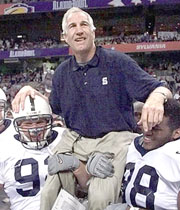
"Well, yes, there was THAT, but what really matters is that he was one hell of an assistant coach!"
The high-profile Sandusky/Paterno/Penn State child molestation scandal has shaken the foundation of the sports world, and in the process, given resolve to past victims of child abuse to identify their molesters. The most recent example is veteran Philadelphia sportswriter Bill Conlin, who abruptly resigned from his job as a columnist for the Philadelphia Daily News when he learned that four adults had come forward to accuse him of molesting them when they were children in the 1970s. This created am immediate crisis for the Baseball Writers Association of America, who had this year bestowed its highest honor on Conlin, the J.G. Spink Award. It never looks good when the person you have declared to represent the best of your profession is revealed as drug-dealer, a serial killer, a foreign agent, or a child molester.
Here’s how the BBWAA dealt with the matter on its website, in this “official statement”: Continue reading
Not That It Will Do Any Good To Say So, But U.S. Acceptance of Prison Rape Is An Ethics Outrage

LOL?
I keep an informal score each television season of how often one of the heroes in a cop or other law enforcement drama will pointedly tell a finally-cornered criminal that he can now look forward to being raped in prison. Of course, this is only representative of the shows I actually see. Even counting only them, however, I have heard such a speech four times in 2011. (The all-time champs in this celebration of prison rape are Dick Wolf’s Law and Order dramas.)
Think about what this means. The scriptwriters are presuming that such a forecast of impending sexual abuse will be enjoyed by the audience, a case of just desserts for the wicked. The casual acceptance of prison rape in America’s penitentiaries is a continuing scandal, and an indictment of our society’s compassion and commitment to the Constitution. Continue reading
An Ethics Lesson Missed, a Life Lost

Jayna Murray, victim of a murderer and ignorance of the the Golden Rule.
The grisly Lululemon Athletica murder trial in Montgomery County, Maryland, concluded with Brittany Norwood being quickly found guilty of the March beating and stabbing death of co-worker Jayna Murray in the yoga-wear store where they both were employed. Among the key testimony at the trial was that of Jana Svrzo, the manager of the Apple store adjacent to the murder scene, who said she heard banging, screaming, grunts and other someone-is-getting-attacked sounds, along with a frantic woman screaming things like, “God help me! Please help me!” and “Talk to me! Don’t do this!” Svrzo said she called another Apple employee over to the wall to confirm her suspicions, and they heard the voice say,”Stop! Stop! Stop!” and then, “Oh, God! Stop!”
The two Apple employees did nothing. Continue reading
“Excuse Me, Sir? You’re About To Die” Ethics
 I had a strange experience as I was leaving a plane a couple of weeks ago.
A distinguished-looking man, older than I, tapped me on the shoulder, and said, “I apologize for the intrusion, but I have been sitting behind you, and I noticed that your earlobes have clear creases in them. This is a sure sign that you either have heart disease or will have it, and are at risk of a heart attack. I just thought you should know.”
Now, as it happens, I know about the supposed link between heart attacks and earlobe creases, and even asked my cardiac specialist about it. He said that 1) some studies had found a statistical link; 2) no study had proposed any good reasons for the link, if there was one; 3) it wasn’t worth worrying about; and 4. one can only address the cardiac risk factors that can be changed, and one can’t change the creases in one’s earlobes. Continue reading
“The 48 Laws of Power”: Robert Greene’s Recipe for Power, Greed and Misery
 “The 48 Laws of Power” is a 1998 book by Robert Greene, a best-seller, and a re-packaging of ideas from multiple sources, including “The Prince” and “The Art of War.” Those who wonder why it is that certain sub-cultures in the United States—business, Hollywood, the entertainment industry, politics, finance— appear to be incurably cynical, amoral, corrupt and untrustworthy would do well to read it, provided they are able to resist being persuaded by its brutal philosophy.
Greene, who has other similarly-oriented best-selling books on business success, is considered a guru by the music industry, and has been embraced with special enthusiasm by hip-hop moguls. What is remarkable about his 48 laws is how completely they discard all ethical virtues, as if fairness, honesty, integrity, responsibility, respect and trustworthiness were irrelevant to the topic of power. In fact, the five most important laws of power are…
1. You must prove your worthiness to hold power by your manner of acquiring it.
2. Power without competence, wisdom and good will lead to tragedy.
3. Do not use power to restrict the welfare, autonomy, freedom, and pleasure of others, but to enhance them.
4. Regard power as a means, not an end.
5. When retaining power itself becomes the goal, it is time to surrender it. Continue reading
Thanking Dick Williams…Finally

The late Dick Williams, doing what great leaders do
If you are not a baseball fan, or under the age of thirty, you probably never heard of Hall of Fame manager Dick Williams, who died yesterday at the age of 84. I never met Williams myself, but I have been indebted to him for four decades. I never told him the immense difference he made in my life, just by doing his job.
In the winter of 1967, I was a devoted fan of my home town team, the Boston Red Sox, and had been since 1962. Over that period I had listened to every single baseball game on my transistor radio when a game wasn’t on TV, which was most of the time, or when I wasn’t at the game, which was almost always the case. I was the only person I knew who followed the team, and for good reason: it was torture. The Red Sox were hopelessly mediocre on the way to awful, and hadn’t had a winning season in more than ten years.
It is a great character builder to follow the fortunes of a terrible baseball team. Almost every day, for six months, you are let down, and yet return to the scene of your despair the next, attempting to muster hope while steeling yourself against likely disappointment. You find yourself finding things to appreciate other than winning: the gallant veteran player who “plays the right way” (Eddie Bressoud, shortstop, 1962-1965); the exciting rookie who gives promise of a better future (Tony Conigliaro, right fielder—rest in peace, Tony); the unique talent who is worth watching for his own sake (Dick Radatz, relief pitcher, 1962-1966). These things help, but following a perennial losing team and caring about them is like being punched in the gut four or five days a week without knowing which day you’re getting it.
Since 1965, I had always reserved seats for the first day of the season and one of the last two home games, just in case those last games would be crucial to a (hahahaha!) Red Sox pennant drive. This was especially pathetic, since the team was getting worse. They had finished in a tie for 9th place in 1966, and as the 1967 season loomed, Vegas had them installed as 100-1 underdogs to win the American League pennant. In truth, the odds should have been longer. Nonetheless, I wrote the Red Sox and got my tickets, this time for the next to last day of the season.
The team was full of rookies and near rookies, and appropriately had hired a minor league manager, Dick Williams, to be the new skipper. Williams was something else, however: he was a gifted leader. One day, in the middle of Spring Training, a Boston scribe asked the new manager what the prospects were for the upcoming season. Would the team escape the cellar? Would there be forward progress? Williams’ answer was instant front page news:
“We’ll win more than we lose.” Continue reading
 Ethics Alarms