Unethical Cartoon of the Month

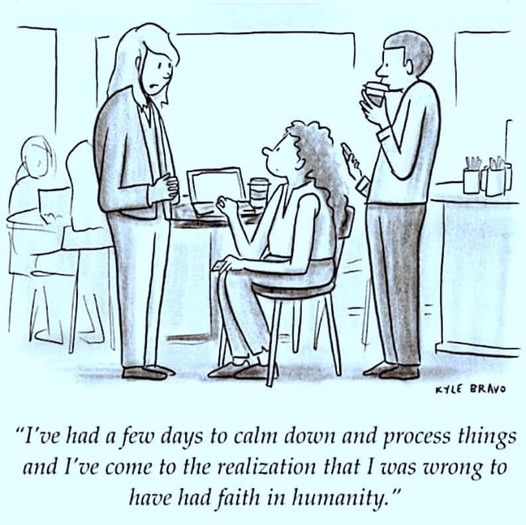
This is one of the times I miss our once-frequent cartoonist commenters, the apparently retired King Kool and the now completely Trump Deranged Ampersand. What a snotty, insulting, arrogant and stupid cartoon that is. I’m not sure where it cane from: my guess would be The New Yorker.

Just because the unethical assertion that voting for Donald Trump (or against the spectacularly awful Kamala Harris, the totalitarianism, censorship and anti-Semitism-supporting party she represented or the incompetent Biden administration) means you are deplorable, “garbage,” a racist, a sexist or a fascist comes in a cartoon doesn’t mitigate the vile nature of the statement. I’m sure the cartoon will be defended by the claim that it is mocking people like the speaker in the drawing.

Sure.

Ethics Quiz: The Comic Strip’s Hidden Message

Yikes.

In February, 2019, venerable ( and usually funny) Sunday comics feature “Non Sequitur” included a hidden message tucked into the corner of a strip . Cartoonist Wiley Miller had scrawled, barely legibly, “Go Fuck yourself, Trump.”

This led some newspapers that had run the strip to cancel the comic permanently. Most, however, did nothing: the strip is still running in, for example, the Washington Post.

Dallas Morning News editor Mike Wilson said that Miller was going “around his editors and even his own syndicate to publish something he must have known we wouldn’t accept. We’ll have no trouble finding a better way to spend the $8,000 we would’ve paid for that strip.” For its part, Kansas City-based Andrews McMeel Syndication, which distributes “Non Sequitur,” apologized, saying,

“We are sorry we missed the language in our editing processIf we had discovered it, we would not have distributed the cartoon without it being removed. We apologize to ‘Non Sequitur’s’ clients and readers for our oversight.”

Miller’s explanation was essentially “Oopsie!” He said he had entered the vulgarity in the corner when he was angry with then-President Trump, and forgot to remove it. He wasn’t trying to sneak the insult by anyone.

Okaaay. Do you believe that?

Your Ethics Alarms Ethics Quiz of the Day is…

What is the fair and responsible punishment for Sunday comics cartoonist who does what Miller did?

Continue reading

Ethics Quiz: The Cartoonist’s Regret

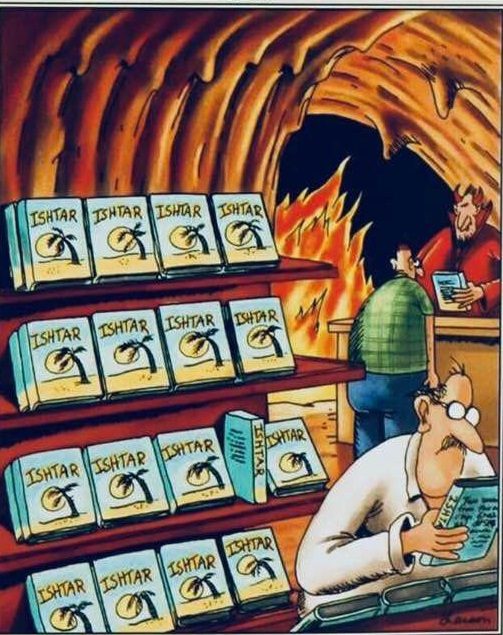
                                        Hell’s video store

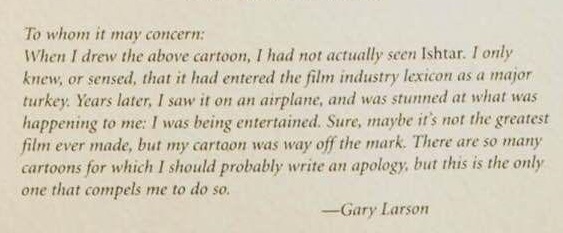
Sometimes Ethics Alarms is on these matters quicker than anyone; sometimes it takes a while. Two years ago, retired “Far Side” cartoonist Gary Larson confessed that the above cartoon was the only one he could think of at the moment that he felt he should apologize for. He wrote,

Ace Ethics Alarms commenter JutGory alerted me to Larson’s lament, which had been recalled in this recent post on the site “Screen Rant.” I tended to find that the cartoonist’s apology reflected well on his  ethics alarms, as did the Screen Rant pundit, who wrote,

In the end, he put his ego aside and admitted he unfairly judged the movie and criticized it without ever seeing it. The Far Side creator sharing his mistake shows that even the most talented and self-aware cartoonists can accidentally cross a line without initially realizing it. Thankfully, after seeing the movie for himself, Gary Larson understood an apology was warranted for the Far Side comic.

Jut, however, has a different take. He wrote,

It was a joke that landed well because of popular sentiment at the time it was made. Thinking about it another way, what if he saw Ishtar at the time and liked it?  He could still make the same joke because it would resonate with the public.  It would still be funny. I guess the real question is whether comics are bound by the same rules as a critic.  A critic should know what it is criticizing.  A comic is going for a laugh.  And, to the extent it was an “unfair” joke (I am not sure it is, as the movie had a widely-known bad reputation), is an apology necessary.  Most jokes are “unfair” to some extent.  But, does that, in itself, require an apology.  From a critic, yes; from a comic, no.

Ooooo, I think I may have to agree with Jut.

Maybe.

Your Ethics Alarms Ethics Quiz of the Day is…

Does Gary Larson have anything to apologize for?

Continue reading

Ethics Quiz: The Cartoon Quote

I would, left to my own instincts, categorize this as a “When Ethics Alarms Don’t Ring” episode. But Legal Insurrection, a conservative commentary blog that I find to be usually reasonable, feels otherwise, so I’ll frame this as an ethics quiz.

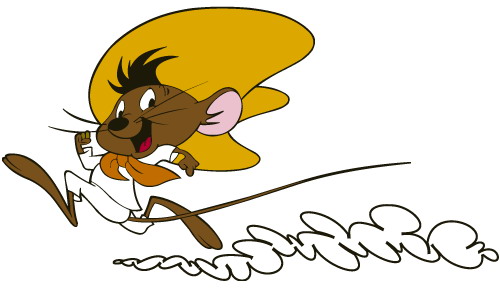
Robert Ternansky, a lecturer at UC-San Diego, was interrupted by loud speaking  from the hallway outside his classroom. Ternansky walked into the hallway and seeing students he took to be Hispanic, immediately quoted the signature catch phrases of now politically incorrect Warner Bros. cartoon character Speedy Gonzalez, “The Fastest Mouse in All of Mexico”: “Sí, sí señor! Ándale, ándale! Arriba, arriba!”The video of the class also catches Ternansky  asking his students, “How do you say ‘quiet’ in Mexican?” One replies, it seems, “Caliente,” and the lecturer says,  “Caliente, huh? Help me. All I knew how to say was ‘Ándale, ándale, arriba, arriba.’ I don’t think that was — to be quiet? That’s like hurry up? Did I insult them?”

Apparently! Students complained, and the school responded with this statement:

UC San Diego officials were recently made aware of offensive and hurtful comments that a professor made in a chemistry class when video of the comments was posted to social media. At that time, the professor was engaged about his comments, and it was made clear to him that they do not reflect our community values of inclusivity and respect. The professor has since apologized to the students and will be doing so to others involved.

As a reminder to our community, and as was shared with media outlets who inquired, UC San Diego is committed to the highest standards of civility and decency toward all. We are committed to promoting and supporting a community where all people can work and learn together in an atmosphere free of abusive or demeaning treatment.

Your Ethics Alarms Ethics Quiz of the Day is, in the words of Legal Insurrection writer Mike LaChance…

“Does this strike anyone as a bit of an overreaction?”

Continue reading

A Case Study Of How Race-Baiting And Race-Bullying Undermines “Diversity” And “Inclusion”: The New Yorker’s Cartoons

The cartoon above is from the current issue of The New Yorker, the woke urban sophisticate’s bible, renowned for its witty, esoteric cartoons since its founding in the flapper era. And yet as woke and progressive and Democratic Party-bootlicking-addicted as it is, The New Yorker rarely includes black characters in its cartoons, and hasn’t since its inception. I checked the most recent compendium of New Yorker cartoons covering eight decades and thousands and thousand of humorous drawings. In only a handful (out of thousands and thousands) do cartoon characters of color even appear in crowd scenes and backgrounds. If they do, they look like the male character above from the only cartoon from the current New Yorker issue to show black characters at all. There were 14 cartoons in the issue, and in the outlier above, blacks are portrayed as white people with tans. I’m sure some professor somewhere will pronounce that representation as offensive anyway. Continue reading

Ethics Quote Of The Month: New York Times Columnist Ross Douthat

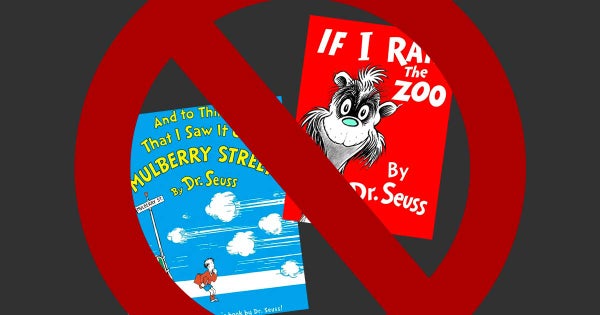
seusscancelled-header

“It was mildly creepy to hear that the custodians of Theodor Geisel’s estate, Dr. Seuss Enterprises, consulted with a ‘panel of experts’ and decided to cease publishing six Seuss titles because they ‘portray people in ways that are hurtful and wrong.’ But it was much creepier that so few people notionally in the free-expression business, so few liberal journalists and critics, seemed troubled by the move.”

New York Times columnist Ross Douthat, one of the paper’s three token conservatives (or perhaps “non-knee-jerk Democrats” is more accurate), in his column, “Do Liberals Care if Books Disappear?”

The question is a rhetorical one. Douthat knows the answer, and so do regular Ethics Alarms readers: “Only if the books that disappear are those they agree with.” Though the column focuses on the Dr. Seuss metaphorical book-burning, Douthat properly interprets what it signifies. Of course, he is appropriately late to the party, for it was obvious well before “If I Ran the Zoo” was under attack that the totalitarian-tending Democrats and their progressive supporters and allies were in favor of “good” censorship. Never mind—Americans rushed to their mailboxes to vote an anti-free speech regime into power anyway.

Better late than never for Ross, I guess. Here are some highlights (but read his whole piece):

Continue reading

As The NYT Charles M. Blow Desperately Searches For A Topic Worthy Of His Brilliance Now That He Can’t Attack Donald Trump In Every Column, And Settles On A Cartoon Skunk…

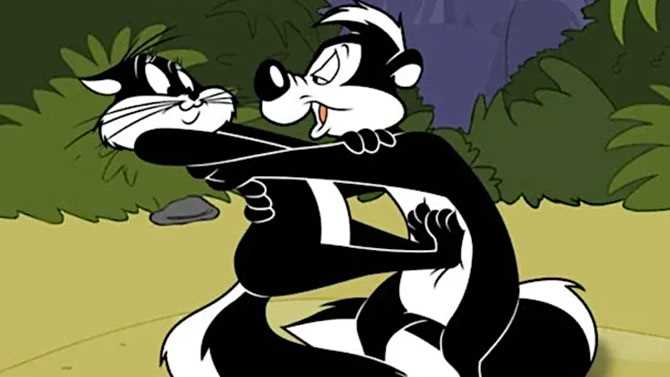
pepe

Of course Charles M. Blow quickly jumped on the “Cancel Dr. Seuss” bandwagon. I’m sure he was ticked off that he didn’t think of it first. The really woke publications have to include a race-baiter niche (or several) on their staffs, and Blow occupies that prime slot at the New York Times. Blow is an anti-white bigot in general, but he’s versatile: for the four years in which the Times enabled his virulent Trump Derangement, Blow proved he was also adept in pushing almost all of the anti-Trump Big Lies, not only the one that asserts that he is a racist. His columns were like crack for Trump-Haters. For everyone else, they were, like Blow himself, staggeringly repetitious, predicable, pompous, and boring.

Now, with Trump only intermittently in the news, Blow has a problem, being addicted to anti-Trump crack himself, and he’s clearly foundering. In his anti-Seuss screed—if you’re white like Theodore Geisel, Blow will presume you’re a racist (incidentally, he begins his columns by writing, “As a child, I was led to believe that Blackness was inferior.” That’s odd: I wasn’t!)—he also attacked Warner Bros. cartoon character Pepé Le Pew for contributing to “rape culture,” which is hilarious wokism self-parody.

Pepé Le Pew is one of the lesser Warner Brothers animated stars, an amorous French skunk whose cartoons consisted of a single gag: an incurable romantic obsessed with the pursuit of amorous conquests, Pepé kept mistaking cats and other creatures as female skunks (they somehow got white stripes painted on them in various accidents, hence the species misidentification), whereupon he would aggressively woo them, including hugging and kissing them without their consent.

Continue reading

Happy Birthday, Dr. Seuss! You’re Cancelled, You Racist.

Suess birthday

Today is Dr. Theodore Geisel’s birthday. Better known to the world as Dr. Seuss, the author and illustrator of such classic children’s books as “The Cat in the Hat,” “Horton Hears A Who,” and my personal favorite, “Fox in Socks” because it drives my wife crazy, was born this day in Springfield, Massachusetts, in 1904. Geisel, who used his middle name and his mother’s maiden name as his nom de plume, wrote 48 books (even some for adults). His work has now sold over 200 million copies and been translated into multiple languages. His style of verse and illustrating have been imitated and parodied countless times. Jesse Jackson even read “Green Eggs and Ham” on Saturday Night Live.

Nobody ever thought of Dr. Seuss books as “racist” until recent fads, events , cancel culture and The Great Stupid washed over the land. Well, OK, not “nobody.” Ethics Alarms had a post about the Seuss Museum in Springfield cutting a piece out of a Dr. Seuss mural because three prominent children’s authors who had been invited to attend the Children’s Literature Festival at the Museum threatened to boycott the event on the theory that the mural, painted to replicate a scene from Dr. Seuss’s first book “And to Think That I Saw It on Mulberry Street,”  was, they claimed, offensive. It had, said one of the grandstanding hysterics, a “jarring image” of a man with slanted eyes and a coolie’s hat using chopsticks to eat rice, because, apparently, Chinese people never wore such hats, don’t use chopsticks and hate rice. I wrote, while awarding the museum an Ethics Dunce designation (I’m thinking about adding a “Weenie of the Week”…what do you think?):

There is nothing racially jarring about Geisel’s painting of a “Chinaman” except to someone already looking for offense. Dr. Seuss’ drawings can be fairly termed cartoons. The definition of a cartoon is “a simple drawing showing the features of its subjects in a humorously exaggerated way.”  What are these juvenile children book authors asserting…that all cartoons are racially insensitive? That only cartoon of non-whites are offensive?…Normal Americans, meanwhile, understand the cartoon art form, recognize that features are exaggerated, and thus do not take drawings like those by Dr. Seuss (or Matt Groening, the creator of The Simpsons) as literal or malicious.

Well, silly me. I thought this was just a one-off moment of woke insanity: I have since learned that the Woke never sleep. In the post, I referenced “The Simpsons” and the fact that nobody had called for the elimination of Apu. Apu has since been cancelled as “racially insensitive.” The show also decreed that white voice actors can no longer portray black characters, so Dr. Hibbard has a new sound. Presumably “The Simpsons” will eventually seek a low IQ hick to voice “Cletis the Slack-Jawed Yokel” and a socially awkward MIT PhD. to do the voice of Prof. Frink.

Continue reading

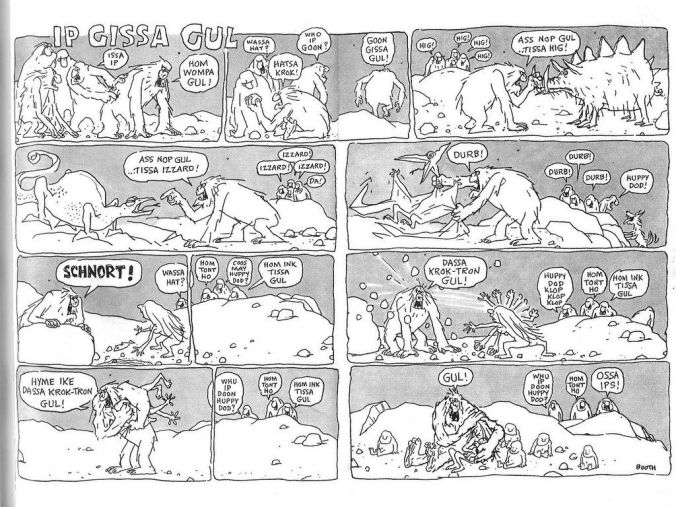
Ethics Poll: “Ip Gissa Gul”

The New Yorker cartoon above, by the magazine’s iconic cartoonist George Booth, first ran in 1975. I remember finding it strange then. I just ran across it again, and it seems ripe for an Ethics Alarms poll.

From Australia, A Cancel Culture Chapter That I Don’t Understand At All

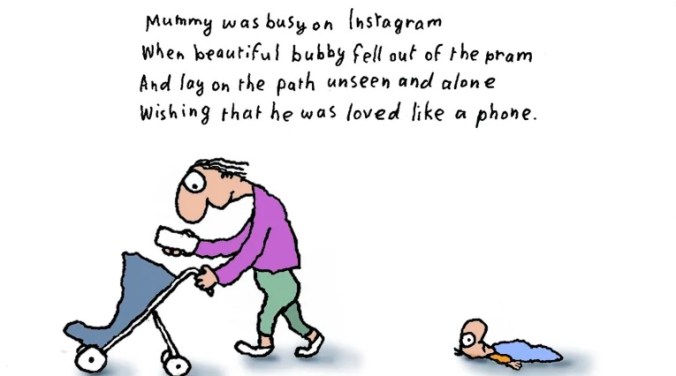
The above cartoon is the work of Michael Leunig, an Australian cartoonist of some note. Apparently the drawing got him into serious trouble with the social media and political correctness mobs Down Under. Color me completely bewildered, mate.

I have always regarded Australia as a having an admirably  rough, honest, brutally independent and common sense-based culture. Apparently I’m missing something; maybe one of Ethics Alarms’ Australian readers can explain what. (There have been about 24,000 views of the blog there so far this year; Australia is the second largest source of Ethics Alarms readers outside the U.S., after Canada.)

Because of the cartoon, Leunig, who has been creating cartoons professionally to express political and social commentary for half a century, is being threatened with cultural “cancellation.” He writes in part that the drawing has “brought so much hostile public reaction that I began to lie awake at night wondering why I had followed such a troubled, painful and precarious career path….

…[To]be so hated, insulted, slandered in the public domain for this – as I was – is indeed a dismal fate for the lone cartoonist. It speaks volumes about the current condition of civil society and tolerance. This is bigotry. The malice has been astounding and so extreme that it has plunged me into a deep contemplation about the nature of angry hatred. Indeed, I am coming to the view that there is an emerging new form of hatred in society which might be more of a mental illness than a passing emotion. Perhaps I would call it “free-floating, obsessive compulsive hatred”.

His son wrote of the effect on the cartoonist’s family: Continue reading