Yet More Casting Ethics: Let’s Slap This Bad Idea Down For Good, Shall We?

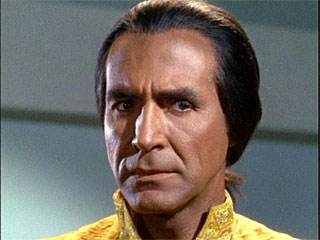
What? They cast a Hispanic actor as Khan instead of a genetically engineered Mongolian actor?

What? “Star Trek” cast a Hispanic actor as Khan instead of a genetically engineered Mongolian actor?

One way really terrible ideas take hold and do damage to the culture is for rational people to ignore them while zealots, ideologues and wackos keep repeating them over and over until they no longer sound as wrong as they are. Allowing illegal immigration to continue undiscouraged was one of those ideas, manifestly ridiculous and destructive. Now look where we are.

Ethic Alarms has had several posts on another really bad idea lately that is being pushed on the culture by political correctness and affirmative action activists: the loopy assertion that ethnic roles in movies and TV should only be cast with actors whose ethnic origins match those of the characters, and that if a director casts someone else, racism and bigotry are at play. Not too long ago, such an assertion would be regarded as too silly to discuss, but we have been through an intense period—the period known as “The Obama Era”— where tribal spoils, grievance-mongering and group identification have been accorded higher priority than, for example, talent, competence, experience or proven success. Through the fog of such distortions, the idea of rigid ethnic casting doesn’t seem so crazy, though it is crazy indeed.

I regard it my duty as someone who has both professional expertise in ethics and casting to slap down this rotten and indefensible  idea every time it raises its repulsive head. I recommend that you do the same.

Yesterday, Ana Valdez, the ex­ec­u­tive di­rec­tor of the Latino Donor Col­lab­o­ra­tive, wrote to the Washington Post to endorse film critic Ann Hornaday’s column complaining about white actors playing Middle Eastern roles (I managed to hold down my bile with that one), and  added…

She failed to ac­knowl­edge per­haps the big­gest white­wash­ing: the con­tin­ual cast­ing of white ac­tors to play Lati­nos. This has been go­ing on for decades, from Eli Wal­lach play­ing Calvera in “The Mag­nif­i­cent Seven” to Mark Ruf­falo play­ing Michael Rezen­des, a Bos­ton Globe re­porter, in “Spot­light.” Jen­nifer Con­nelly won an Os­car for her por­trayal of Ali­cia Lardé Nash in “A Beau­ti­ful Mind,” and Ben Af­fleck played Tony Men­dez in the Os­car-win­ning “Argo.” All of these char­ac­ters are Latino. Ethan Hawke, Meryl Streep, Cather­ine Zeta-Jones, Jeremy Irons and Glenn Close all have played Lati­nos in mo­tion pic­tures…. It does look like Hol­ly­wood is try­ing not to hire Lati­nos.

No, it doesn’t look like that at all. Continue reading

More Casting Ethics: In Search Of Acting Afghans

whiskeytangofoxtrot

The problem is that our educational system belches out new graduates who have been indoctrinated into rigid and often absurd ideas about right and wrong, They quickly fill the culture with those ideas and their freedom-stultifying emanations. The ideas act like viruses: if you don’t diagnose them and wipe them out, our very minds are at risk.

Here is an example, by mere coincidence, concerning casting ethics, the same topic as the recent post about how some African-Americans seem to want to discriminate on the basis of skin shade, at least when it comes to casting movies. (Who knew?) I was reading Entertainment Weekly on an airplane, as I only read Entertainment Weekly on airplanes, and this whole issue (The “Batman v. Superman” issue) struck me as being written by 22 year-olds. In a review of Tina Fey’s latest bomb (“Whiskey Tango Foxtrot”—“WTF,” or What the Fuck, get it?), reviewer Leah Greenblatt wrote this…

“And its more than a little disappointing that the two major Afghan supporting roles are filled by obviously non-Afghan actors….”

Leah doesn’t bother to explain why it’s a little disappointing; she just assumes it’s obvious, as in, “What? They didn’t hire real Afghans to play Afghans? I’m outraged!” Meanwhile, a young impressionable reader who assumed that a film reviewer has some expertise in such things, would absorb this heretofore unknown standard of decency and take it as cant. Contagion! This is how the political correctness virus eats our brains. Continue reading

A Law Student Creates A Dishonest List Called “100 Times A White Actor Played Someone Who Wasn’t White” And Begins Another List Called “Times The Washington Post Published A Race-Baiting Piece Of Lazy Research And Sloppy Reasoning By Someone Who Looks Like She Will Be A Terrible Lawyer”

I didn’t set out to make the news media’s tolerating unethical race arguments the theme today, I really didn’t. While I was researching ESPN’s decision not to hire whites on its new website, to which the Wall Street Journal shrugged and said, by not saying, “Wait….WHAT?” in effect, “Sure, go ahead, discriminate!”, I came upon this piece of journalistic offal called “100 Times A White Actor Played Someone Who Wasn’t White” on the Washington Post website. It was authored by Meredith Simons, a law student and freelance writer. Well, Meredith, free-lance writers get away with these miserably researched and unfairly gathered articles a lot, but if you try to sneak this kind of crap past a judge or a senior partner, you’re going to have a rude awakening.

The fact that her article is incompetent and unfair in myriad ways doesn’t mean that Hollywood has been an equal opportunity employer throughout decades past. It hasn’t, but it has reflected the society and tastes in which it operates, and often has been a leader in race attitudes, as in the film “Imitation of Life.” There is work to be done, but careless articles like Simons’ just causes ignorance and confusion.

The immediate impetus for her hit piece on Hollywood casting was apparently the controversy over the casting of white actor Joseph Fiennes as Michael Jackson in a planned biopic. Simons calls him “African American icon Michael Jackson,” which is the lawyer’s trick of framing an issue to rig the debate—good one, Meredith—but skin-bleaching, child-molesting, whitebread pop star Jackson is hardly an “African American” icon: he’s a national pop icon who went out of his way to reject race and racial labels. That is what the song “Black and White” was about, right? Sure, the casting was a gimmick, but it’s a clever and legitimate gimmick that I would guess Jackson would have approved of enthusiastically. When they make “The Rachel Dolezal Story,” will Simons complain if a black actress gets the part?

So based on a phony race controversy—two, in fact, with the Oscar nomination spat included—Simons comes up with an even more phony list. “Despite decades of protests over racially inappropriate casting and the recent protests over the lack of diversity among Oscar nominees, filmmakers continue to cast white actors as minority characters on a depressingly regular basis,” she writes.

(A tip  for Social Justice Warriors: don’t write about the performing arts and casting if you don’t know a damn thing about either. The purpose of the performing arts is 1) to make a good product and 2) to make money. Anything that in any way interferes with either is irrelevant. There is no such thing as “racially inappropriate casting” if it furthers either of these objectives, or ideally both. It is not Hollywood’s job to eradicate racial inequality in the U.S. If it helps, that’s responsible and ethical of the movie-makers. This is, however, neither its art nor its business.)

Simons’ list is the epitome of the Texas Sharpshooter fallacy done badly. The fallacy consists of cherry-picking facts that support a predetermined argument and “drawing a circle around them” as if they are the sole relevant facts, while intentionally or mistakenly omitting equally relevant facts that would tend to disprove it. Bad lawyer that she is, she draws a metaphorical circle around “facts” that don’t even support her argument. I’m not going to go through the entire hundred  (say “thank-you, Jack!”) but I’ll point out some of her most egregious botches.

To begin with, either she didn’t see the movies on the list, or intentionally misrepresents them. My favorite, and typical of her terrible research: Continue reading

Woody Allen, James Shigata, And Diversity Casting Ethics

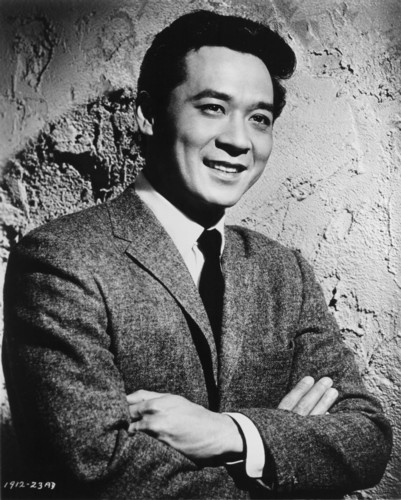
You have no idea who this is, do you? Well, it shouldn't have turned out  that way...

You have no idea who this is, do you? Well, it shouldn’t have turned out that way…

I’m sure you heard about James Garner’s recent death, but were you aware of James Shigata’s passing? Shigata, who died July 28 at the age of 85, was a contemporary of Garner’s, a superb actor, and like Garner, a leading man with leading man looks. James Shigata, however, was of Asian descent, though American through and through, and never escaped the perceived limitations of the shape of his eyes. Though he had a starring role in the hit film adaption of  the Rodgers and Hammerstein musical “Flower Drum Song” and routinely received critical acclaim for all of his film work, but though he got roles on television through the ’80s, he never was able to break through the typecasting straightjacket that deemed him only suitable for “Asian” roles. If you remember him as all, it is probably as the brave Japanese executive shot by Allan Rickman in “Die Hard.”

I thought about Shigata when I read a piece in Salon, noting that director Woody Allen didn’t cast African-Americans in his movies, and that his explanation why didn’t justify the neglect. Prachi Gupta writes, Continue reading

What Is An Ethical Tiger Lily?

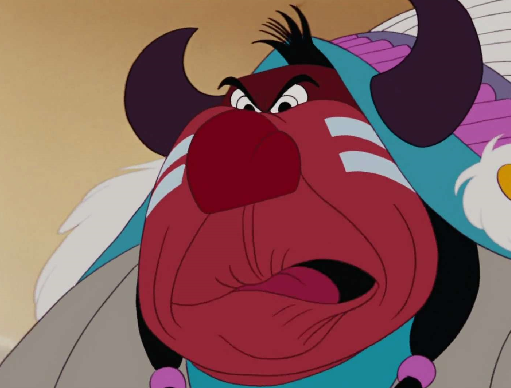
Believe it or not, this is Disney's version of an Indian chief.

Disney’s version of an Indian chief.

I recently watched the Disney “Peter Pan,” long my favorite of the classic animated films, which I had not seen from beginning to end in decades. I was genuinely shocked at the portrayal of the Indians, which would make the average movie Western seem politically correct and the Washington Redskins seem like a compliment. I know the story is a fantasy; I know that these are not supposed to represent real Native Americans, but a Victorian child’s visualization of the villains of their games. Nevertheless, it is hard to imagine the effect of such a film on a Native American child as being anything but devastating. The Neverland Indians, and their heroine, Tiger Lily, have been a human relations problem since at least the civil rights era, and the provocation is legitimate: did you recall (I had forgotten) that Tiger Lily belonged to the “Piccaninny tribe”? That James Barrie was a funny guy. Continue reading

Ethics Quiz: Are Fake Dwarves Unethical?

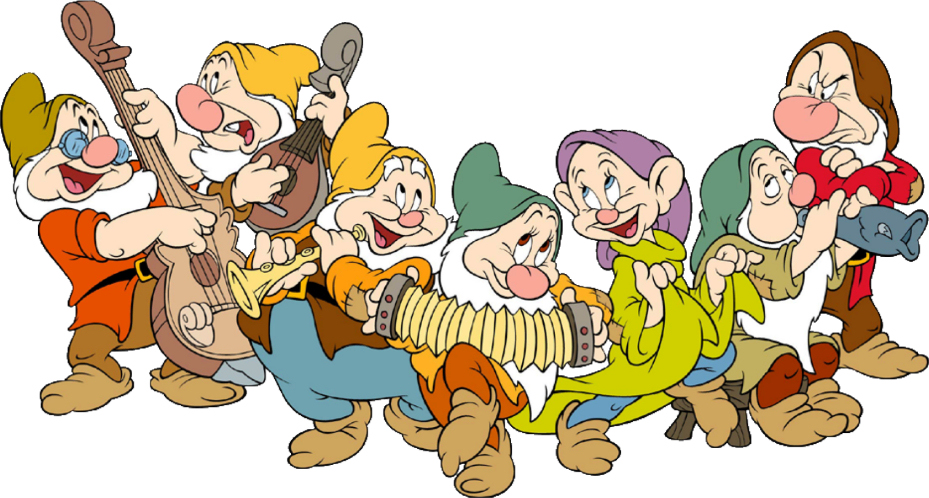
Remember, Disney didn’t cast little people as the dwarfs either…he cast ink.

The advocacy group “Little People of America” is crying foul because the seven dwarves (or dwarfs, if you’re Walt Disney) in “Snow White and the Huntsman” were played not by real little people (who don’t like being called dwarves, just playing them for money) but by digitally-altered normal-sized actors.

A representative of the group told the gossip web site TMZ that the studios should be “casting people with dwarfism as characters that were specifically written to be played by little people … and other roles that would be open to people of short stature.”

Your Ethics Quiz of the Day: Do movie makers have an obligation to cast small people in small people’s roles? Is it unethical to use special effects to do avoid casting them? Continue reading