
Randy Cohen’s Scofflaw Cycling: How Did THIS Guy Ever Get To Be Called “The Ethicist”?

Stop means “stop,’ unless Randy decides it means “yield”—after all, he knows best.

Randy Cohen was the original author of the New York Times Magazine’s column “The Ethicist.” During his tenure he made a name for himself with lively and sometimes witty prose, and on Ethics Alarms, at least, a disturbing tendency to rationalize clearly unethical conduct when it suited his political agenda, which was unapologetically left of center. In one notorious example, he told a student whose wealthy and famous father was paying her college tuition that it would be ethical for her to cash a partial tuition refund check she received from the university to her mother and stepfather, who believed that the father had not paid his fair share of child support. Cash that check, advised Cohen….“You are entitled to this money not because he is successful while you struggle. Such rough justice would also encourage you to sneak into his house, swipe his sofa and sell it on some kind of furniture black market. That would be stealing; this is merely claiming what he owes you.”  Of course, this is also stealing: cashing a check not intended for you because you believe it should be used to settle a disputed debt between the owner and someone else is not honest or fair, regardless of the merits of that belief. But Randy is a class warrior: as “The Ethicist,” he routinely took the position that it was “ethical” for people to use dubious means to get an edge on the evil rich, which in his world apparently means anyone richer than him.

I don’t know what Cohen has been doing since the Times sacked him; it isn’t practicing ethics, as he didn’t do this before his tenure, and confessed when he left the job that writing about ethics didn’t make him practice ethics while he was “The Ethicist” either, something I found and still find incomprehensible. Now, he tells us in a recent Times piece, the Ex-Ethicist is riding around New York City on his bicycle, running stop signs and red lights.

He tells us, moreover, that this is ethical, though it is certainly illegal. “I roll through a red light if and only if no pedestrian is in the crosswalk and no car is in the intersection — that is, if it will not endanger myself or anybody else, ” Cohen says. “To put it another way, I treat red lights and stop signs as if they were yield signs. A fundamental concern of ethics is the effect of our actions on others. My actions harm no one. This moral reasoning may not sway the police officer writing me a ticket, but it would pass the test of Kant’s categorical imperative: I think all cyclists could — and should — ride like me.”

This is arrogant, fatuous, reckless and wrong. But that’s Randy.

Even Coehn’s reading of Kant is wrong. The categorical imperative says that an action is ethical only if it could be the universal rule without harm, and this, despite Cohen’s rationalizations, could not. Who says the cyclist’s judgment of when it is safe to run a red light or stop sign is correct or reasonable in every instance? Why couldn’t motorists also use this same justification for running red lights at will? Continue reading
Casey Anthony’s Lawyer is Pronounced Unethical By an Expert

Jack Thompson knows incivility

Ah, the Casey Anthony trial continues to be the legal equivalent of “Jersey Shore,” or some other annoying TV reality show. In today’s episode: Hypocrisy! Revenge!  Irony! Abuse of process! Incivility!  And a special guest!

Cheney Mason, one of Casey Anthony’s defense attorneys, gave a raised middle finger (the international symbol of “I have nothing but contempt and utter disdain for you and your untoward words and conduct, so please have some form of unpleasant sexual intercourse with yourself!”) to a spectator who was verbally harassing Mason and others celebrating Anthony’s July 5 acquittal at a restaurant immediately after the trial.  Such public conduct by a lawyer is rude, undignified and inappropriate, but it is also rude, undignified and inappropriate for sea captains, puppeteers and plumbers, too. Incivility by a lawyer has to be especially egregious and must in some way threaten to undermine the administration of justice to raise the possibility of bar discipline, and flipping the bird to a jerk in a restaurant just plain doesn’t qualify. Now, a lawyer running all over town giving the finger to everyone for weeks on end, or a lawyer making the gesture to judges, opposing counsel or jury members in court would be very different matters. Such conduct would call into legitimate question a lawyer’s fitness to practice law. One such incident? No. I won’t speculate on what percentage of lawyers have given the upturned finger to someone during their careers, but you can.

Nevertheless, a Florida citizen decided to file an ethics complaint against Mason, which is his right. But this wasn’t just any Florida citizen; the complainant was Jack Thompson, a once nationally prominent attorney who managed the nearly impossible: he got himself disbarred for life in Florida for incivility, along with other ethical misconduct. Continue reading

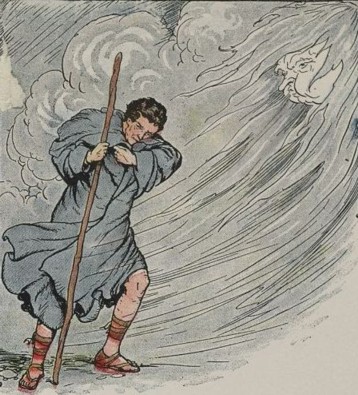
Aesop’s Unethical and Misleading Fable: “The North Wind and the Sun”

Today, by happenstance, I heard an Aesop’s Fable that I had never encountered before recited on the radio. Like all Aesop’s Fables, this one had a moral, and it is also a statement of ethical values. Unlike most of the fables, however, it doesn’t make its case; it is, in fact, an intellectually dishonest, indeed an unethical, fable.

It is called “The North Wind and the Sun,” and in most sources reads like this:

“The North Wind and the Sun disputed as to which was the most powerful, and agreed that he should be declared the victor who could first strip a wayfaring man of his clothes. The North Wind first tried his power and blew with all his might, but the keener his blasts, the closer the Traveler wrapped his cloak around him, until at last, resigning all hope of victory, the Wind called upon the Sun to see what he could do. The Sun suddenly shone out with all his warmth. The Traveler no sooner felt his genial rays than he took off one garment after another, and at last, fairly overcome with heat, undressed and bathed in a stream that lay in his path.”

The moral of the fable is variously stated as “Persuasion is better than Force” , or “Gentleness and kind persuasion win where force and bluster fail.”

The fable proves neither. In reality, it is a vivid example of dishonest argument, using euphemisms and false characterizations to “prove” a proposition that an advocate is biased toward from the outset. Continue reading

Unethical Website of the Month: Lovely-Faces.Com

If the Guinness World Record for smugness and arrogance-holding creators of Lovely-Faces.com’s “logic” became acceptable, kidnapping President Obama would be a dandy way to demonstrate that the Secret Service was incompetent, and triggering a “fire sale” crash of technology-based U.S. systems would be a fine way to show that they are insufficiently protected. Paolo Cirio, a media artist, and Alessandro Ludovico, media critic and editor-in- chief of Neural magazine, claim that their goal of showing how Facebook makes identity theft too easy justifies their means of proving it:  stealing 250,000 Facebook member profiles and organizing them into a new dating site—without the members’ permission, of course. Continue reading

The Marcelas Owens Bias Test: What’s Wrong With This Picture?

The photo in question, which you can see here, shows young Marcelas Owens being embraced by Vice President Joe Wash-My-Mouth-Out -With-Soap Biden as President Obama signs the health care reform bill.

If you see nothing wrong with using an 11-year-old boy who has lost his mother as a PR prop, go to the back of the ethics class. Sure, Marcelas probably enjoyed the trip to Washington and all the attention. Those microcephalics (pin-heads, in carny-speak) who used to be exhibited in circus freak shows enjoyed the attention too. But an 11-year-old cannot give consent to being used as a cynical political “freak” to tug at the heart strings and convince easily swayed people with an intellectually dishonest inference. Continue reading