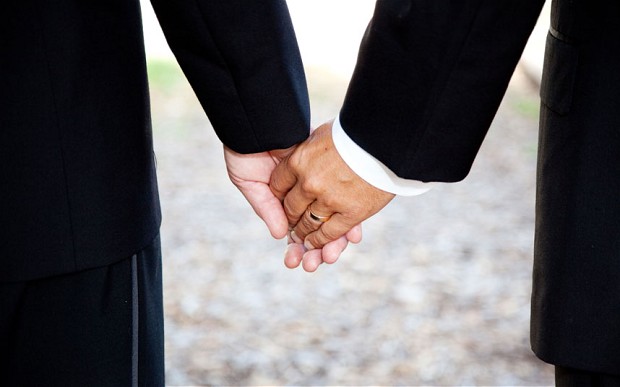
An Irish Gay Marriage Ethics Quiz: Ethics Hero, Ethics Dunce…or What?

gay-marriage

It’s comforting, I think, to realize that the U.S. isn’t the only Western nation that is in cultural upheaval over the gay marriage issue.

The  Irish Government, for example, will be holding a referendum on same-sex marriage at the end of May, only two decades after homosexuality was decriminalized.  Now polls suggest that  almost 80% of the Irish people favor legalizing same-sex marriage. Kowabunga, or rather, Faith ‘n Begorrah!

 Father Martin Dolan, the long-time priest at the Church of St Nicholas of Myra in Dublin’s city center for 15 years, called upon his congregations at the Saturday night Mass and Sunday morning service to support same sex marriage in the upcoming Irish vote. Then he announced that he was gay himself.

Dolan’s revelation received applause and a standing ovation.

Your Ethics Alarms Ethics Quiz for the day:

Was this conduct by the priest ethical?

I have some observations.

1. Since the Catholic Church does not approve of homosexuality, I believe that it is doubly unethical for a gay man to be a Catholic priest. First, it is dishonest, and second, it is hypocritical.

2. Announcing that he is gay is a good campaign tactic, as his parishioners presumably admire him, but it is making a national and cultural decision personal.

3. Father Dolan, being gay himself, has a personal interest in the result. He is therefore not an objective advocate, and as a priest, giving guidance to a congregation, he is obligated to be objective and without conflict.

4. Yes, it is more ethical for him to disclose his bias than not. It is still a bias, and still taints his judgment and credibility on the issue.

5. If this is a moral, religious issue, then Father Dolan has jurisdiction to provide his guidance and advice. If it is a political question, then he is abusing his power and influence, and that is irresponsible. This involves a vote that isn’t binding on any church, which means the referendum is a political issue, not a religious one.

6. Verdict: abuse of power.

7. Is it ethical for a priest to directly challenge Church teachings as an official, employee and figure of authority in the Church, with a public statement he knows would not be approved by his superiors? No. It is a betrayal of trust.

My view:

The priest’s advocacy was unethical.

_______________________

Pointer: Fred!

Facts: Irish Central
The Case Of The Too Candid Catholic Teacher

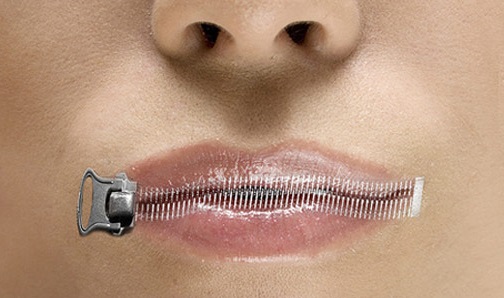
"You can unzip it, Patricia, when you work somewhere else...."

“You can unzip it, Patricia, when you work somewhere else….”

Apparently I missed another “media firestorm,” so allow me to catch up, particularly since the analysis of this story has been muddled beyond comprehension.

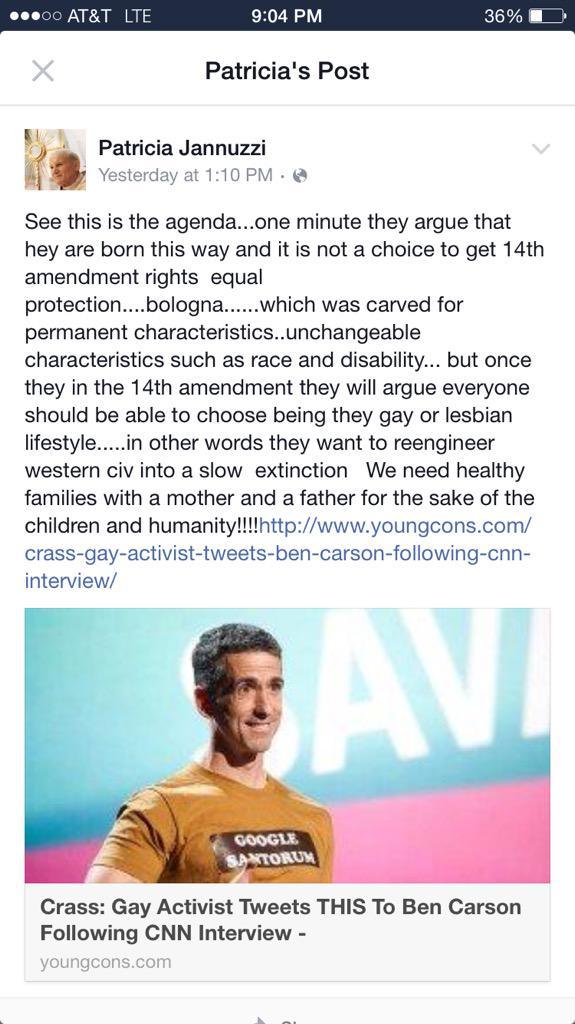
Patricia Jannuzzi, a religion teacher at Somerville’s Immaculata High School, posted this on her personal Facebook page:

jannuzzi-fb-post

This being the internet, after all, someone sent it far and wide, with resulting embarrassment to the school. Jannuzzi, a theology teacher with Immaculata for 33 years, was ordered to de-activate her Facebook page after an online petition   demanded that she be punished. Jannuzzi was placed on administrative leave,  and the school administration notified alumni, parents and students, in a letter that said in part,

“This episode has reflected not only on this teacher but, by extension, on Immaculata High SchoolWe regret deeply any hurt this has caused to any individuals and the negative light in which it has cast our school….Although these were posts to a personal social media page, Immaculata High School recognizes the need to ensure that our faculty, staff and students full understand the behaviors expected of them as members of our community and recognize our intolerance of discriminatory behaviors of any kind.”

Points: Continue reading

Comment of the Day: “The Humiliation of Jessica Urbina”

catholic church

I confess to priming Patrice, an old friend and the resident Catholic theologian here, for this. I have known here for many years, and she is what I would call a passionate and rebellious Catholic scholar, and hoping she would weigh in on my criticism of the Catholic Church in the wake of the treatment of high school senior Jessica Urbina, which I view as symptomatic of the Church as it is of the schools. As I expected, however, Patrice makes a strong case.

Here is her Comment of the Day on the post, The Humiliation of Jessica Urbina:

Well, you knew I was going to respond, right?

“The cruel treatment of Jessica is one more indication of the sorry state of the Catholic Church, which appears to be a fatal cesspool of hypocrisy, desperate public relations, and an integrity vacuum. There are two kinds of Catholics, it seems: those who profess the be devout followers of the Church but who discard and violate its doctrine and core principles whenever they seem too burdensome, unpopular or embarrassing, and those who blindly follow the dictates of the Church, no matter how clearly they have been proven wrong and wrongful by the accumulated experience and wisdom of civilization, because morality never changes.”

So, what am I? The feckless “Cafeteria Catholic” or the “Fundamentalist Catholic”? I really take exception to your gross generalizations about Catholics as being one or the other of your versions. Knowing me, Jack, how could you make such generalizations?

As a sometime student of Theology, I prefer to see myself as a Catholic who dissents in good conscience from certain teachings of the Church — not because they are “too burdensome, unpopular, or embarrassing,” but because I believe that there is more to be learned from the core teachings of Jesus than what we have thus far proclaimed. And for the record, I am saddened by what happened to Jessica. What the school did (notice I say school, not church) was not compassionate, kind, or tolerant.

The Catechism of the Catholic Church states the following:
“A human being must always obey the certain judgment of his conscience. If he were deliberately to act against it, he would condemn himself.”

The problematic part comes after that: “Yet it can happen that moral conscience remains in ignorance and makes erroneous judgments about acts to be performed or already committed.” It’s kind of a Catch 22. Does the Church see a well-formed conscience as one that has been properly educated (indoctrinated?) in the “truths” that the Church has put forth, and therefore agrees with the Church on all matters? Maybe. I suspect that this conscience thing was intended to give courage to Catholics who would have to disobey their “Catholic conscience” to do something they were being encouraged or forced to do in the secular world that is against Church teachings. Thus, martyrs. Regardless, I stand by my educated conscience.

I hold up the subjects of my senior thesis, which was about dissent in the Church: Hans Küng and Charles Curran. Both censured for their dissent, but still voices in the wilderness. Look at Pierre Telhard de Chardin. Got into a lot of trouble for his writings, but somewhat “rehabilitated” in today’s world of theological thought.

With regard to Jessica, I see this as an educational system problem, because it might have happened at any school. The fact that it happened at a Catholic school makes it look like a Catholic problem, but I sense that you would find the same problem in schools in various places around the country, as well as other denominations which teach (yes, there are others) that homosexuality is wrong/forbidden/whatever. I’m sure I’m breaking one of your principles here, but really I do see this as an authoritarian school problem first and foremost. It’s also a self-expression issue.

I personally wish Jessica great success as she, no doubt, continues to break the barriers that keep her and others from being and expressing who they are.

The Humiliation of Jessica Urbina

JESSICA_URBINA

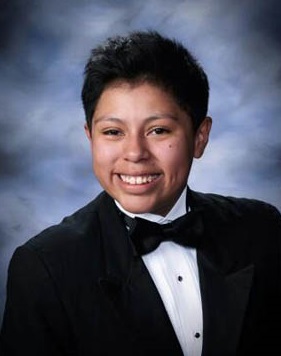
Every year at this time, Ethics Alarms covers one or more ethics controversies over a yearbook photo that has been deemed inappropriate for a high school graduation yearbook. The 2014 controversy, I think, has more significance than the others. Like other examples of rigid school administrator enforcement of poorly though-out rules and blatant cruelty to children, what was done to Jessica Urbina demonstrates the peril of allowing those in what no passes as the education profession to have power over our children, since they so frequently abuse it, or influence over the development of our children’s character, as the administrators display such flawed character themselves. The more I think about this incident, however, the more I conclude that it foretells the dying of a major religion in this country, and why it may deserve to die.

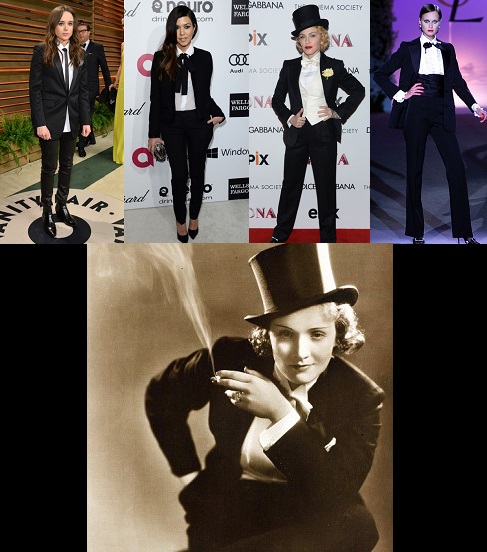
The yearbook photo of senior Jessica Urbina was deleted from her class  yearbook because she wore a tuxedo. School officials at San Francisco’s Sacred Heart Cathedral High School said  she violated the Archdiocese of San Francisco’s policy because she didn’t wear the dress that’s required for female students in yearbook photos. This is the no-tolerance version of yearbook photo rules, sexist, anti-gay, cruel and stupid. Jessica isn’t dressed inappropriately or unkempt; in fact, she looks great. She took care to make herself presentable for her yearbook, and succeeded. Quite reasonably, however, she decided to appear in clothing that made her feel comfortable, given her sexual orientation, for she is reputedly gay. Tuxes are not a gay uniform by any means; hetero and gay women have worn them as fashion for decades. Below are, clockwise, Ellen Paige, Kim Kardashian, Madonna, super-model Danielle Luquet de St Germain, and the immortal Marlene Dietrich:

Celebs in Tux

I know: yecchhh! How disgusting!

Seriously–there is nothing, nothing, provocative, inappropriate or wrong with Jessica’s attire. She is nicely groomed, her clothing is impeccable, the photograph is impeccable, and she looks cute and happy. The school officials knew what to do about that.
Continue reading

Harvard’s Black Mass: An Ethics Problem With No Answer


Impossible.

Impossible.

P versus NPthe Hodge conjecturethe Riemann hypothesisthe Yang–Mills existence and mass gap The Navier–Stokes existence and smoothness. The Birch and Swinnerton-Dyer conjecture. These are some of the unsolved problems of mathematics, but they are child’s play compared to the unsolvable ethics dilemma concocted at Harvard College.

Is Harvard right to allow students to hold a historic recreation of a Black Mass? Is Harvard wrong? Is it unethical for the students to engage in the project? Is it gratuitously insulting to religion, particularly Catholicism? Does it even matter if it is?

To bring you up to date:

The Harvard Extension Cultural Studies Club is planning to recreate a “satanic black mass” on campus next week, enacted by Satanic Temple, a New York-based, Satanist group that engages in outrageous displays to draw attention to First Amendment rights. “Our purpose is not to denigrate any religion or faith, which would be repugnant to our educational purposes, but instead to learn and experience the history of different cultural practices,” the HECSC said in a statement.

The statement lays the foundation for a hung jury in seeking an ethics verdict. Since the Black Mass was originally devised to denigrate the holy mass, saying that recreating the mass isn’t intended to denigrate religion is the kind of thing Captain Kirk used to say to evil, logic-bound computers to make smoke come out of their hard drives. “It-is-true-but- it’s-not-true-but-nothing-can-be-true-and-not-true–KABOOM! Continue reading

Bob Newhart, Legatus And GLAAD: “What’s Going On Here?” Is Tricky To Answer

"Hey, Bob---What's going on here?"

“Hey, Bob—What’s going on here?”

The news item about comedian Bob Newhart cancelling an appearance for the Catholic executives networking group Legatus under pressure from GLAAD is fascinating.

From the perspective of Ethics Alarms, it illustrates a peculiar phenomenon I experience often, where a prominent story seems to have been designed by the Ethics Gods specifically to combine and coalesce several issues that have been discussed here recently. For Bob’s travails neatly touch on the issues of pro-gay  advocacy groups attempting to restrict expression they disagree with( The Phil Robertson-A&E Affair, Dec. 19), a comedian being pressured to alter the course of his comedy (Steve Martin’s Tweet Retreat, Dec. 23) and an entertainment figure being criticized for the activities of his audience (Mariah’s Dirty Money, Dec. 23). You would think I could analyze the Newhart controversy by just sticking my conclusions from those recent posts, plus some of the more illuminating reader comments, into my Ethics-O-Tron, and it would spit out the verdict promptly.

It doesn’t work that way, at least in this instance, and that prompts the other observation. In most ethics problems, the starting point is the question, “What’s going on here?”, which forces us to determine the factual and ethical context of the choices made by the participants. Here, the question can be framed  several diverging ways, leading to different assessments of the ethics involved. Thus, asking “What’s going on here?” in the Bob Newhart Episode, we might get: Continue reading

A Reminder: Why “User Pays” Is Unethical

The View

[Back in 2007, a ridiculous lawsuit spawned an even more ridiculous pronouncement from “The View’s” Rosie O’Donnell, which prompted the following post (originally titled “The Pants, the Judge, and Rosie’s Mouth”)  on this blog’s predecessor,  The Ethics Scoreboard.The two law-related issues that the public has the most difficult time grasping are why lawyers defend guilty people, and this one: the contingent fee system for civil plaintiffs.  While I was pre-occupied the last couple of days by two challenging ethics programs and 10 hours of driving back and forth into West Virginia to deliver one of them, I missed the outbreak of another “loser pays” discussion in one of the comment threads. It’s clearly time to run this one again (I last put it on Ethics Alarms in 2010), with a few tweaks.]

The tale of Roy Pearson, the infamous Washington, DC administrative law judge who is suing his dry cleaner for damages of $65.5 million for a lost pair of pants, would normally warrant scant comment beyond this obvious one: Pierson is a bully, his lawsuit is unreasonable and unethical, and he deserves whatever sanctions the legal system can devise. A Washington Post editorial suggested that the lawsuit, which Pierson says is justified by his inconvenience, court costs, and the mental anguish caused by the loss of his beloved pants, is proof enough of bad character and terrible judgement that he should not be reappointed to another ten-year term.  [ Update: He wasn’t.] That would normally end the issue, freeing me to move on to more important matters, like global warming and American Idol.

And then Rosie O’Donnell opened her big mouth. Continue reading

Ethics Quote of the Week: Phyllis McGinley (1905-1978)

The Angry Man

The other day I chanced to meet
An angry man upon the street —
A man of wrath, a man of war,
A man who truculently bore
Over his shoulder, like a lance,
A banner labeled “Tolerance.”

And when I asked him why he strode
Thus scowling down the human road,
Scowling, he answered, “I am he
Who champions total liberty —
Intolerance being, ma’am, a state
No tolerant man can tolerate.

“When I meet rogues,” he cried, “who choose
To cherish oppositional views,
Lady, like this, and in this manner,
I lay about me with my banner
Till they cry mercy, ma’am.” His blows
Rained proudly on prospective foes.

Fearful, I turned and left him there
Still muttering, as he thrashed the air,
“Let the Intolerant beware!”

Poet Phyllis McGinley, quoted in the comment thread on the Volokh Conspiracy’s post about the Supreme Court decision this week in Glowicki vs. Howell Public School District. Continue reading

The Assumption Church in Barnesville, Minn: Wrong On Belief, Right On Integrity

“Oh, what the hell. Sign him up.”

In Barnesville, Minnesota, the Catholic Church has denied the religious sacrament of confirmation to two students who posted their support for gay marriage on Facebook.

Good.

The Catholic Church has been barely holding on to a dwindling membership by adopting the strategy of becoming an organized religion for hypocrites. Being a member of any church should mean the full acceptance of its core teachings. The students involved publicly expressed their disagreement with the Catholic Church’s opposition to gay marriage, and the Church was right to deny them confirmation.

Is the Catholic Church dead wrong to oppose same sex marriage as a sin? Of course. The way to make the Church enter the 21st Century is for double-talkers like John Kerry, Joe Biden and Mario Cuomo to show some backbone and integrity, and reject the Church or their upbringing because it doesn’t accept same sex marriage and abortion, while they obviously do. Instead, these and other faux-Catholics absurdly claim in public that they support diametrically opposed positions simultaneously. All three have piously stated that as Catholics they believe that life begins at conception (ergo, abortion is the sinful taking of innocent human life), but that as elected officials they feel it is inappropriate to “impose their beliefs” on the public. Of course, what elected leaders do is to impose their beliefs on the public, wherever those beliefs come from. What Cuomo, Biden and Kerry, as well as many others, have done, is to aggressively and pro-actively support policies, like abortion-on-demand, that they and their Church say they believe are wrong. Liars or hypocrites, take your pick. Continue reading

Unethical Quote of the Week: Vice-President Joe Biden

“With regard to the assault on the Catholic Church, let me make it absolutely clear. No religious institution, Catholic or otherwise, including Catholic Social Services, Georgetown Hospital, Mercy — any hospital — none has to either refer contraception. None has to pay for contraception. None has to be a vehicle to get contraception in any insurance policy they provide. That is a fact. That is a fact.”

—– Vice-President Joe Biden, in a rare moment during Wednesday’s Vice Presidential candidates debate when he wasn’t interrupting, mocking, shouting, or otherwise setting new lows for national debate civility and decorum, on the topic of the Administration’s contraception and abortion mandate. The problem: it isn’t a fact. In fact, it isn’t true at all.

I was not going to touch on the substance of any of the debates, because I do not want to play the “fact check” game that has already warped the campaign and given partisan journalists the opportunity to misrepresent any the statement of any politician—usually a Republican—whom they disagree with as “a lie.” Perhaps inspired by this trend, the Obama-Biden campaign’s strategy has devolved into calling Mitt Romney and Paul Ryan “liars” when 1) they may be mistaken, they may be inexact, they may be overstating, and they may be wrong, but are not lying, and 2) President Obama and Vice-President Obama, not to mention other Democrats involved in the campaign, have not set their own bars for accuracy, honesty and fairness any higher than the GOP side. But the refrain of “Liar!” has been so emphatic and repetitive that the fans of the Democratic ticket are adopting it as a rallying cry, usually without the slightest idea of whether there have been any actual lies or not. Meanwhile, the tactic demeans the electoral process and our democracy. Columnist Dan Henniger expressed my feelings on this topic well when he wrote, before Wednesday’s debate: Continue reading