Comment of the Day: “Annoying and Ill-Timed Tangential Issue Dept.: There’s Nothing Especially Virtuous About Running A Marathon”

Here is a helpful Comment of the Day from Rich Page, providing important perspective to the issue of marathoning and marathoners. I am especially grateful for comments like these, which add leavening to posts that can be a little more jarring than I intend, even though I know exactly how they will be taken when I post them. 

I didn’t want to get too deep into all the many reasons people run, so what was intended as an observation about many marathon and running enthusiasts could have been taken as a knock on running for fun, for example. Fun is important; fun is natural; fun is grand. I think fun is a wonderful reason to do anything. I do a lot of things just for fun, and always have—luckily, I find my various jobs fun, all of them. 

Rich’s post balances mine perfectly, and makes it whole and better. As to the timing—I agree, I wish I could have “hung it on a different hook,” and perhaps I should have waited for another one, since I have been waiting a while as it is.Perhaps my rule should be that if I can’t conceive of any graphic or photo that won’t risk being offensive to a lot of readers, that’s a strong indication that I should postpone the topic to another day.

This is the Comment of the Day on “Annoying and Ill-Timed Tangential Issue Dept.: There’s Nothing Especially Virtuous About Running A Marathon”: Continue reading

Annoying and Ill-Timed Tangential Issue Dept.: There’s Nothing Especially Virtuous About Running A Marathon

I sincerely apologize for the timing of this topic, which has actually been percolating in my brain for a while. I first considered it after finding myself annoyed by a commercial running on television of late, comparing various artists who completed major works after their 55th birthdays with a similarly aged woman who recently ran a marathon. Then, yesterday, in the wake of the terrorist attack on my home town, I read multiple Facebook posts from otherwise intelligent people expressing profound sadness for all the marathoners who trained so hard for Boston and were not able to finish. That did it.

I believe we can stipulate, can we not,  that any marathoner who returned home whole after watching fellow competitors having their arms and legs blown off  and complained that the race was terminated before he could finish would immediately be eligible for the Jerk Hall of Fame. If horror, grief and empathy for the victims, concern for the nation, and gratitude for the pure luck of being spared doesn’t wash such selfish thoughts right out of a runner’s mind, then that person needs to keep on running until he has left civilization. Meanwhile, the increasingly accepted cultural attitude that running a marathon or an iron man competition is especially admirable shows something is out of whack in our value system.

I didn’t feel like confronting my Facebook friends yesterday, but please tell me how being prevented from running in a race one has trained for is any more of a tragedy than a thousand other minor disappointments we all face every day, and far less worthy of sympathy than thousands of others. A while back I was blocked from giving a seminar in Tennessee that I had prepared for, because of a storm that grounded all usable flights. That cost my company $5,000. It meant that a lot of Tennessee lawyers had to hustle to find other ways to get their ethics credit, and the ways they found were going to be a lot more boring than I am. Those are real consequences, tangible and significant. What is the result of not being able to finish the Boston Marathon? Who is significantly harmed? Nobody. The marathoner is disappointed and inconvenienced, that’s all. There are other races. He or she is in shape, They did the best they could. The Marathon will be held next year. The terrorist attack is a tragedy. The fact that racers couldn’t cross the finish line is trivial. It just doesn’t matter very much, or shouldn’t.

I’m not condemning runners, any more than I condemn people who spend their spare cash on jewelry, summer houses and vacations instead of saving the whales: it’s their lives and and their priorities, not mine, and they can do what they choose. At the same time, the aura of virtue surrounding extreme runners and the popular myth that running a marathon is more ennobling than commonplace altruistic and practical uses of an individual’s time is bizarre. That commercial I mentioned speaks of being productive in latter years. Running a marathon doesn’t produce anything more than playing a videogame does. Picasso, whose late career artwork is mentioned in the spot, created something beautiful that will be enjoyed for centuries: now that’s productive, and also worthy of admiration and praise. Whose life is enriched by the completion of a marathon, other than the runner’s? It isn’t a communal act, a generous act, a productive, charitable, creative or selfless act. It is a completely self-absorbed and self-focused act, requiring many hours that could just as easily be used communally, generously, productively, charitably, creatively and selflessly. Again, it’s the runner’s life, and if he or she wants to use their brief time on earth to complete manufactured and artificial challenges that accomplish nothing tangible and leave the world no better than it was before, that’s an individual choice; running a marathon doesn’t harm anyone, either, unless it interferes with being a good and attentive father, spouse, and friend. Extolling this kind of activity, however, just distorts societal values, and bestows heroic status on the wrong people, for the wrong things.


Mariska Hargitay and Hugh O’Brian Show How To Use Celebrity Ethically

O'Brien and Hargitay---Good guys on the screen, but more importantly, off it.

O”Brian and Hargitay
Heroes on the screen, but more importantly, off it.

I have left the impression in more than one post that performers and celebrities too often use their fame and finances to garner wide dissemination for opinions that they are unqualified by experience, intellect, maturity and education to have taken more seriously than the rants of a typical 7th grade blogger. That is an accurate observation. Unfortunately, such public figures are taken seriously, so we must listen to Sean Penn sing hosannas to a South American dictator, see Kanye West pronounce a President guilty of wanting see blacks drown in New Orleans, and watch Ann Hathaway protest the existence of rich people with Occupy Wall Street (while collecting her million dollar fees.) Not all celebrities waste their influence and our time on dubious pursuits, however. There are others, and since they are interested in substantive issues and more concerned with accomplishing something than getting publicity, we often don’t know about their work.

George Clooney and Matt Damon are in this group, as is classic TV Western star Hugh O’Brian, better known as “Wyatt Earp.” Since 1958, O’Brian has been funding and building the Hugh O’Brian Youth Foundation, which was founded to “inspire and develop our global community of youth and volunteers to a life dedicated to leadership, service and innovation”  after a meeting between O’Brian and famous humanitarian Dr. Albert Schweitzer. This large and thriving non-profit commonly goes by the name of “HOBY”; one has to search the fine print to find any mention of its once famous founder, now in his eighties.

And then there is Mariska Hargitay. Continue reading

Comment of the Day: “What’s Next for the Alisal Union School District…John Dillinger High School?”

The second Comment of the Day on my post about a Salinas, California school district choosing to name an elementary school after an executed thief and murderer from that state’s colorful past is an unusual one. When I was first presented with J.S.’s comment protesting what he took as a false assertion that Mr. Dillinger was a killer in addition to being an epic bank-robber, I took him to be Dillinger fetishist, like the warped souls who are obsessed with villains like Billy the Kid and Charles Manson. I was wrong: as he explains here, he is a Dillinger family member, and has a valid reason for insisting that the original Public Enemy #1 is only condemned for the (many) crimes he actually committed. Here is S.S’s  heartfelt Comment of the Day, on the post “What’s Next for the Alisal Union School District…John Dillinger High School?”: Continue reading

A Christmas Story Redux: Alek and the Controllable Christmas Lights

Go ahead! Try em!

Go ahead! Try em!

Christmas is right around the bend, so it is again time to celebrate Alek O. Komarnitsky and his creative, slightly wacky, Christmas lights extravaganza that he has transformed from a mildly unethical spoof to an act of charity and generosity.

Back in 2004, Alek received national attention for his whimsical holiday website that allowed people all over the world to turn his elaborate Christmas lights on and off from their home computers. Everyone had fun, which was clearly Alek’s design. Still, when it became known that his site was a hoax and that the lights going on and off were only an illusion, I weighed in (on The Ethics Scoreboard) with the opinion that perpetrating such a large-scale deception was wrong, no matter how well-intentioned and light-hearted. Alek took issue with my criticism, and we had a spirited e-mail debate.

Then, at a significant cost in time and money, Alek devised a way to really let people all over the world turn on his lights. He has done this ever since, and uses the site to raise money to cure Celiac disease. He writes: Continue reading

I’ve Always Said, If You Want To Know The Values of America, You Have To Watch “Family Feud”

Somehow I missed this significant moment, from 2011.

The clip doesn’t show it, I but I’m guessing “STDs” scored higher in the survey than either answer given.

<sigh>

___________________________

Pointer: Jo Ursini (Thanks, Jo!)

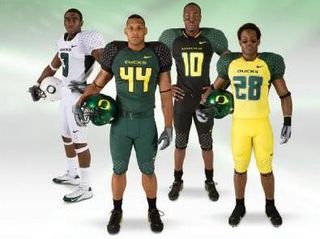
Football Fashion, Ethics, and Our Wasteful Consumption

The many fashion choices of the Oregon Ducks...and children are starving in Appalachia.

The many fashion choices of the Oregon Ducks…and children are starving in Appalachia.

On his excellent ethics blog, the Ethics Sage, a.k.a. Dr. Steven Mintz, recently expressed dismay at the increasing trend in college and high school football teams that has them changing uniform designs for no discernible reason, but at significant expense. Focusing on the multiple uniforms used over a season by the Oregon Ducks, he wrote:

“The poverty line threshold in the U.S. ($23,050 for a family of four) is, on a daily basis, about $16 per person per day. If my estimates are close, the cost to outfit the Duck football players for a year is about $48,000, double the poverty level for a family of four and enough to sustain 3,000 people for one day or about 8 people for one year. When you think about the extravagant spending on uniforms by the Ducks, you begin to understand that it reflects a society where glitz and glamor are valued over feeding the hungry — not a pretty picture”

I am not sure what to make of this argument. Is Mintz arguing that the Ducks are ethically obligated to send the money they spend on extravagant uniform diversity to the poor? Isn’t this really just the old “How dare you waste those perfectly good peas when children are starving in Ethiopia?” argument? Realistically , there is no way the university’s football uniform budget is going to be able to help feed the poor. Why pick on the Ducks? He goes on to write, Continue reading

Mark Cuban and the Ethical Tit For Tat.

No thank-you.

“Tit for tat” is unethical always—almost. Few ethics rules are absolute, and this isn’t one of them Sometimes tit for tat, that is, doing something unethical to someone who has done the same unethical act to you or someone else, can be justifiable, if it causes no real harm, and does some good as well. Spreading the rumor that Harry Reid is a pederast because he falsely suggested that Mitt Romney was a tax evader doesn’t qualify.  But Mark Cuban offering to donate $1 million to charity if Donald Trump shaves what is allegedly the hair on his head?

Perfect. Continue reading

Unthical Quote of the Week: Donald Trump

“Very sadly for the country, for a charity — and for the president himself, President Obama has just missed the deadline and now a charity of his choice will not be receiving $5 million — or as I stated much more than $5 million.”

—- Real state tycoon, self-promoting birther and Romney supporter Donald Trump, blaming President Obama for not accepting his challenge to produce various personal records in exchange for Trump sending $5 million dollars to a charity of the President’s choice.

What a mind-boggling, species-embarrassing ass.

OK, this isn’t really Donald Trump; it’s one of the evil, people-eating monsters from “Killer Klowns From Outer Space,”  one of the cleverest tongue-in cheek horror films. But there’s really not much difference, when you get right down to it. Mitt Romney shouldn’t want the support of either of them. In fact, I’d take the clown over the Donald.

Trump also noted that his money could have been used to swell the relief funds for Superstorm Sandy. That’s right: According to Trump, President Obama is responsible for Donald Trump not being generous, charitable and patriotic by  contributing to help the victims of a disaster.

I know that it is a tight election contest, and no candidate should be expected to toss away any voter or supporter—“Any port in a storm,” and all that. (Remind me to add that one to the ratioanalizations list.) Nevertheless, Mitt Romney would bolster credibility and reputation for integrity if he repudiated this awful man, and pronounced him what he is beyond all argument: a vile, irresponsible, offensive buffoon whose admiration, endorsement friendship or support sullies and diminishes anyone and anything he bestows it upon.

_____________________________

Facts: The Blaze

Graphic: Release Donkey

Forget Balancing: Lance Armstrong Is a Villain

A constant conundrum faced by every culture is how it should categorize significant individuals whose positive contributions to society and civilization are marred by other acts that range from the unethical to the despicable. How much bad can a great man do and still be called “great”? How much wrong can a good woman engage in and still fairly be remembered as “good”? Can one wonderful act erase a lifetime of bad conduct? Are some bad acts so terrible that nothing can compensate for them? Every real human being is going to yield to some temptations, make some bad choices, be selfish, be cruel, lie, or worse. If we insist that all our heroes have an unblemished record in every aspect of their lives, we simply forfeit our heroes.

One reaction to this persistent dilemma is that we tend to be reluctant to look under the rock of a heroes accomplishments for fear that we will be disillusioned, or once the rock is lifted, we will attempt to rationalize into invisibility the ugly things we find there, or insist that they don’t matter. Of course they matter. It matters that Thomas Jefferson, who gave this nation its beating heart, didn’t pay his debts, cheated his friends and refused to live up to his own ideals. It matters that Clarence Darrow, who saved over a hundred men from execution, was a terrible father and husband and an unethical lawyer. It matters that Arthur Miller, whose plays dramatized the plight of the aging worker and the dangers of political persecution, rejected his mentally-challenged son, leaving him institutionalized and without contact from his father, though he knew who his father was. Charles Lindbergh, Jackie Kennedy, Diane Fossey, Thomas Edison, George Washington, Andrew Jackson, Frank Sinatra, Ted Kennedy, Pete Rose, Lillian Hellman, Walter Cronkite, Hillary Clinton—the list of the great, near-great, lionized and admired who behaved less than admirably or worse in significant ways can circle the globe. In assessing their character, as well as whether their lives deserve to be regarded as positive or negative influences on their society, fellow citizens and civilization, all we can do is apply a complex balancing formula, with factors in their lives weighted according to ethical principles, experience and our own priorities.

The question of how this balance should be applied has been raised in recent weeks in the wake of the final verdict on Lance Armstrong’s cycling career, which was decisively removed from the categories of “alleged misconduct,” “controversies,”and definitely “witch hunts” for all time as mountains of documentation, lab tests, and testimony moved it squarely into the categories of “outrageous cheating’, “criminal activity”, “corruption” and “fraud.” Continue reading