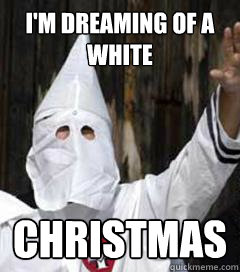
Sure, who wouldn’t think this was funny coming from a member of your school board?
The most important feature of apologies is that they express sincere and honest regret for the real harm done. If the first apology for misconduct fails that test, how much credence should a second attempt have? Does it negate the first apology completely? Ought it to be read and understood in light of the initial, unsatisfactory apology? Or should it be ignored completely as a public relations document crafted to achieve a result, rather than to express genuine contrition?
The case of Chris Harris, a board member for the Hooks Independent School District in the town of Hooks, Texas, provides a fascinating test.
Lat week, Harris posted an image of a Klu Klux Klan member with the caption, “I’m dreaming of a white Christmas” to his Facebook page. The reaction to this was what almost anyone with a fully functioning cerebrum would expect, a category that Harris does not belong to, or at least did not when he posted it. Perhaps after shouting, “Doh!” or perhaps not, Harris rushed to repair the damage, publishing this apology:
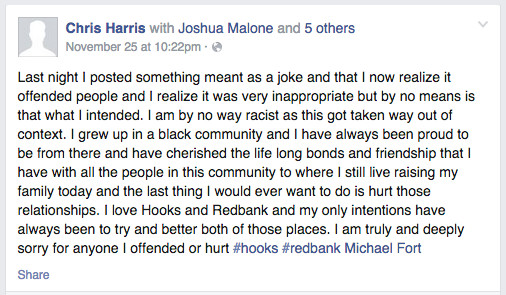
Terrible apology! Continue reading
 Ethics Alarms