The Song “White Christmas” Is Sad, and It’s Meant To Be

I’m rewriting a post from last Christmas that I liked, in part because the ethics news is ticking me off, in part because I am once again having a non-Christmas because I miss my late wife Grace too much to celebrate anything, and in part because the song means a lot to me. I foolishly posted the first version of this last year on Christmas day, guaranteeing that few would read it. I’ll try a bit earlier this time.

I co-wrote two Christmas revues for my late, lamented (by me, anyway) professional theater company in Arlington, Virginia, The American Century Theater. The most popular of the two (though not my personal favorite) was called “If Only In My Dreams,” a title taken from the lyrics of another wistful Christmas song, “I’ll Be Home For Christmas,” by lyricist Kim Gannon and composer Walter Kent. It was introduced by Bing Crosby in 1943—it’s amazing how many of our secular Christmas songs were first recorded by Bing. Well, maybe not so amazing: what was amazing was the range and warmth of his voice. 

“If Only In My Dreams” was constructed around the letters written by GIs overseas during World War II to their families or  girlfriends as Christmas loomed. They were published in an issue of American Heritage, a wonderful magazine now, sadly, in the company of Life, Look, and the Saturday Evening Post, gone and nearly forgotten. I alternated those letters with narration and the popular Christmas songs of the period. The brilliant Jacqueline Manger directed the show, which was being written as she rehearsed it. 

The most famous and important of these songs was, of course, “White Christmas.” Bing Crosby’s version is still the best selling single of all time, and deserves the title. When Irving Berlin handed the song over to the musician who transcribed his melodies (Irv could not read music and composed by ear, just like another brilliant and prolific tune-smith, Paul McCartney), he  famously announced that he had written, not just the best song he had ever created, but the best song that anyone had ever written.  Continue reading

Friday Open Forum: It’s a Marshmallow World!

Ironically, the very song that triggered my blue Christmas reflexes as described in last night’s post (I heard it on Sirius-XM’s Christmas Traditions channel, where 99.6% of the artists featured are dead and most of them are dearly missed) became relevant this morning, as we Northern Virginians woke up to a snow-covered landscape and big, fluffy flakes falling. (Climate change, you know!) The song was written in 1949 by Carl Sigman (lyrics) and Peter DeRose (music), and Bing Crosby—of course!—introduced it. Bing’s recording was a hit, but over time it is Dino’s version that has become iconic, and it’s easy to understand why. It’s a frivolous song about enjoying snow, and Martin’s inimitable slurry, cheery rendition is perfect for the mood. Another Christmas song in the canon is all Dean’s: he aced “Let it Snow!” as well.

So many of the modern seasonal songs have truly terrible lyrics (and some traditional carols too), but “Marshmallow World” has a lyric for the bridge I regard as excellent, and also ethically inspiring:

Oh, the world is your snowball, see how it grows
That’s how it goes whenever it snows
The world is your snowball just for a song
Get up and roll it along
!

Today let the open forum be your snowball, and see how it grows…

The Most Ethical Christmas Carol

Well, unfortunately I started thinking that it’s beginning to look a lot like Christmas this week, so I’m depressed and miserable.

It’s my favorite time of the year because its the most ethical time of the year, but my wife, who was a Christmas fanatic, is dead; my son, who now insists that she’s my daughter, barely speaks to me though I have been nothing but supportive (because that’s my job); my sister is going to be across country for the holiday; and my mom, who was the center of every Christmas in my life as long as she was breathing, breathes no more. I have neither the time to decorate a tree properly (like I used to) nor the resources to  purchase one, and half-hearted decorations will only remind me of 2702 Westminster Place glories past. But I can’t avoid Christmas, just as I can’t avoid ““It’s a Wonderful Life”” as you know.  So I’ll be celebrating my favorite holiday here, on Ethics Alarms, with my five loyal readers and the other visitors who drop in, and pretty much nowhere else. That means, among other gifts, I will be bestowing various Christmas-related post from the Ethics Alarms Christmas attic. Like this one…

*** Continue reading

Celebrating the 110th Anniversary of the Strange But Ethical “Christmas Truce”

One of the weirdest events in world history took place on Christmas 1914, at the very beginning of the five year, pointless and stunningly destructive carnage of The Great War, what President Woodrow Wilson, right as usual, called “The War to End All Wars.”

World War I, as it was later called after the world war it caused succeeded it,  led to the deaths of more than 25 million people, and if anything was accomplished by this carnage, I have yet to read about it.

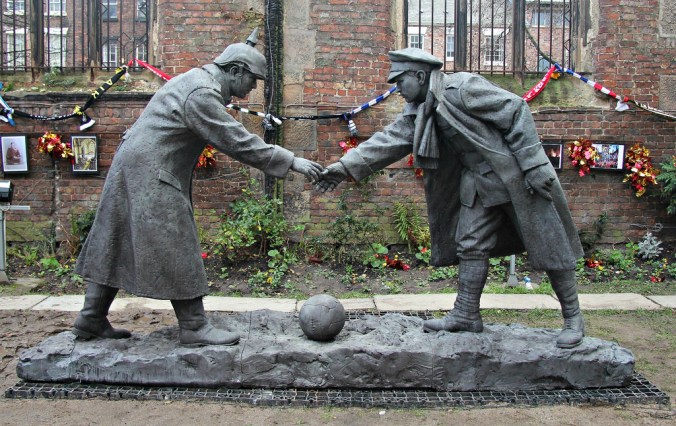
The much sentimentalized event was a spontaneous Christmas truce, as soldiers on opposing sides on the Western Front, defying orders from superiors, pretended the war didn’t exist and left their trenches, put their weapons and animus aside, sang carols,  shared food, buried their dead, and even played soccer against each other, as “The Christmas Truce” statue memorializes above.

The brass on both sides—this was a British and German phenomenon only—took steps to ensure that this would never happen again, and it never did.

It all began on Christmas Eve, when at 8:30 p.m. an officer of the Royal Irish Rifles reported to headquarters that “The Germans have illuminated their trenches, are singing songs and wishing us a Happy Xmas. Compliments are being exchanged but am nevertheless taking all military precautions.” The two sides progressed to serenading each other with Christmas carols, with the German combatants crooning  “Silent Night,” and the British adversaries responding with “The First Noel.“ The war diary of the Scots Guards reported that a private  “met a German Patrol and was given a glass of whisky and some cigars, and a message was sent back saying that if we didn’t fire at them, they would not fire at us.”

The same deal was struck spontaneously at other locales across the battlefield. Another British soldier reported that as Christmas Eve wound down into Christmas morning,  “all down our line of trenches there came to our ears a greeting unique in war: ‘English soldier, English soldier, a merry Christmas, a merry Christmas!’” He wrote in a letter home that he heard,

Continue reading

Tales of “White Christmas”

I didn’t expect a white Christmas in Northern Virginia this morning, and there wasn’t one. It’s a good thing too: a snow-covered vista would have probably made me cry, and that’s been happening too often this holiday season. (My mother, who made up Christmas traditions and legends as an avocation, once told my sister and me that it was bad luck for the whole year to come if you cried on Christmas.) The song “White Christmas” is supposed to make you cry, however, or at least get a bit misty.

I co-wrote two Christmas revues for my late, lamented (by me, anyway) professional theater company in Arlington, Virginia, The American Century Theater. The most popular of the two was called “If Only In My Dreams,” taken from the lyrics of another wistful Christmas song, “I’ll Be Home For Christmas,” by lyricist Kim Gannon and composer Walter Kent and introduced by Bing Crosby in 1943. The show was constructed around the letters written by GIs overseas during World War II to their families or  girlfriends as Christmas loomed, alternating those stories with narration and the popular Christmas songs of the period.

The most famous and important of these songs was, of course, “White Christmas.” Bing Crosby’s version was the best selling single record of all time for half a century. When Irving Berlin handed the song over to the musician who transcribed his melodies (Irv could not read music and composed by ear, just like another brilliant and prolific tune-smith, Paul McCartney), he  famously announced that he had written, not just the best song he had ever written, but the best song that anyone had ever written.  Continue reading

Reflections On The Ethical Holiday


“Christmas is built upon a beautiful and intentional paradox; that the birth of the homeless should be celebrated in every home.”

—G.K. Chesterton.

“It’s Christmas Eve. It’s the one night of the year when we all act a little nicer, we smile a little easier, we cheer a little more. For a couple of hours out of the whole year we are the people that we always hoped we would be.”

—Frank Cross (Bill Murray) in “Scrooged”

CHARLIE BROWN: I guess you were right, Linus. I shouldn’t have picked this little tree. Everything I do turns into a disaster. I guess I really don’t know what Christmas is all about. Isn’t there anyone who knows what Christmas is all about?

LINUS: Sure, Charlie Brown. I can tell you what Christmas is all about.  Lights, please?

“And there were in the same country shepherds abiding in the field, keeping watch over their flocks by night. And lo, the angel of the Lord came upon them, and the glory of the Lord shone round about them. And they were sore afraid. And the angel said unto them, ‘Fear not, for behold, I bring you tidings of great joy which shall be to all people. For unto you is born this day in the City of David a savior, which is Christ the Lord.’ And suddenly there was with the angel a multitude of the heavenly host, saying, ‘Glory to God in the highest, and on Earth peace, goodwill toward men.’”

That’s what Christmas is all about, Charlie Brown.

—Charles M. Schulz

“Our hearts grow tender with childhood memories and love of kindred, and we are better throughout the year for having, in spirit, become a child again at Christmas-time.”

—Laura Ingalls Wilder

“Then the Grinch thought of something he hadn’t before!

What if Christmas, he thought, doesn’t come from a store.

What if Christmas…perhaps…means a little bit more!”

—Dr. Seuss, “How the Grinch Stole Christmas”

“Want to keep Christ in Christmas? Feed the hungry, clothe the naked, forgive the guilty, welcome the unwanted, care for the ill, love your enemies, and do unto others as you would have done unto you.”

— Steve Maraboli, in “Unapologetically You: Reflections on Life and the Human Experience”

“My idea of Christmas, whether old-fashioned or modern, is very simple: loving others. Come to think of it, why do we have to wait for Christmas to do that?”

— Bob Hope

“I heard the bells on Christmas Day
Their old, familiar carols play,
And wild and sweet
The words repeat
Of peace on earth, good-will to men!”

—Henry Wadsworth Longfellow

“There are many things from which I might have derived good, by which I have not profited, I dare say,’ returned the nephew. ‘Christmas among the rest. But I am sure I have always thought of Christmas time, when it has come round—apart from the veneration due to its sacred name and origin, if anything belonging to it can be apart from that—as a good time; a kind, forgiving, charitable, pleasant time; the only time I know of, in the long calendar of the year, when men and women seem by one consent to open their shut-up hearts freely, and to think of people below them as if they really were fellow-passengers to the grave, and not another race of creatures bound on other journeys. And therefore, uncle, though it has never put a scrap of gold or silver in my pocket, I believe that it has done me good, and will do me good; and I say, God bless it!”

—Fred, Scrooge’s Nephew, in Charles Dickens’ “A Christmas Carol” Continue reading

Wait…So Everyone’s Been Lying To Me All These Years About What Angels Look Like?

Above you will see three interpretations of what angels—you know, those benign, heavenly creatures we hear on high and observe, “Hark! They sing!,” the celestial guardians like the funny little old man who shows Jimmy Stewart that he’s really led a wonderful life, the kind of immortal being that appeared to Mary to tell her she was going to bear the Son of God, you know, those things?—really look like. The version on the left is from the Mike Flanagan horror series “Midnight Mass.” It’s a scary angel, but not as scary as the ones that show up in Robert and Michelle King’s scary TV series “Evil,” which look like this…

Yikes.

The version of Gabriel in the center is pretty much how I had been taught and told and shown how angels look for most of my life, and I assumed that was how they are represented in the Bible. Now, this is at least partially my own fault for not knowing the Bible better than I do, but when artists, churches, Sunday school teachers, movies, tree ornaments, Christmas cards and children’s books all show angels as friendly-looking Scandinavians with big, white, fluffy wings, I think I can be excused for assuming that there is at least as much authority for those representations as there is for anything else in the Bible—-an assertion to which Carnac the Magnificent (oh, look it up, ye of pop culture deficit!) would say to me, “You are wrong, Ethics Breath!”

Continue reading

Don’t Diss “Do You Hear What I Hear?”When I’m Around, and Other Rueful Notes On The Blue Christmas Ahead

I’m probably not celebrating Christmas anywhere but on Ethics Alarms this year. Last Christmas was truly awful in every way, with my wife Grace in pain and suffering from some creeping malady that killed her in February  and that I was too blind to detect (and so were her doctors). We were also in our worst financial crunch in 25 years of running our ethics business, my son was having personal problems, and all was definitely not happy and bright.

I am certainly conflicted about the holiday this year. I am a passionate Christmas booster, as long-time readers here know, because I regard the secular holiday as a vital social balm as well as an ethics catalyst. It is a unique holiday that calls on us to be kind, generous and forgiving, and, if possible (I’m trying!) to just be happy for life and its wonders. I am not religious, but I do believe that this is a profoundly ethical time of year. We all need Christmas, frankly. I need it, even though I dread every minute of it this year.

One of the special features of Christmas is that it is soaked with nostalgia and traditions along with bittersweet memories of people and events long past. Charles Dickens got this aspect of the holiday exactly right; it is why I love “A Christmas Carol” so much and have so often participated in public presentations of the story. My last professional directing gig was a staged reading of it, and that was the fourth time I have overseen one; I also have organized and directed three mass “radio” readings, using conference call technology and the sound effects wizardry of Keith Bell. (Where is Keith these days? See, there’s another memory knocking!).

With The American Century Theater, I co-wrote and presented two Christmas musical revues: “If Only In My Dreams,” which centered on the letters GIs wrote home at Christmastime during World War II, and “An American Century Christmas,” a salute to the old-fashioned TV Christmas specials and perennial Christmas movies like the three that have Ethics Alarms “guides’ here: “It’s A Wonderful Life,” which I posted at Thanksgiving, “White Christmas,” which will be updated and posted soon, and on Christmas Eve this year, “Miracle on 34th Street.” The first revue was more popular, but the second was my favorite, because it was generated entirely by my own warm memories of what Christmas was like for me and my sister growing up in Arlington, Massachusetts.

Both of our parents were Depression kids in poor families and their Christmases were spare at best, so both were determined to make the holiday magical for their children. And it was. We would decorate the tree carefully and lovingly a week before the 25th—I remember my mother insisting that each strand of genuine tin tinsel saved for years be placed individually on the branches—and go to bed after hanging our (huge) stockings with visions of sugarplums dancing in our heads. When we got up on Christmas morning, my parents had meticulous constructed a “Christmas panorama,” with the giant stockings stuffed with gadgets, oranges, walnuts and small packages lying by the fireplace, and the whole living room covered with presents, mine on the left of the living room, my sister’s on the right. The gifts were mostly unwrapped, and the vista was ever spectacular.

My father, a photography fanatic who was terrible at his hobby, had the old home movie projector spotlights blazing. He would record Edith and I coming down the stairs to see the amazing treasure left by Santa as mom looked on beaming and eager to see our reactions. My parents insisted on going through this ritual even after we were in college! My mother wouldn’t let the tradition go.

In 1963, the week before Christmas, Bing Crosby hosted “The Hollywood Palace,” a live variety show that was always headed by some entertainment legend, though Bing had the honor more than anyone else. That week he introduced a new Christmas song, the last popular Christmas song to have an unambiguous religious context. That was “Do You Hear What I Hear?,” and the video above was what I saw live. Something in the song immediately resonated with me; I was always a Bing Crosby fan, following the guidance of my father, but I loved everything about the new song despite its childlike simplicity. I said so immediately following Bing’s rendition. Sure enough, the song was playing on our old Magnavox stereo when my sister and I came down the stairs in our pajamas on Christmas morning.

“Do You Hear What I Hear?,” Bing’s version of course though there have been hundreds of covers, is the first Christmas song I play every year as soon as whiffs of holly, evergreens and mistletoe are in the air. It throws my mind back to those magical Christmases that Grace and I tried to recreate for our son every year while he was growing up. That magic was significantly dimmed when my father died, in his sleep, on my birthday in 2009, leading to the saddest Marshall Christmas. The spirit fell away a bit more the next year, when my mother, who never got over losing the love of her life after 58 years of marriage, was in the hospital fighting a voracious hospital infestion that killed her two months later. Christmas was never the same after Mom died: it was her joy and obsession. Still Christmas reminds me of her, and Dad, and that lost magic…and Bing.

I was pondering when and whether to put up a post about “Do You Here What I Hear?” this year when I checked out Ann Althouse’s blog and discovered that she had posted the video as a joke after her post about Jill Biden getting a laugh at her Christmas comments wishing the assembled “joy.” Apparently some took her choice of words as a sly swipe at Kamala Harris’s ill-fated “joy” theme.

In the comments to the post, some wags made jokes about how  the shepherd boy tells the king to bring the “child shivering in the cold” silver and gold when what the baby needed was a blanket or a space heater. Yeah, good one: they made those jokes in 1963. Some jackass wrote, “If you listen to the lyrics, “Do You Hear What I Hear” ranks right up there with “Santa Claus is Coming to Town” for supposedly secular seasonal songs with aggressively creepy quasi-Christian imagery applied to Progressive pieties.”

Oh, bite me. The song was never intended to be “secular” and how it can be heard as “anti-Christian” is beyond me. And Bing: he was a devout Catholic, and one of the reasons Crosby became the voice of Christmas is that he sang Christmas music with such reverence and conviction. (The other reason was that he had that amazing, rich, expressive voice.).

It is especially perverse to impugn the lyrics of a Christmas song written by a man with the first name “Noël.”  “Do You Hear What I Hear” was written in October of 1962 during the Cuban Missile Crisis, by a married songwriting team that wondered at the time if it would be the last thing they ever did. Regney, the lyricist, was born in France and had studied music at the Strasbourg Conservatory and at the Conservatoire National de Paris. When France was overwhelmed by Hitler’s troops in 1940, he was conscripted into the German army. As a Nazi soldier, Noël secretly joined the French underground and served as a spy, passing information along to the resistance. Once he led German soldiers into a trap where they were massacred by French fighters who cut them down in a crossfire. Regney was shot too, but survived.  He then deserted and worked with the French underground until the end of the war. Continue reading

“Ick” or Ethics?

Yikes.

Possible responses:

  • This is self-evident pandering.
  • High officials shouldn’t behave like this in public.
  • If Donald Trump did it, the mainstream media and anti-Trump activists would call it “racist.”
  • It’s kind of cute and charming.
  • The video is dumb, but how can it not make you smile? If it does, how bad can it be?
  • Gov. Polis needs better advisors.

What was your reaction?

Everybody SING! “Trump’s Deranged for Christmas…You Can Count on He…”

...Trump might blow the race to Joe
By acting crazily.
Christmas Eve found Donald
Roasting no chestnut
Trump’s deranged for Christmas
He’s in a nasty rut
!

Here is what the man who wants to be trusted to hold the most powerful job on earth sends out to the public…

Continue reading