“Proportionality” is an ethical principle, one that has been recognized for centuries. In the Josephson Institute’s “Six Pillars of Character,” it is included under the “pillar” of Fairness. Plato explained that he concept of ethical retributive justice must be committed to three principles:
- That those who commit wrongful acts deserve to suffer a proportionate punishment;
- That it is intrinsically morally good if a legitimate authority gives such wrongdoers the punishment they deserve; and
- That it is morally impermissible to intentionally to punish the innocent, or to inflict disproportionately large punishments on wrongdoers.
This brings us to the case of Thom Brennaman, play-by-play broadcaster for the Cincinnati Reds and the son of retired and revered Marty Brennaman, also a veteran baseball announcer. Last night, Brennaman the Younger was caught on an open mic describing someplace as the “one of the fag capitals of the world” after the Fox Sports Ohio feed returned from a commercial break in the top of the seventh inning in the first game of a doubleheader at Kansas City. This led the Reds to pull Brennaman off the air after the fifth inning of the second game, and the announcer was quickly suspended.
The team quickly released a statement:
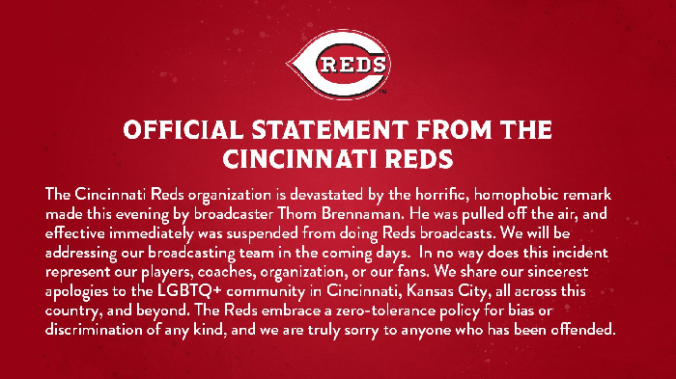
Note “horrific.” That “horrific” word can be heard near the beginning of the famous song above from “Company,” lyrics by Broadway icon Stephen Sondheim (who is gay). To my knowledge, no audience members have ever walked out of a performance upon hearing it. Sondheim, now in his eighties, did recently concoct an alternate lyric for those productions that are determined to be politically correct. He’s a prudent man, I guess. I wish he hadn’t.
The word is apparently so horrific that I had to search all over the web to find out what it was. Most accounts said that the announcer used an “anti-gay slur,” and left it to readers’ imagination what was said. This is crummy, craven, virtue-signaling and incompetent journalism. If the story is about the uproar over a word, a news reporter is obligated to say what the word is. When the ESPN report only said that the word used was “horrific,” I thought it was something I had never heard before. It’s a slur, that’s all. It’s a word. Continue reading

 Ethics Alarms