“How Not To Be A Hero” by Edward Snowden

“If his motives are as he has represented them-–“I understand that I will be made to suffer for my actions,” but “I will be satisfied if the federation of secret law, unequal pardon and irresistible executive powers that rule the world that I love are revealed even for an instant,” he wrote in a note accompanying his first set of leaked documents—-then he acted courageously and selflessly.”

—- Ethics Alarms, June 10, 2013, referring to the conduct and statements of Edward Snowden, NSA “whistleblower.”
That's outrageous! They are collecting our phone records and our...hey, "The Fugitive!" I LOVED that show!!

That’s outrageous! They are collecting our phone records and our…hey, “The Fugitive!” I LOVED that show!!

Now we know that his motives are not as he represented them. From his statement that I quoted, I assumed that Snowden’s intent was to make himself available to U.S. authorities, and to prompt debate regarding the government’s widespread intrusions into the private communications of presumed-to-be-innocent citizens, as well as to ensure that the issue did not get drowned out, superseded and swept aside by distractions, as so many vital issues are. This was an indispensable second step, though I did not begrudge him some time to prepare for it. It would be the action of a one engaged in classic civil disobedience; it would demonstrate sincerity, public-mindedness and courage, and it would avoid his exploitation by the many around the world, and domestically, who wish the U.S. ill.

Instead, Snowden decided to run. Continue reading

“The Ethicist” Gets Lost: Bad Advice, Worse Defense, In The Case Of The Self-Plagiarizing Student

Oh, Chuck, Chuck, Chuck...

Oh, Chuck, Chuck, Chuck…

Chuck Klosterman,The New York Times’ third “Ethicist,” ruffled ethics feathers last week when he decreed that submitting the same paper to multiple college courses was ethical. (You can read his advice to a guilty-feeling student here.) Essentially, his argument in the column came down to three rationalizations, The Compliance Dodge (No rules were broken!), the Trivial Trap (It’s no big deal, and nobody was hurt ) and my least favorite of all, The Comparative Virtue Excuse ( “You’re not betraying the public’s trust,” Klosterman says—in other words, “At least you didn’t kill someone.”),with nods to several more. On the first, which is a close relative of Marion Barry’s Excuse, so you know what I think of it, Klosterman essentially argues that following formal rules constitutes sufficient ethics, which is the hallmark of the unethical. On the second, he himself cheats: he says no one was harmed, yet he ignores the fact that the student intentionally kept the fact that he used one paper for two assignments from the professors involved. Why was that? The student didn’t tell the professors because he knew they wouldn’t approve. Thus the student withheld information that was material, that would have resulted in negative consequences, and that the professors making the assignment had a right to know. That’s a failure of candor and a breach of the duty of honesty in communications. That’s unethical. Continue reading

Ethics Quiz: The Case of the Unauthorized Clean-Up

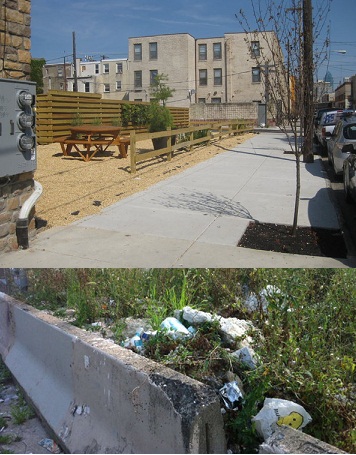
The photo on top is how the lot looks today, thanks to a generous citizen. Philadelphia wants it put back to the way it looked in the lower photo. Wait…WHAT?

Can an act that benefits everybody still be unethical? That’s the underlying conundrum in this week’s Monday Warm-Up Ethics Quiz.

In the Point Breeze neighborhood of Philadelphia, a city-owned lot was in nightmarish condition, filled with trash, weeds and rats. Ori Feibush owned a coffee shop that backed onto the lot, and had repeatedly petitioned the city to do something about it, like clean it up. Feibush, who also is a real estate developer, says he submitted seven written requests to buy or lease the land, calling the Philadelphia Redevelopment Authority about it 24 times. There was no response to any of this, and the city claims that it has no record of any inquiries.

Finally, Feibush couldn’t stand the mess any more. He spent more than $20,000 of his own money to clean up the lot, removing more than 40 tons of junk, garbage, and trash. Point Breeze residents are thrilled.

The city, however, is threatening to take legal action against Feibush for trespassing, explaining through a spokesman that “Like any property owner, [the Philadelphia Redevelopment Authority] does not permit unauthorized access to or alteration of its property. This is both on principle (no property owner knowingly allows trespassing) and to limit taxpayer liability.” It is demanding that Feibush return the land to its original condition—that is, fill it up with garbage so it is an eyesore, dangerous, and useless again.

Your Ethics Quiz:
Who is in the wrong, the city, or Ori Feibush? Continue reading

Ethics Dunce: Sen. Rand Paul

Sen, Rand Paul, protester.

Sen. Rand Paul, libertarian and Republican U.S. Senator from Kentucky, has a choice: he can be a high elected official of the United States government, or he can engage in civil disobedience. He cannot do both.

Sen. Paul was detained today by the Transportation Security Administration in Nashville, Tenn., after refusing a full body pat-down following an image scan that did not clear him through security. I feel his pain. But a United States Senator must obey the law and cooperate with all lawful activities of the U.S. government and its agencies. If he objects to pat-downs so much, he has the power and influence to wield to try to change procedures and policies. Apparently they were not so burdensome while thousand of other citizens endure them every day.  Now that Sen. Paul is facing a feel-up from a gloved stranger, he is suddenly over-come with principle. Easy for him, too, since unlike us mortals, Senators are exempted by the Constitution from being detained while on the way to work.

For a U. S. Senator to defy a TSA agent who is attempting to keep the skies safe in the manner determined to be appropriate by the U.S government encourages and implicitly endorses defiance by everyone else.  That is a breach of Paul’s duty as a high elected official of the United States.

What Would Happen If, While Submitting To a TSA Search, You Started Singing “The Piña Colada Song”?

"Would you cut the comedy please? I'm trying to feel you up!"

A retired Air Force Lt. Colonel apparently was arrested at a TSA airport checkpoint after she refused to stop reciting the Fourth Amendment of the Bill of Rights (“Searches and Seizures”) while she was being screened. You can read her account here.

I’m not going to jump on the bandwagon of the various commentators from both sides of the political spectrum who are leading condemnation of the incident. My interest is in the ethics of the encounter and its subsequent reporting, as I do not see this as an example of official abuse and suppression of rights.

I object to much of how the Department of Homeland Security and the TSA has handled airport screening policy since 2001, as I discussed in this post and elsewhere. I agree that the public should not meekly accept what it regards as unjustified intrusions on their privacy, dignity and health, and that complaining, petitioning the government, putting pressure on elected and appointed officials and leveling criticism in various forums is a necessary and reasonable response. Nevertheless, the episode described in the accounts of this arrest has been mischaracterized. It was a situation in which TSA agents were placed in an impossible situation for the purpose of generating third-party indignation. The woman engaging in the protest also targeted individuals who can only be called innocent parties, the TSA screeners. They have a job, they have procedures to follow, and they have to follow them. They also have a lousy job, having to brush up against the privates of strangers while being glared at or verbally abused.

My question, as with many protests, is, “What was the objective here?” To be as annoying as possible? To cause a scene? To let everyone in the vicinity know that the woman objected to the procedures? To come as close to interfering with the screening process as possible without justifying an arrest? To get her name in the papers? To delay her fellow passengers, most of whom just want to get through the vile process and make their flights?

Or to get arrested? Continue reading

Occupy Wall Street: Unethical Demonstration, Unethical Supporters

If this is the level of your comprehension, I really don’t care what you think.

“Ethics Bob” Stone recently posted about the ethics of mass demonstrations like “Occupy Wall Street,” noting that long-term, open-ended demonstrations begin crossing ethical lines once they accomplish the goal of sending a message and hang around anyway, creating fertile ground for violence, and, though Bob doesn’t mention this, inconveniencing the public, wasting scarce municipal funds, and tempting pundits to make fools out of themselves.

Even with this, Bob is giving the Occupiers more credit than they deserve. A group that imposes its presence on the public, law enforcement, and local governments is entitled to express a minority and even a crackpot viewpoint. There is an ethical obligation, however, not to abuse the right of assembly and the precious time of everyone else by creating a big disturbance that means nothing, conveying a message that is irresponsible because it is based on ignorance.

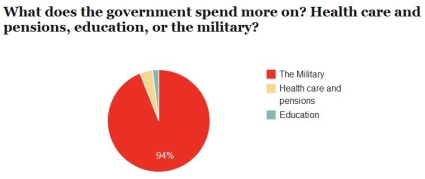
New York Magazine quizzed the Occupy Wall Street demonstrators, and discovered that: Continue reading

Comment of the Day: “Unethical Business Practices: Online Reputation Services”

For those offended by the fact that this is the second Comment of the Day, I can only note that I haven’t posted a COTD for a while, so they can consider this one as making up for say, September 9.

Tgt has some uncomfortable truths about the practicalities of taking principled stands, in the context of my discussing the dishonest and bullying tactics of so-called online reputation protection services without specifically naming any one company.

There are gradients of this dilemma, which I’m not sure the author sufficiently acknowledges. For example, in the recent Defense of Marriage Act controversy in which law firm King & Spalding arguably dumped an unpopular representation because of inappropriate but no less threatening warnings from its biggest client, there are core professional values involved: once a lawyer ( or firm) accepts a representation, he or she may not, consistent with professional norms, drop the new client because of fear that the representation will have unpleasant consequences. There is no ethical obligation, however, to engage in a protest or civil disobedience when one objects to an abuse of official power. There is an obligation to do something, and it is ethically legitimate to choose a course that addresses the wrong without causing unnecessary harm to oneself or others. One not  cowardly by not being foolhardy.

Unless I accept John Adams’ rather perverse conviction that the only way one knows one is doing the right thing is when he is certain that the consequences will be personally ruinous, I don’t agree that I have failed an ethical obligation by choosing to flag unethical conduct without specifically inciting a company whose business it is to intimidate websites.

Besides, as I noted in my response to this comment, I am not through with these guys. Not by a longshot. But here is tgt’s Comment of the Day to my opening volley: Continue reading

Ethics Quote of the Week: The Washington Post Editors

Clear out, everybody! Ann Miller wants to honor Thomas Jefferson!

“Aggrandizing what amounts to a stunt based on misinformed views of the First Amendment cheapens the real and courageous achievements of those who advance the causes of civil rights by refusing to comply with immoral laws”

—–The Washington Post, in an editorial entitled “Dancing at a National Memorial Isn’t Civil Disobedience”

The Post is talking about the escalating and pointless battle by self-indulgent, publicity-seeking, First Amendment grand-standers —a description that I shortened to the crude but sufficiently explanatory “assholes” in my post on the same topic-–to demonstrate for the endangered ‘right” to dance inside government memorial structures(Next up: frog races, strip shows, and Mummer parades). The editorial makes the true content of this noble exercise plain: it is 100% nonsense: Continue reading

The Ethics Of Refusing To Help Wikileaks

Do private corporations have an ethical obligation to allow Wikileaks to use their services? MasterCard, Visa and PayPal stopped processing Wikileaks donations. Amazon kicked the site off its server. Twitter stopped its tweets; Facebook stopped its interfacing.

Columbia University Professor Tim Wu rhetorically asked them:

“Since when are you in the business of deciding who is and who isn’t a good civil disobedience movement?”

Before I address the Professor’s question, let’s make some distinctions. Continue reading

Unethical Post of the Month: Jonah Goldberg

In his latest post on the National Review website, conservative blogger Jonah Goldberg wonders why the CIA hasn’t had the sense to assassinate WikiLeaks founder and current renegade leaker Julian Assange. That’s right: Goldberg believes that in the national interest (for Assange has gathered and leaked massive amounts of classified information relating to U.S. military operations), the U.S. government should murder an Australian citizen without due process, a trial, or anything approaching regard for law, ethics, and human rights.

I make it a rule, in the interest of civility and respect, to control the urge to sink to pure name-calling, but really: what an idiot. And a dangerous one. Continue reading